On eBird ↗
Brown Booby
Live sightings near you, the range map, bar charts of when it is seen, and Macaulay Library photos and recordings.
Brown Booby
Sula leucogaster
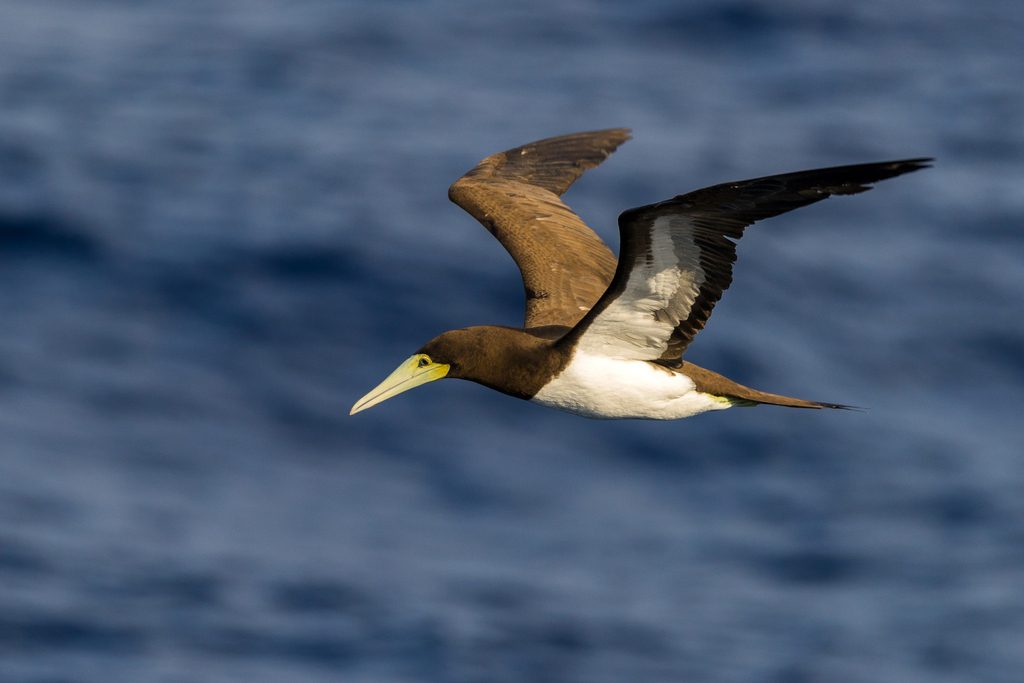
The brown booby (Sula leucogaster) is a large seabird in the booby and gannet family Sulidae, of which it is one of the most common and widespread species. It has a pantropical range, which overlaps with that of other booby species. The gregarious brown booby commutes and forages at low height over inshore waters. Flocks plunge-dive to take small fish, especially when these are driven near the surface by their predators. They nest only on the ground, and roost on solid objects rather than the water surface.
From the article Brown booby on Wikipedia (CC BY-SA), quoted section by section
Description
The booby's head and upper body (back) is covered in dark brown to blackish plumage, with the remainder (belly) being a contrasting white. The bare-part colours vary geographically, but not seasonally. The species also displays sexual dimorphism of the bare part colours, the males having a blue orbital ring, as opposed to the yellow orbital ring of the female. Female boobies reach about 80 centimetres (31 in) in length; their wingspans measure up to 150 cm (4.9 ft), and they can weigh up to 1,300 g (2.9 lb). Male boobies reach about 75 centimetres (30 in) in length; their wingspans measure up to 140 cm (4.6 ft), and they can weigh up to 1,000 g (2.2 lb). Unlike other species of sulid, the juvenile plumage already resembles that of the adult. They are grey-brown with darkening on the head, upper surfaces of the wings and tail, while the lower breast and underpart plumages are heavily flecked brown on white. Their beaks are quite sharp and contain jagged edges. They have fairly short wings resulting in a fast flap rate, but long, tapered tails. While these birds are typically silent, they occasionally make grunting or quacking sounds.
What it does
This species breeds on islands and coasts in the pantropical areas of the Atlantic, Indian and Pacific oceans. They frequent the breeding grounds of the islands in the Gulf of Mexico and the Caribbean Sea. With the rise in pollution in the world, brown boobies have been using marine debris to make their nests, with 90.1% of these nest were consisted of plastic, while nests near shipwreck have a high percentage of the wreckage debris. This bird nests in large colonies, laying two chalky blue eggs on the ground in a mound of broken shells and vegetation, but usually raises just one chick, the second one to hatch being unable to compete for food with its older sibling, or even ejected from the nest by it. It winters at sea over a wider area. Brown booby pairs may remain together over several seasons. They perform elaborate greeting rituals, and are also spectacular divers, plunging into the ocean at high speed. They eat mainly small fish (such as flying fish, mullets, halfbeaks, anchovies, goatfish, crowned squirrelfish, and Indian mackerels), squids (including the family Ommastrephidae), or shrimps which gather in groups near the surface and may catch leaping fish while skimming the surface. Along with plunge-diving, some fledglings and adults practice kleptoparasitism, where they steal prey from other seabirds. …
Wikipedia: “Ecology”
Listen
Looking for field recordings…
Where it lives
Recorded sightings
—
geo-referenced records in GBIF, from museums, herbaria and field observers.
Drag the globe to turn it. Dots are where records exist, not a range map; darker means more records.
In the old herbals & bestiaries


In the stacks
Searching the stacks…
Every page naming Sula leucogaster in the Biodiversity Heritage Library →
This page is assembled live from iNaturalist, GBIF, Wikipedia, the Source Library and the Internet Archive. It is not yet part of the hand-edited codex. iNaturalist taxon 3797.