- Animals
- ›Chordates
- ›Vertebrates
- ›Birds
- ›Pelicans, Herons, Ibises, and Allies
- ›Herons, Egrets, and Bitterns
- ›Typical Herons and Egrets
- ›Ardea
On eBird ↗
Purple Heron
Live sightings near you, the range map, bar charts of when it is seen, and Macaulay Library photos and recordings.
Purple Heron
Ardea purpurea
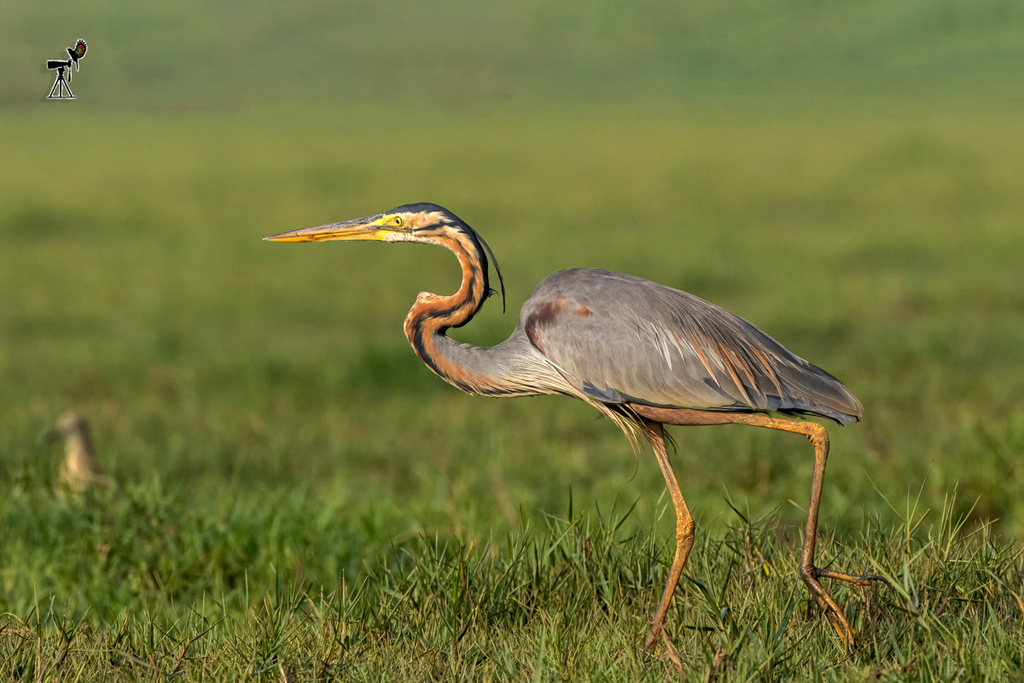
The purple heron (Ardea purpurea) is a wide-ranging heron species. It breeds in Africa, central and southern Europe, and southern and eastern Palearctic. The Western Palearctic populations migrate between breeding and wintering habitats whereas the African and tropical-Asian populations are primarily sedentary, except for occasional dispersive movements.
It is similar in appearance to the more common grey heron but is slightly smaller, more slender and has darker plumage. It is also a more evasive bird, favouring densely vegetated habitats near water, particularly reed beds. It hunts for a range of prey including fish, rodents, frogs and insects, either stalking them or standing waiting in ambush.
From the article Purple heron on Wikipedia (CC BY-SA), quoted section by section
Description
The purple heron is a large bird, 78–97 cm (31–38 in) in length with a standing height from 70 to 94 cm (28 to 37 in) and a 120–152 cm (47–60 in) wingspan. However, it is slender for its size, weighing only 0.5 to 1.35 kg (1.1 to 3.0 lb). It is somewhat smaller than the grey heron, from which it can be distinguished by its darker reddish-brown plumage, and, in adults, its darker grey back. Adults have the forehead and the crown of the head black, with a dark stripe down the back of the neck that terminates in a slender, dangling crest. This is shorter than the crest of the grey heron and does not exceed 140 mm (5.5 in). The sides of the head and the neck are buffish chestnut, with dark streaks and lines down either side of the whole the neck. The mantle is oily brown and the upper scapular feathers are elongated but not the lower ones. The rest of the upper parts and the tail are brownish grey. The front of the neck is paler than the sides and there are some elongated feathers at the base of the neck which are streaked with white, chestnut and black. The breast is chestnut brown, with some blackening at the side, and the belly and under-tail coverts are black. The brownish-yellow beak is long, straight and powerful, and is brighter in colour in breeding adults. …
Range & habitat
The purple heron has a mostly palaearctic distribution and breeds in Europe, Asia and Africa. The range of the western race extends from Portugal eastwards across much of central and southern Europe and parts of North Africa as far as Lake Balkhash in Kazakhstan. In Africa, the bird breeds in Senegal, down the east coast of Africa and in Madagascar. The eastern race extends from the Indian subcontinent, eastwards to eastern China and the Philippines, and northwards to the basins of the Amur River and the Ussuri River at about 49°N. The southern race is restricted to Madagascar, and a small population of purple herons on the Cape Verde Islands is regarded as a separate race by some authorities. Between August and October, birds of the western population migrate southwards to tropical Africa, returning northwards in March. Purple herons often overshoot their normal range on their return, and are vagrants to northern Europe including Britain. They have also been recorded in French Guiana, Barbados, Brazil, and Trinidad and Tobago. The eastern population is largely resident, though some birds from the northern part of the range fly southwards to Korea, Thailand and Malaysia. The African birds are resident. The purple heron inhabits marshes, lagoons and lakes surrounded by dense vegetation. …
Wikipedia: “Distribution and habitat”
What it does
Flight is slow, with the neck retracted and the legs extending a long way behind the tail. This is characteristic of herons and bitterns, and distinguishes them from storks, cranes and spoonbills, which extend their necks in flight. It is a secretive bird, spending less time out in the open than the grey heron and tending to skulk in reed beds. Its long toes mean it can walk on floating vegetation, and it sometimes walks over bushes in the same way, not making any attempt to grip the branches. It seldom perches in trees, preferring more terrestrial sites to rest. It is most active at dawn and dusk, roosting with other birds in the middle of the day and at night, but increasing its diurnal activity while rearing young. It feeds in shallow water, grabbing its prey with its powerful beak. It will often wait motionless for prey, or slowly stalk its victim. The diet consists mainly of fish, small mammals and amphibians, but nestling birds, snakes, lizards, crustaceans, water snails, insects and spiders are also eaten. Terrestrial beetles are the commonest insect prey, followed by water beetles and aquatic larvae, with grasshoppers, dragonflies, bees and flies also being consumed. The purple heron usually breeds in colonies but sometimes the nests are solitary. …
Wikipedia: “Behaviour and ecology”
Listen
Looking for field recordings…
Where it lives
Recorded sightings
—
geo-referenced records in GBIF, from museums, herbaria and field observers.
Drag the globe to turn it. Dots are where records exist, not a range map; darker means more records.
In the stacks
Searching the stacks…
Every page naming Ardea purpurea in the Biodiversity Heritage Library →
This page is assembled live from iNaturalist, GBIF, Wikipedia, the Source Library and the Internet Archive. It is not yet part of the hand-edited codex. iNaturalist taxon 4951.