- Animals
- ›Chordates
- ›Vertebrates
- ›Birds
- ›Pelicans, Herons, Ibises, and Allies
- ›Herons, Egrets, and Bitterns
- ›Typical Herons and Egrets
- ›Egretta
On eBird ↗
Western Reef-Heron
Live sightings near you, the range map, bar charts of when it is seen, and Macaulay Library photos and recordings.
Western Reef Heron
Egretta gularis
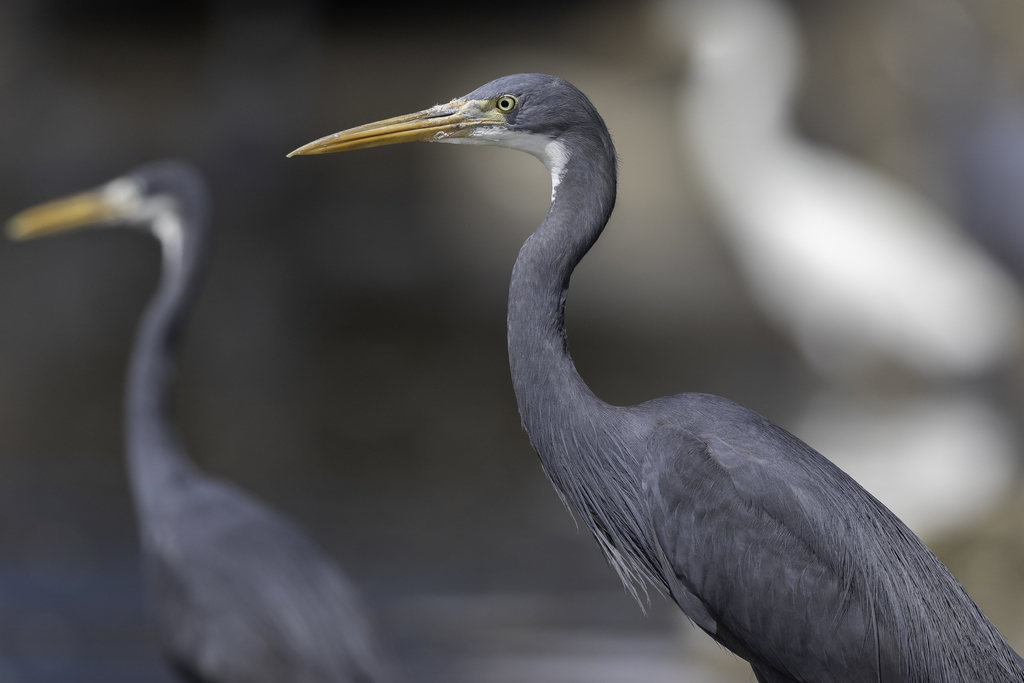
The western reef heron (Egretta gularis), also called the western reef egret, is a medium-sized heron found in Africa and parts of Asia, with vagrancy occurring in Europe and the Americas. It has a mainly coastal distribution and occurs in several plumage forms: a slaty-grey plumage which can only be confused with the rather uncommon dark morph of the little egret (Egretta garzetta); a white form which can look very similar to the little egret, although the reef heron's bill tends to be paler and larger; and a black form with a white throat, E. g. gularis, found in West Africa. There are also differences in size, structure and foraging behaviour. There have been suggestions that the species hybridizes with the little egret, and based on this, some authors treat schistacea and gularis as subspecies of Egretta garzetta. Works that consider the western reef heron as a valid species include the nominate gularis and schistacea as subspecies.
From the article Western reef heron on Wikipedia (CC BY-SA), quoted section by section
Description
This bird has two plumage colour forms. There is an all-white morph and a dark grey morph; morphs can also occur with intermediate shades of grey which may be related to age or particoloured in grey and white. The white morph is similar in general appearance to the little egret, but has a larger yellower bill, extended yellow on thicker legs, and when foraging tends to be very active, sometimes also moving its wing or using it to shade the water surface. The grey morph has a whitish throat and is unlikely to be confused with any other species within the range of this egret with beak and legs similar to that of the white morph. During the breeding season the legs and facial skin are reddish. Breeding birds have two long feathers on the sides of the nape. The nominate subspecies gularis has a range from West Africa to Gabon, with some birds breeding in southern Europe. Subspecies schistacea (Hemprich & Ehrenberg, 1828) breeds from the Persian Gulf along the coast of India to the east of the India Peninsula. The bill of gularis is more pointed while schistacea has the larger bill especially towards the base. The form on the eastern coast of South Africa is usually separated as the dimorphic egret Egretta dimorpha. The dark and white morph is thought to be controlled by a single allele with the dark character being incompletely dominant over the gene for white.
Range & habitat
It occurs mainly on the coasts in tropical west Africa, the Red Sea, the Persian Gulf (Iran) extending east to India. It also occurs in the Lakshadweep Islands and Sri Lanka where breeding was once recorded at Chilaw. The nominate subspecies breeds in west Africa from Mauritania to Gabon. Birds may also be found off the mainland such as in the Canary Islands. Small numbers have been recorded hybridising with liitle egrets in Spain. Subspecies schistacea is found from the Red Sea coast east round the Indian coast. Breeding colonies are known from the east coast of India around Pulicat Lake. They occasionally occur further inland. The western reef heron (nominate subspecies) occurs as a vagrant in North America, South America and the Caribbean islands. Based on the growing number of records it is suspected that they may establish breeding colonies in Brazil. Several records around 1980–1990 in Germany, Austria and France have been attributed to birds that escaped from an animal dealer in Mittelfranken. In June 2026 a member of the species was identified by sight in Caernarfon in Wales.
Wikipedia: “Distribution and status”
What it does
These birds stalk their prey in shallow water, often running or stirring the water with their feet or flicking their wings to disturb prey; they may also stand still and wait to ambush prey. They eat fish, crustaceans, and molluscs. In coastal areas, they regularly feed on mudskippers. Laboratory studies show them to be capable of making corrections for refractions but the probability of missing increases when they are forced to strike at prey at very acute angles to the water surface. Like other herons and egrets they have few vocalizations, making a low kwok or grating sounds when disturbed or near the nest. The western reef heron's breeding habitat is coastal wetlands. In the Red Sea region the breeding season is from June to August. The nominate subspecies breeds in West Africa from late April to September. In India the breeding season is during the monsoon rains from April to August and end of May in the former breeding colony at Chilaw in Sri Lanka. Most of the breeding colonies in Gujarat in western India were on mangroves. They nest in colonies usually of their own species but sometimes with other egrets and smaller herons, usually on platforms of sticks placed in trees or shrubs. The male fetches sticks of the nest while the female places them to form the platform. …
Wikipedia: “Behaviour and ecology”
Listen
Looking for field recordings…
Where it lives
Recorded sightings
—
geo-referenced records in GBIF, from museums, herbaria and field observers.
Drag the globe to turn it. Dots are where records exist, not a range map; darker means more records.
In the stacks
Searching the stacks…
Every page naming Egretta gularis in the Biodiversity Heritage Library →
This page is assembled live from iNaturalist, GBIF, Wikipedia, the Source Library and the Internet Archive. It is not yet part of the hand-edited codex. iNaturalist taxon 4935.