- Animals
- ›Chordates
- ›Vertebrates
- ›Birds
- ›Pelicans, Herons, Ibises, and Allies
- ›Herons, Egrets, and Bitterns
- ›Typical Herons and Egrets
- ›Egretta
On eBird ↗
Little Egret
Live sightings near you, the range map, bar charts of when it is seen, and Macaulay Library photos and recordings.
Little Egret
Egretta garzetta
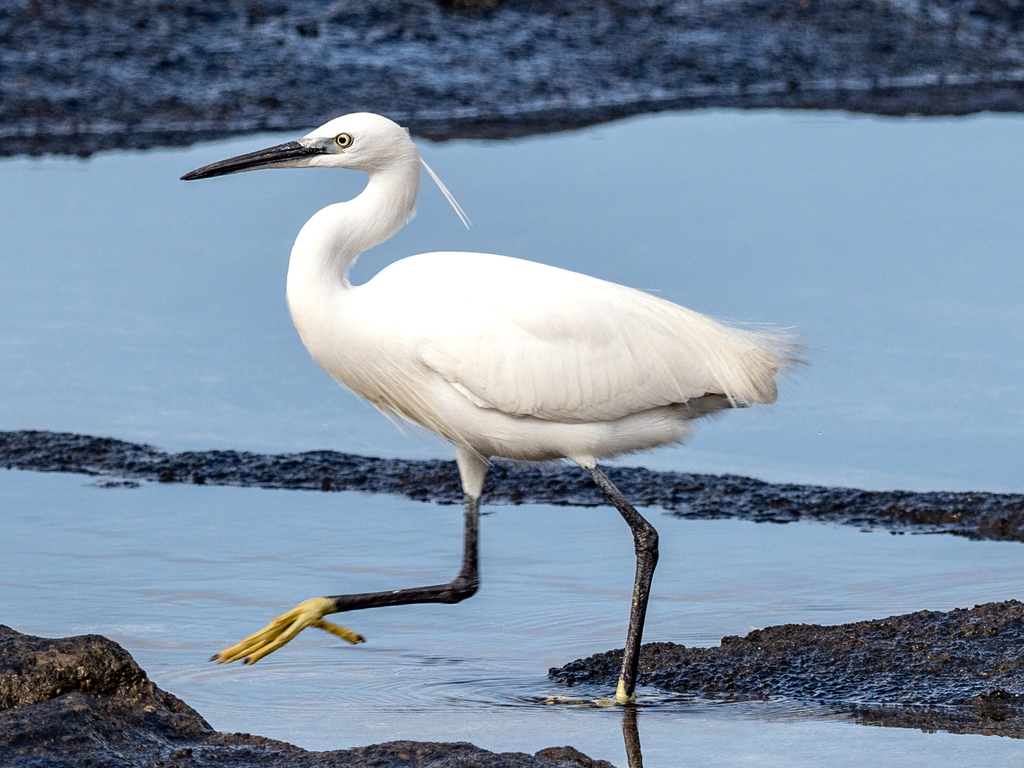
The little egret (Egretta garzetta) is a species of small heron in the family Ardeidae. It is a white bird with a slender black beak, long black legs and, in the western race, yellow feet. As an aquatic bird, it feeds in shallow water and on land, consuming a variety of small creatures. It breeds colonially, often with other species of water birds, making a platform nest of sticks in a tree, bush or reed bed. A clutch of three to five bluish-green eggs is laid and incubated by both parents for about three weeks. The young fledge at about six weeks of age.
It is a polytypic species with two or arguably more subspecies. Its breeding distribution comprises the wetlands, waterways and shorelines of warm temperate to tropical parts of Asia, Africa, Australia, and Europe. A successful colonist, its range has gradually expanded north, with stable and self-sustaining populations now present in the United Kingdom.
From the article Little egret on Wikipedia (CC BY-SA), quoted section by section
Description
The adult little egret is 55–65 cm (22–26 in) long with an 88–106 cm (35–42 in) wingspan, and weighs 350–550 g (12–19 oz). Its plumage is normally entirely white, although there are dark forms with largely bluish-grey plumage. In the breeding season, the adult has two long plumes on the nape that form a crest. These plumes are about 150 mm (6 in) and are pointed and very narrow. There are similar feathers on the breast, but the barbs are more widely spread. There are also several elongated scapular feathers that have long loose barbs and may be 200 mm (8 in) long. During the winter the plumage is similar but the scapulars are shorter and more normal in appearance. The bill is long and slender and it and the lores are black. There is an area of greenish-grey bare skin at the base of the lower mandible and around the eye which has a yellow iris. The legs are black and the feet yellow. Juveniles are similar to non-breeding adults but have greenish-black legs and duller yellow feet, and may have a certain proportion of greyish or brownish feathers. The subspecies nigripes differs in having yellow skin between the bill and eye, and blackish feet. …
Range & habitat
The breeding range of the western race (E. g. garzetta) includes southern Europe, the Middle East, much of Africa and southern Asia. Northern European populations are migratory, mostly travelling to Africa although some remain in southern Europe, while some Asian populations migrate to the Philippines. The eastern race, (E. g. nigripes), is resident in Indonesia and New Guinea, while E. g. immaculata inhabits Australia and New Zealand, but does not breed in the latter. During the late twentieth century, the range of the little egret expanded northwards in Europe and into the New World, where a breeding population was established on Barbados in 1994. The birds have since spread elsewhere in the Caribbean region and on the Atlantic coast of the United States. Little egrets have been recorded in South America, with most extralimital records coming from Brazil and French Guiana. There is also a record of the species from Colombia. The little egret's habitat varies widely, and includes the shores of lakes, rivers, canals, ponds, lagoons, marshes and flooded land, the bird preferring open locations to dense cover. On the coast it inhabits mangrove areas, swamps, mudflats, sandy beaches and reefs. Rice fields are an important habitat in Italy, and coastal and mangrove areas are important in Africa. The bird often moves about among cattle or other hoofed mammals.
Wikipedia: “Distribution and habitat”
What it does
Little egrets are sociable birds and are often seen in small flocks. Nevertheless, individual birds do not tolerate others coming too close to their chosen feeding site, though this depends on the abundance of prey.
Food and feeding. They use a variety of methods to procure their food; they stalk their prey in shallow water, often running with raised wings or shuffling their feet to disturb small fish, or may stand still and wait to ambush prey. They make use of opportunities provided by cormorants disturbing fish or humans attracting fish by throwing bread into water. On land they walk or run while chasing their prey, feed on creatures disturbed by grazing livestock and ticks on the livestock, and even scavenge. Their diet is mainly fish, but amphibians, small reptiles, mammals and birds are also eaten, as well as crustaceans, molluscs, insects, spiders and worms.
Breeding. Little egrets nest in colonies, often with other wading birds. On the coasts of western India these colonies may be in urban areas, and associated birds include cattle egrets (Bubulcus ibis), black-crowned night herons (Nycticorax nycticorax) and black-headed ibises (Threskiornis melanocephalus). In Europe, associated species may be squacco herons (Ardeola ralloides), cattle egrets, black-crowned night herons and glossy ibises (Plegadis falcinellus). …
Wikipedia: “Behaviour”
Listen
Looking for field recordings…
Where it lives
Recorded sightings
—
geo-referenced records in GBIF, from museums, herbaria and field observers.
Drag the globe to turn it. Dots are where records exist, not a range map; darker means more records.
In the stacks
Searching the stacks…
Every page naming Egretta garzetta in the Biodiversity Heritage Library →
This page is assembled live from iNaturalist, GBIF, Wikipedia, the Source Library and the Internet Archive. It is not yet part of the hand-edited codex. iNaturalist taxon 4943.