- Animals
- ›Chordates
- ›Vertebrates
- ›Birds
- ›Hawks, Eagles, Kites, and Allies
- ›Hawks, Eagles, and Kites
- ›Harrier-Hawks
- ›Polyboroides
On eBird ↗
African Harrier-Hawk
Live sightings near you, the range map, bar charts of when it is seen, and Macaulay Library photos and recordings.
African Harrier-Hawk
Polyboroides typus
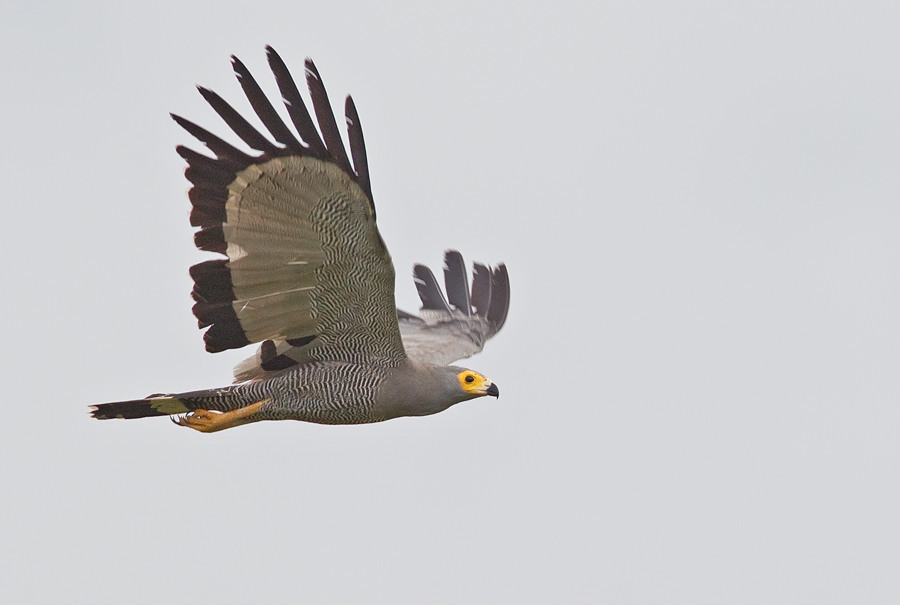
The African harrier-hawk, harrier hawk, or gymnogene (Polyboroides typus) is a bird of prey. It is about 60–66 cm in length, and is related to the harriers. It breeds in most of Africa south of the Sahara. The only other member of the genus is the allopatric Madagascan harrier-hawk (Polyboroides radiatus).
From the article African harrier-hawk on Wikipedia (CC BY-SA), quoted section by section
Description
The African harrier-hawk is a medium-sized raptor. The upperparts, head and breast are pale grey. The belly is white with fine dark barring. The broad wings are pale grey with a black trailing edge fringed with a narrow white line. The tail is black with a single broad white band. There is a bare facial patch of variable colour, usually red or yellow. Sexes are similar, but young birds have pale brown instead of grey, and dark brown replacing black. An unusual trait of this species is the double-jointed ankles it possesses, which enable it to reach into otherwise inaccessible holes and cracks for prey. A comparable leg-structure and behaviour can be found in the Neotropical crane hawk as well as the extinct Australian Pengana; a case of convergent evolution. The call is a whistled sueee-sueee-sueee.
Range & habitat
African harrier-hawks are a common raptorial species south of the Sahara being most commonly found in the tropical regions of western Africa becoming less common in East and South Africa. African harrier-hawks are adaptable in their habitat preferences, occupying the following habitats in the Dzanga-Sangha Special Reserve in the Central African Republic: thick rainforest, forest edge, riparian areas, agricultural land and human occupied areas. African harrier-hawks are adaptable and able to live in both urban and rural human occupied areas and they are one of the most common raptorial species in traditional rural villages of eastern Guinea-Bissau. African harrier-hawks have also been known to breed in Palm trees present in cities and urban gardens.
Wikipedia: “Distribution and habitat”
What it does
The African harrier-hawk is omnivorous, eating the fruit of the oil palm as well as hunting small vertebrates. Its ability to climb, using wings as well as feet, and its long double-jointed legs, enable this bird to raid the nests of cavity-nesters such as barbets and woodhoopoes for eggs and nestlings. It has been known to prey on introduced species such as feral pigeons, house sparrows and eastern gray squirrels.
Wikipedia: “Diet”
Listen
Looking for field recordings…
Where it lives
Recorded sightings
—
geo-referenced records in GBIF, from museums, herbaria and field observers.
Drag the globe to turn it. Dots are where records exist, not a range map; darker means more records.
In the stacks
Searching the stacks…
Every page naming Polyboroides typus in the Biodiversity Heritage Library →
This page is assembled live from iNaturalist, GBIF, Wikipedia, the Source Library and the Internet Archive. It is not yet part of the hand-edited codex. iNaturalist taxon 5246.