- Animals
- ›Chordates
- ›Vertebrates
- ›Birds
- ›Hawks, Eagles, Kites, and Allies
- ›Hawks, Eagles, and Kites
- ›Buteonine Hawks, Kites, and allies
- ›Buteo
On eBird ↗
Augur Buzzard
Live sightings near you, the range map, bar charts of when it is seen, and Macaulay Library photos and recordings.
Augur Buzzard
Buteo augur
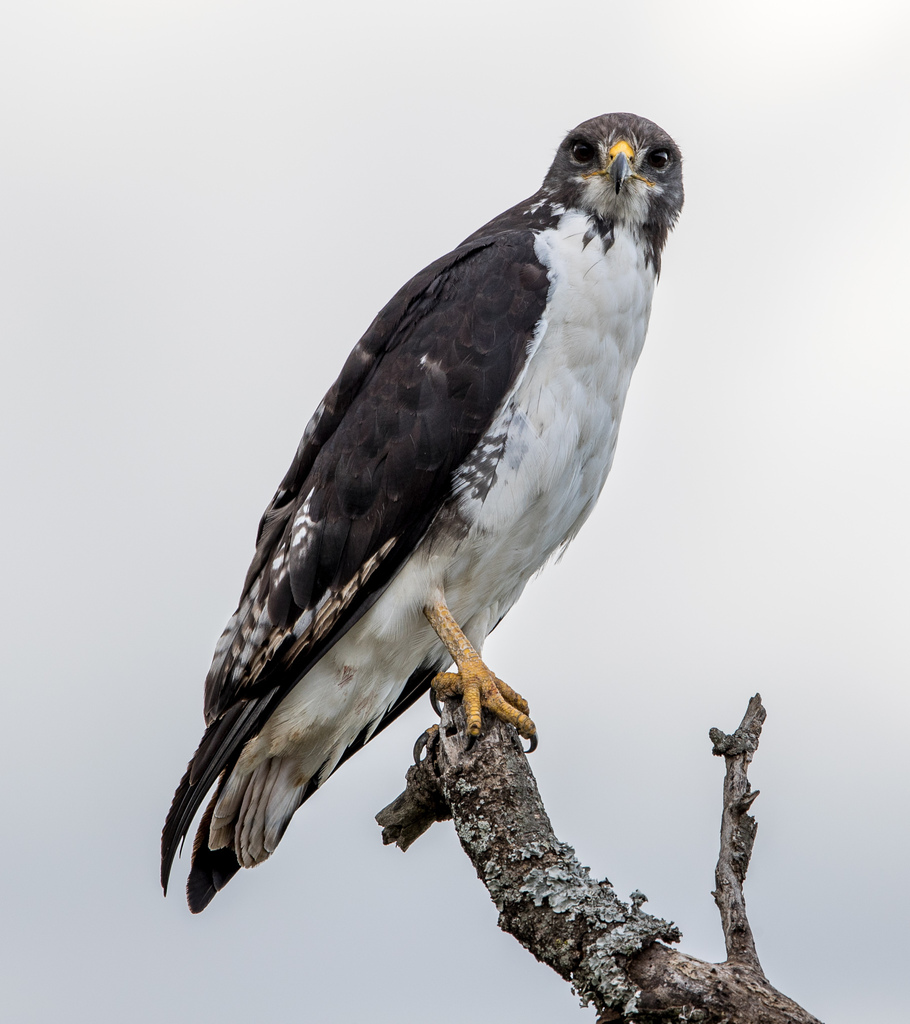
The augur buzzard (Buteo augur) is a fairly large African bird of prey. This species is distinct in typical adult plumage for its blackish back, whitish underside and orange-red tail, while juvenile augur buzzards are generally rather brown in colour; however a dark morph is known, which causes the bird's entire body to become darker. This member of the Buteo genus is distributed in several parts of the central and southern Africa, normally being found from Ethiopia to southern Angola and central Namibia. It is resident and non-migratory throughout its range. This is a species of mountains (most typically at about 2,000 m (6,600 ft) altitude, but up to 5,000 m (16,000 ft)), and adjacent savannah and grassland. It is a typical buteonine raptor, being a generalist predator which tends to prefer small mammals supplemented by reptiles and birds among various prey items.
From the article Augur buzzard on Wikipedia (CC BY-SA), quoted section by section
Description
Augur buzzards are one of two larger Buteo species native to Africa, alongside their cousins, the similarly sized jackal buzzard. Adults measure about 48 to 60 cm (19 to 24 in) with a large wingspan of 120 to 150 cm (3 ft 11 in to 4 ft 11 in). Males weigh from 880 to 1,160 g (1.94 to 2.56 lb), while females weigh from 1,100 to 1,330 g (2.43 to 2.93 lb). A small sample of 5 augur buzzard weighed an average of 973.2 g (2.146 lb) while 22 birds averaged 131.5 cm (4 ft 4 in) in wingspan. The adult augur buzzard is strikingly plumaged and essentially unmistakable if seen well. It is an almost black brown above with a rufous tail that stands out strongly in contrast. The primary flight feathers are blackish and the secondaries off-white, both barred with black. Below the chin and around the throat is mainly white, and the rest of the underparts and the underwing coverts are rich rufous. The flight feathers from below are white, tipped with black to form a dark trailing edge to the wing. The juvenile augur buzzard is mainly brown above and rufous brown below and on the tail. It may be confused with the steppe buzzard (Buteo buteo vulpinus), a migratory subspecies of the common buzzard (Buteo buteo) that overwinters in East and southern Africa. However, the augur is considerably larger and bulkier with broader wings and a heavier flight style and an unbarred undertail. …
Range & habitat
The augur buzzard is found in eastern and southwestern Africa. Despite its erratic-seeming distribution, it is often common in its range. The augur buzzard is found from eastern Sudan and Ethiopia (also northern Somalia, inhabited by the subspecies B. a. archeri) down through the northeast of the Democratic Republic of the Congo, Uganda, Kenya, parts of Tanzania into Zambia, Malawi, Zimbabwe, Mozambique, western Angola and west-central Namibia. Despite its wide range in southern Africa it appears to only occur in South Africa as a vagrant. The augur buzzard is found in open or light wooded upland areas but can also range into lowland deserts at sea level (such as in Namibia) and some more mountainous, precipitous areas of eastern Africa. They seem to prefer to hunt in elevated savanna grasslands, high open moorland, inland cliffs, cropland sometimes into open forest or desert edges as well. Augur buzzards in east Africa usually live between 400 and 4,600 m (1,300 and 15,100 ft) elevation but normally occur above 1,500 m (4,900 ft) and have been recorded living at 5,000 m (16,000 ft) in Ethiopia.
Wikipedia: “Range and habitat”
What it does
Pairs have noisy aerial displays, including outside the breeding season. Their call is quite different from their cousin, the jackal buzzard, and most other birds of prey, being a harsh, resonant crow-like a-kow a-kow a-kow or a-ung a-ung a-ung, drawn out as aerial display escalates into a longer, higher-pitched a-waaa a-waaa a-waaa. The large (up to 1 m [3 ft 3 in] wide) stick nest is built in a tree or on a crag, and is often reused and enlarged in subsequent seasons. On average two (sometimes only one and rarely three) creamy or bluish white eggs are laid and incubated by the female only, although food is brought to her on the nest by the male. Augur buzzards exhibit variations in breeding behaviour that appear to correlate with their habitat. In agricultural sites, increased maternal care and paternal foraging results in larger broods and more prey deliveries to nests. Reduced predation pressure from conspecifics and other raptors in agricultural sites as a result of lower inter-/intra-specific interactions may enable the species to maximise provisioning of their young hence potentially increasing productivity. Conversely, in natural sites, males often take on a larger share of incubation while females focus on defending the territory. The eggs hatch in about 40 days. Siblicide is known to occur in augur buzzards. After a further 56–60 days the chicks can attempt flight. …
Wikipedia: “Behaviour”
In human culture
The Seattle Seahawks of the National Football League currently use an augur buzzard named Taima as a live mascot at games.
Wikipedia: “Popular culture”
Listen
Looking for field recordings…
Where it lives
Recorded sightings
—
geo-referenced records in GBIF, from museums, herbaria and field observers.
Drag the globe to turn it. Dots are where records exist, not a range map; darker means more records.
In the stacks
Searching the stacks…
Every page naming Buteo augur in the Biodiversity Heritage Library →
This page is assembled live from iNaturalist, GBIF, Wikipedia, the Source Library and the Internet Archive. It is not yet part of the hand-edited codex. iNaturalist taxon 204471.