- Animals
- ›Chordates
- ›Vertebrates
- ›Birds
- ›Hawks, Eagles, Kites, and Allies
- ›Hawks, Eagles, and Kites
- ›Snake-Eagles, Serpent-Eagles, and allies
- ›Spilornis
On eBird ↗
Crested Serpent-Eagle
Live sightings near you, the range map, bar charts of when it is seen, and Macaulay Library photos and recordings.
Crested Serpent-Eagle
Spilornis cheela
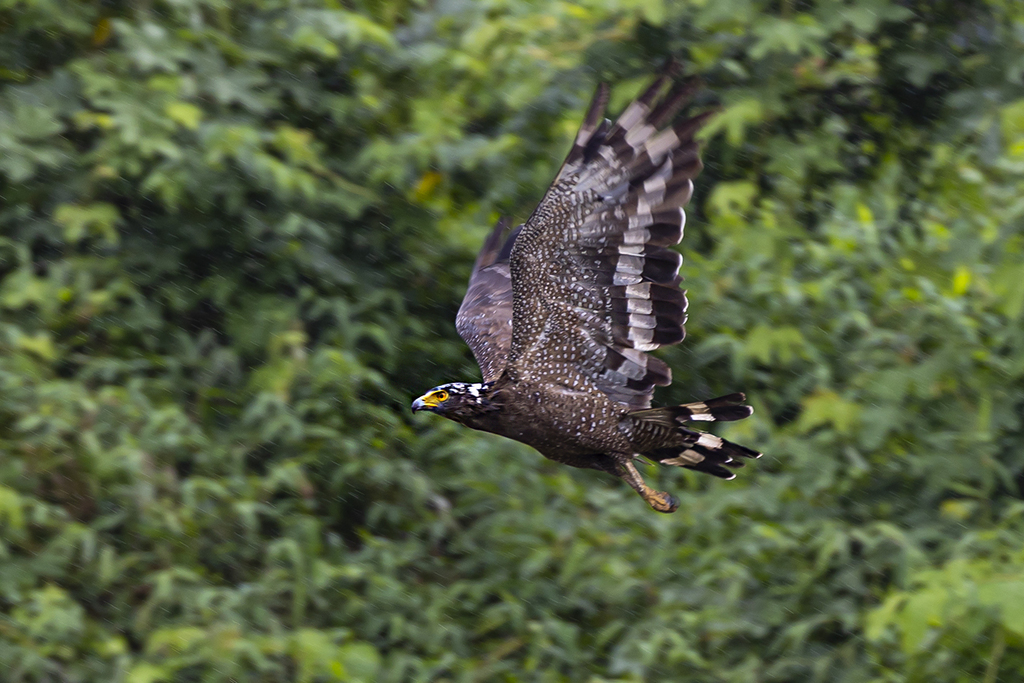
The crested serpent eagle (Spilornis cheela) is a medium-sized bird of prey that is found in forested habitats across tropical Asia. Within its widespread range across the Indian subcontinent, Southeast Asia and East Asia, there are considerable variations and some authorities prefer to treat several of its subspecies as completely separate species. In the past, several species including the Philippine serpent eagle (S. holospila), Andaman serpent eagle (S. elgini) and South Nicobar serpent eagle (S. klossi) were treated as subspecies of the crested serpent eagle. All members within the species complex have a large-looking head with long feathers on the back, giving them a maned and crested appearance. The face is bare and yellow joining up with the ceres while the powerful feet are unfeathered and heavily scaled. They fly over the forest canopy on broad wings and tail have wide white and black bars. They call often with a loud, piercing and familiar three or two-note call. They often feed on snakes, giving them their name and are placed along with the Circaetus snake-eagles in the subfamily Circaetinae.
From the article Crested serpent eagle on Wikipedia (CC BY-SA), quoted section by section
Description
This medium-large, dark brown eagle is stocky, with rounded wings and a short tail. Its short black and white fan-shaped nuchal crest gives it a thick-necked appearance. The bare facial skin and feet are yellow. The underside is spotted with white and yellowish-brown. When perched the wing tips do not reach until the tail tip. In soaring flight, the broad and paddle-shaped wings are held in a shallow V. The tail and underside of the flight feathers are black with broad white bars. Young birds show a lot of white on the head. The tarsus is unfeathered and covered by hexagonal scales. The upper mandible does not have an overhanging festoon to the tip.
Size. This species of serpent eagle manifests an unusual amount of size variation across its assorted subspecies. Total length of fully-grown crested serpent eagles can vary from 41 to 75 cm (16 to 30 in) and wingspan can vary from 89 to 169 cm (2 ft 11 in to 5 ft 7 in). The largest proportioned race appears to be the nominate, S. c. cheela, with a wing chord of 468 to 510 mm (18.4 to 20.1 in) in males and 482 to 532 mm (19.0 to 20.9 in) in females, tail lengths of 295 to 315 mm (11.6 to 12.4 in) and tarsus length of 100 to 115 mm (3.9 to 4.5 in). In comparison, S. c. …
What it does
The crested serpent eagle is a reptile eater which hunts over forests, often close to wet grassland, for snakes and lizards. It has also been observed to prey on birds, large insects like grasshoppers or locusts, amphibians, mammals, fishes, termites and large earthworms. It is found mainly over areas with thick vegetation both on the low hills and the plains. This species is a resident species, but in some parts of their range they are found only in summer. The call is a distinctive kluee-wip-wip with the first note being high and rising. They call a lot in the late mornings from their perches where they spend a lot of time and they rise on thermals in the mornings. In southern Taiwan, males have a larger home range than females. Males on average had a home range of 16.7 km2 while females used about 7 km2. When alarmed, they erect the crest and the head appears large and framed by the ruff. They will sometimes follow snakes on the ground. They roost in the interiors of trees with dense foliage. A radio-telemetric study of the species in Taiwan found that the birds spend 98% of the day perched and usually finding food in the morning hours. They appear to use a sit and wait foraging strategy.
The breeding season begins in late winter when they start courting and establishing territories. The eggs are laid in early summer. …
Wikipedia: “Behaviour and ecology”
Listen
Looking for field recordings…
Where it lives
Recorded sightings
—
geo-referenced records in GBIF, from museums, herbaria and field observers.
Drag the globe to turn it. Dots are where records exist, not a range map; darker means more records.
In the stacks
Searching the stacks…
Every page naming Spilornis cheela in the Biodiversity Heritage Library →
This page is assembled live from iNaturalist, GBIF, Wikipedia, the Source Library and the Internet Archive. It is not yet part of the hand-edited codex. iNaturalist taxon 5158.