- Animals
- ›Chordates
- ›Vertebrates
- ›Birds
- ›Hawks, Eagles, Kites, and Allies
- ›Hawks, Eagles, and Kites
- ›Elanine Kites
- ›Elanus
On eBird ↗
Black-winged Kite
Live sightings near you, the range map, bar charts of when it is seen, and Macaulay Library photos and recordings.
Black-winged Kite
Elanus caeruleus
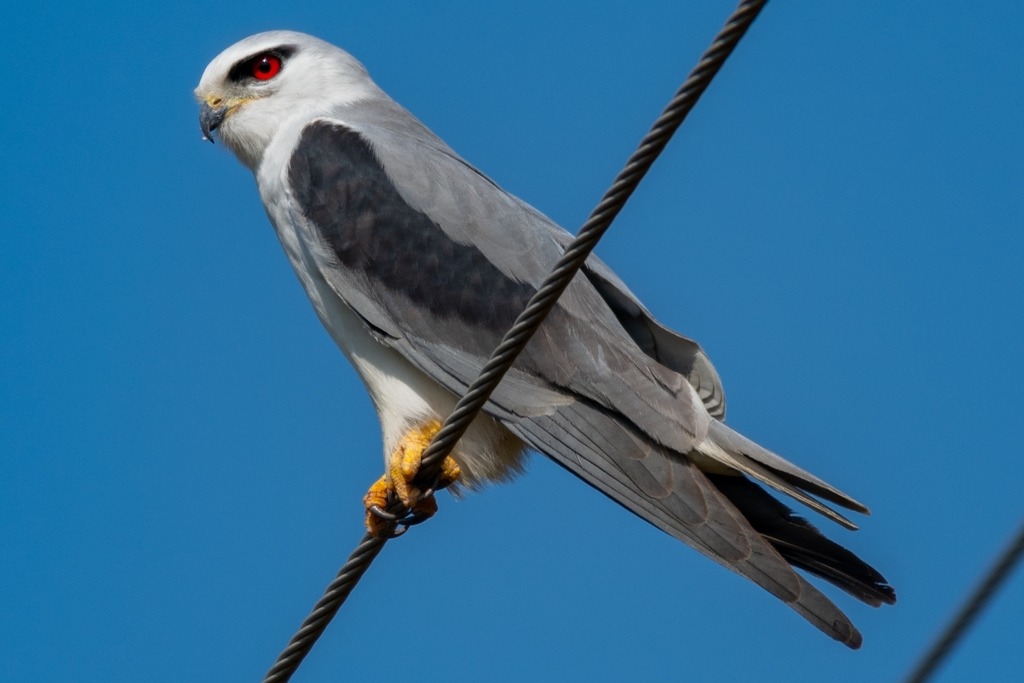
The black-winged kite (Elanus caeruleus), also known as the black-shouldered kite (not to be confused with the closely related Australian species of the same name), is a small diurnal bird of prey in the family Accipitridae best known for its habit of hovering over open grasslands in the manner of the much smaller kestrels. This Palearctic and Afrotropical species was sometimes combined with the Australian black-shouldered kite (Elanus axillaris) and the white-tailed kite (Elanus leucurus) of North and South America which together form a superspecies. This kite is distinctive, with long wings; white, grey and black plumage; and owl-like forward-facing eyes with red irises. The owl-like behaviour is even more pronounced in the letter-winged kite (Elanus scriptus), a nocturnal relative in Australia. Although mainly seen on plains, they are sometimes seen on grassy slopes of hills in the higher elevation regions of Asia. They are not migratory, but show nomadism in response to weather and food availability. They are well adapted to utilize periodic upsurges in rodent populations and can raise multiple broods in a single year unlike most birds of prey. Populations in southern Europe have grown in response to human activities, particularly agriculture and livestock rearing. It is now present in Southwest France.
From the article Black-winged kite on Wikipedia (CC BY-SA), quoted section by section
Description
This long-winged raptor is predominantly grey or white with black shoulder patches, wing tips and eye stripe. The long falcon-like wings extend beyond the tail when the bird is perched. In flight, the short and square tail is visible and it is not forked as in the typical kites of the genus Milvus. When perched, often on roadside wires, it often adjusts its wings and jerks its tail up and down as if to balance itself. The sexes are alike in plumage. Their large forward-facing eyes placed under a bony shelf that shades them is distinctive; their velvety plumage and zygodactyl feet are characters shared with owls and the genus has been considered as a basal group within the Accipitridae. They are thought to have been adapted for living in savanna habitats where seasonal rodent population peaks occur. Such food resources are also favoured by the owls. The inner vanes of the feathers have velvety barbules. They have a diploid chromosome number of 68 (some older studies claimed 64 for E.c.caeruleus and 66 for E.c.vociferus) with a distinct karyotype with resemblances to the kites and honey buzzards and suggesting a basal position within the diurnal birds of prey.
Range & habitat
The black-winged kite is a species primarily of open land and semi-deserts in sub-Saharan Africa and tropical Asia, but it has a foothold within Europe in Spain and Portugal. The species range appears to be expanding in southern Europe and, more recently, also to West Asia. The first records of breeding in Europe were in the 1860s and since then they have become more widespread and populations are on the rise. It is thought that land-use changes, particularly agriculture and pastureland have helped the species. The species has expanded its range in southern Europe and vagrants from Switzerland and England indicate that the species is moving north. Several geographic populations have been named as subspecies and these include the nominate subspecies which occurs in Spain, Africa and Arabia. The subspecies vociferus is found east of this range across South Asia and into Southeast Asia. Along Sumatra, Java, Borneo and the Philippines subspecies hypoleucus (sometimes considered a full species) includes the population wahgiensis described from New Guinea. The subspecies sumatranus is not always recognized. …
Wikipedia: “Distribution and habitat”
What it does
The black-winged kite breeds at different times of the year across its range. Although nesting has been noted throughout the year in India, they appear not to breed in April and May. Males establish territories and defend them from competition. Females move into the territories of males. Studies in Africa found that males were more numerous than females. Courtship is noisy and involves chases and once the pair is formed they copulate frequently. The nest is a loose platform of twigs in which 3 or 4 eggs are laid. The female spends more effort in the construction of the nest than the male. The eggs are pale creamy with spots of deep red. Both parents incubate but when the chicks hatch, the male spends more time on foraging for food. Females initially feed the young, sometimes hunting close to the nest but will also receive food from the male. After fledging the young birds continue to be dependent for food on the male parent for about 80 days, initially transferring food at perch and later in the air. Young birds have reddish brown feathers on the upperparts and on the breast. The reddish colour is derived from porphyrins and is thought to provide the young birds some camouflage. Once breeding is complete females often move on to new territories sometimes deserting before the young fledge, leaving males to feed and raise the young. …
Wikipedia: “Behaviour and ecology”
Listen
Looking for field recordings…
Where it lives
Recorded sightings
—
geo-referenced records in GBIF, from museums, herbaria and field observers.
Drag the globe to turn it. Dots are where records exist, not a range map; darker means more records.
In the stacks
Searching the stacks…
Every page naming Elanus caeruleus in the Biodiversity Heritage Library →
This page is assembled live from iNaturalist, GBIF, Wikipedia, the Source Library and the Internet Archive. It is not yet part of the hand-edited codex. iNaturalist taxon 5275.