On eBird ↗
Dalmatian Pelican
Live sightings near you, the range map, bar charts of when it is seen, and Macaulay Library photos and recordings.
Dalmatian Pelican
Pelecanus crispus
The Dalmatian pelican (Pelecanus crispus), also known as the curly-headed pelican, is the largest member of the pelican family and among the heaviest flying birds in the world. With a wingspan typically ranging between 2.7 and 3.2 metres (8 ft 10 in and 10 ft 6 in), it ranks among the largest soaring birds. These pelicans are known for their graceful flight and often travel in synchronised flocks. With a range spanning across much of Central Eurasia, from the eastern Mediterranean in the west to the Taiwan Strait in the east, and from the Persian Gulf in the south to Siberia in the north, it is a short-to-medium-distance migrant between breeding and overwintering areas.
As with other pelicans, its diet is mainly fish, and the males are larger than the females. Its curly nape feathers, grey legs and silvery-white plumage are distinguishing features, and the wings appear solid grey in flight. The adults acquire a drabber plumage in winter, however, making them look more similar to the great white pelican. Its harsh vocalizations become more pronounced during the mating season. It breeds across the Palearctic from southeastern Europe to Russia, India and China in swamps and shallow lakes. It usually returns to traditional breeding sites, where it is less social than other pelican species. Its nests are crude heaps of vegetation, which are placed on islands or dense mats of vegetation.
From the article Dalmatian pelican on Wikipedia (CC BY-SA), quoted section by section
Description
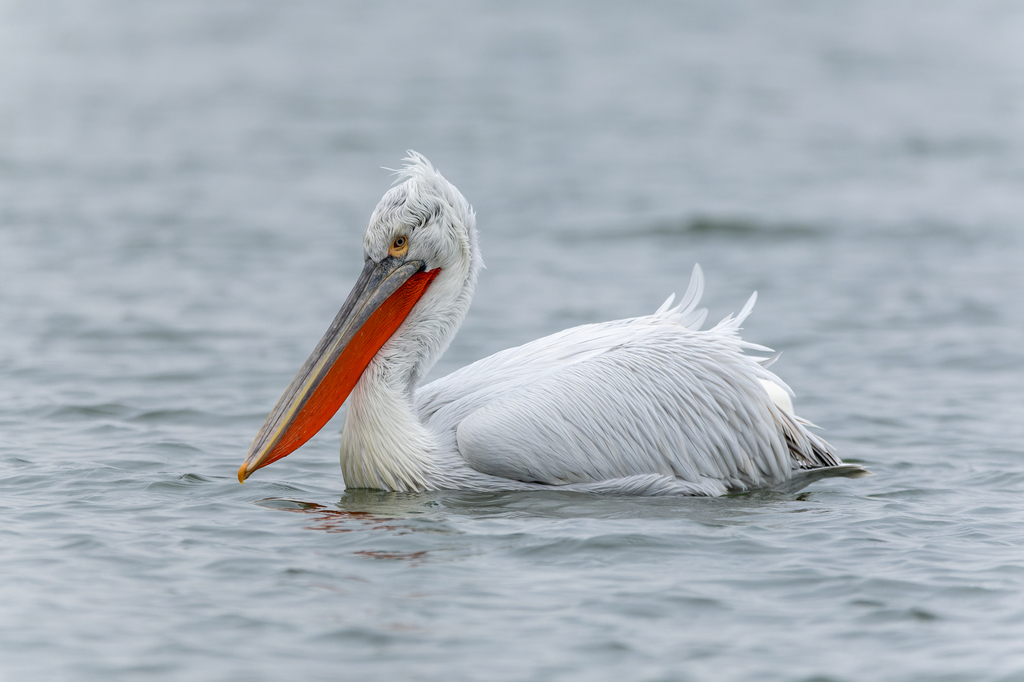
The Dalmatian pelican is the largest of all pelican species and one of the heaviest flying birds in the world, with a body length of 1.6–1.8 m (5 ft 3 in – 5 ft 11 in), a wingspan typically ranging between 2.7–3.2 m (8 ft 10 in – 10 ft 6 in)., and an average weight of about 9.5 kg (21 lb). The species is most easily recognised by its enormous bill, which typically measures between 37 and 45 cm (15 and 18 in) long and includes a large pouch used for catching fish. This makes it the bird species with the second longest bill, only surpassed by the Australian pelican (Pelecanus conspicillatus), whose bill length ranges from 34.6 to 50 cm (13.6 to 19.7 in). During the breeding season, this pouch becomes a vivid orange-red, contrasting with the more subdued yellow or grey tones observed during the rest of the year. The upper mandible remains greyish throughout, often with a slight orange tip. The Dalmatian pelican has silvery-white plumage, which may appear more grey or creamy, especially in winter. A distinguishing feature is the presence of a shaggy crest of curly feathers on the nape and back of the head, giving the bird a notably unkempt appearance compared to the smooth-headed great white pelican (Pelecanus onocrotalus). …
Range & habitat
Historically, the Dalmatian pelican was far more widespread across Europe than it is today. Subfossil remains dating back to the Holocene climatic optimum, approximately 7400 to 5000 years BP have been found as far north as Denmark. Additional remains dated to 1900–600 BP have been uncovered in central Europe, the Netherlands, and Great Britain. These finds suggest that the species once ranged across much of the continent during periods of warmer climate.Currently, the Dalmatian pelican is widely distributed across southeastern Europe, Central Asia, and the Indian subcontinent, inhabiting large, open wetlands such as lakes, rivers, deltas, estuaries, and floodplains. Unlike the great white pelican, which remains mostly in lowlands, the Dalmatian pelican nests at various elevations and is more philopatric, typically returning to the same traditional breeding sites unless they become unsuitable due to disturbance or degradation. During the non-breeding season, the Dalmatian pelican seeks out ice-free inland waters, such as large lakes in Europe or temporary wetlands known as jheels in India, which provide essential foraging and resting habitat. …
Wikipedia: “Distribution and habitat”
What it does
The Dalmatian pelican is a piscivorous, non-apex predator, functionally classified as an opportunistic secondary-to-tertiary consumer. It forages across freshwater, brackish, and coastal ecosystems, primarily during crepuscular hours, using shallow-water surface capture techniques. Its trophic role positions it as a top-level vertebrate consumer, but below strict apex predators due to its limited prey diversity and lack of intra-guild predation.
Diet composition. They predominantly consume fish from freshwater, brackish, and marine environments. Most of these are small to medium-sized fish; large enough to justify the effort of capture but small enough to be swallowed whole, as pelicans do not tear or chew their prey. Additionally, the species they prey on tend to form schools or shoals, are often benthic, and exhibit slow movements. These traits facilitate collective predation. Such preferences are typical of visual predators that forage in groups or in clear waters. Below are examples of prey species recorded in its diet:
Total quantity. …
Wikipedia: “Feeding ecology”
At the table
Dalmatian pelicans have been systematically monitored since 1967 through mid-winter counts conducted as part of the International Waterbird Census (IWC), coordinated by Wetlands International. Today, the species is surveyed across five major population units: the Western and Eastern subpopulations of the Black Sea–Mediterranean flyway, the Fore-Caucasus and West Caspian populations, the Central and West Asia flyway populations, and the Mongolia–China population. These efforts are coordinated by BirdLife International and the UNEP/AEWA Secretariat, in collaboration with national and local partners. Population censuses integrate aerial and ground surveys, bird ringing programs, and increasingly, satellite telemetry using GPS tags. These tools are vital instruments for tracking population trends, guiding conservation priorities, evaluating the success of habitat restoration, and informing national and international conservation status assessments. They support the design and revision of action plans, the identification of key breeding and wintering sites, and the monitoring of reintroduction efforts and mitigation measures. identification
Challenges and innovations. Despite decades of effort, comprehensive coverage remains difficult in some regions due to limited access, sparse ornithological infrastructure, or logistical constraints. …
Wikipedia: “Monitoring and population censuses”
Listen
Looking for field recordings…
Where it lives
Recorded sightings
—
geo-referenced records in GBIF, from museums, herbaria and field observers.
Drag the globe to turn it. Dots are where records exist, not a range map; darker means more records.
In the stacks
Searching the stacks…
Every page naming Pelecanus crispus in the Biodiversity Heritage Library →
This page is assembled live from iNaturalist, GBIF, Wikipedia, the Source Library and the Internet Archive. It is not yet part of the hand-edited codex. iNaturalist taxon 4333.