On eBird ↗
Pacific Golden-Plover
Live sightings near you, the range map, bar charts of when it is seen, and Macaulay Library photos and recordings.
Pacific Golden-Plover
Pluvialis fulva
The Pacific golden plover (Pluvialis fulva) is a medium-sized plover. The genus name is Latin and means relating to rain, from pluvia, "rain". It was believed that golden plovers flocked when rain was imminent. The species name fulva is Latin and refers to a tawny colour.
From the article Pacific golden plover on Wikipedia (CC BY-SA), quoted section by section
Description
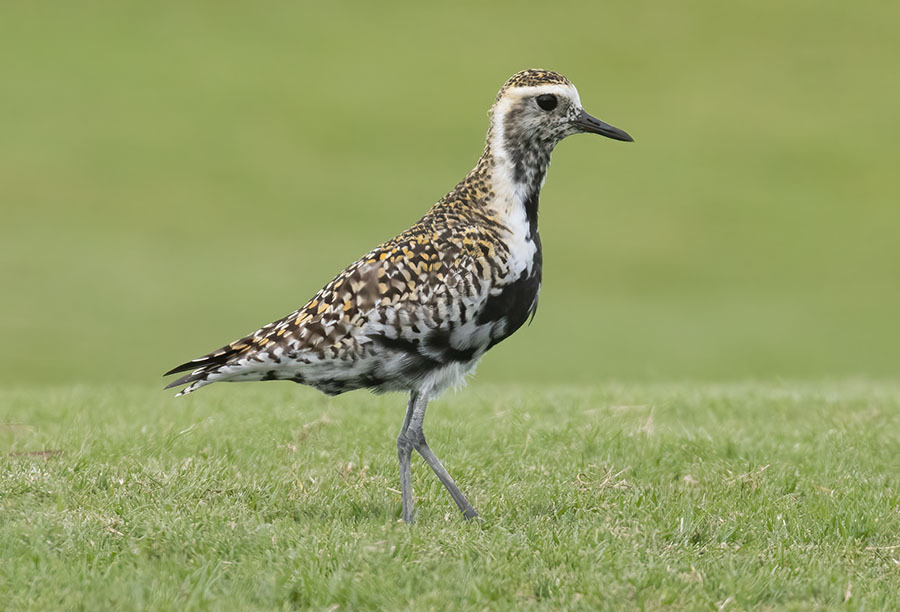
Adults are about 25 cm (9.8 in) long with a wingspan averaging 61 cm (24 in) At their lightest, fat free, the birds weigh around 135 g (4.8 oz) In March, the birds begin gaining weight. Before leaving for their Arctic breeding grounds, the birds weigh about 200 g (7.1 oz). In breeding plumage, the male is spotted gold and black on the crown, back, and wings. Face and neck are black bordered with white, breast is black, rump is dark. Bill is black, legs are gray to black. Female similar but black breast mottled and less distinct. In nonbreeding plumage, sexes look identical. The black on the face and breast bordered by white is replaced with dark brown, gray, and yellowish patterning and lighter underparts. Molt to breeding plumage begins in March and April, prior to migration. Molt to nonbreeding plumage begins in the Arctic during egg incubation. Downy chicks are spotted gold and black on head and back with whitish yellow underparts. Legs and feet are adult size at hatching. Similar birds are the European golden plover, Pluvialis apricaria, and the American golden plover, Pluvialis dominica. The Pacific golden plover is more similar to the American golden plover, with which it was once considered the lesser golden plover. The Pacific golden plover is slimmer than the American golden plover, has longer legs, and usually has more yellow on the back.
Range & habitat
The Pacific golden plover is migratory, and breeds during May, June, and July in Alaska and Siberia. It migrates south to Asia, Australasia, and Pacific islands in August and September, and stays until April or May. It is a rare vagrant to western Europe. Although a shorebird, the Pacific golden plover feeds mostly inland, preferring open spaces with short vegetation. During the breeding season, the Arctic tundra provides insects and berries for food, and effective camouflage for predator avoidance. In Hawaii, Pacific golden plovers, known locally as kōlea, have adapted remarkably to human presence and to human alteration of the natural environment including, backyards, parks, cemeteries, rooftops, pastures, and golf courses. Because kōlea are site-faithful, each bird returns to, and defends, the same territory year after year, resulting in people observing the comings and goings of the kōlea with special interest. Some observers name and feed their birds, and some birds become tame around their caretakers. The oldest kōlea recorded lived to be at least 21 years, 3 months; its age was unknown at banding. Kōlea are the subject of a Hawaii Audubon Society's citizen science project called Kōlea Count, www.koleacount.org. …
Wikipedia: “Distribution and habitat”
What it does
It forages on tundra, in mowed grass, and on beaches and tidal flats, eating nearly anything that crawls including insects, spiders, mollusks, crustaceans, and small reptiles, as well as berries, leaves, and seeds. Foraging pace is a repeated run-stop-peck. Most wintering birds feed singly within an established territory. Non-territorial birds feed in loose groups.
Wikipedia: “Food and feeding”
Listen
Looking for field recordings…
Where it lives
Recorded sightings
—
geo-referenced records in GBIF, from museums, herbaria and field observers.
Drag the globe to turn it. Dots are where records exist, not a range map; darker means more records.
In the stacks
Searching the stacks…
Every page naming Pluvialis fulva in the Biodiversity Heritage Library →
This page is assembled live from iNaturalist, GBIF, Wikipedia, the Source Library and the Internet Archive. It is not yet part of the hand-edited codex. iNaturalist taxon 4896.