- Animals
- ›Chordates
- ›Vertebrates
- ›Birds
- ›Parrots
- ›Old World Parrots
- ›Long-tailed Parrots and allies
- ›Eclectus
On eBird ↗
Moluccan Eclectus
Live sightings near you, the range map, bar charts of when it is seen, and Macaulay Library photos and recordings.
Moluccan Eclectus
Eclectus roratus
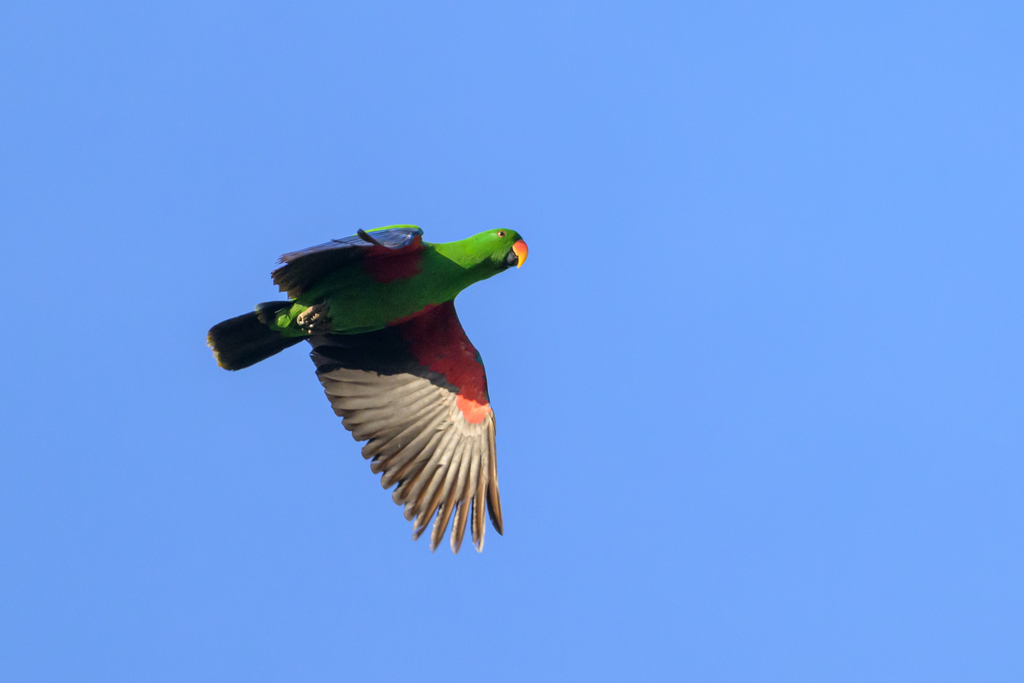
The Moluccan eclectus (Eclectus roratus) is a parrot native to the Maluku Islands (Moluccas). It is unusual in the parrot order for its extreme sexual dimorphism of the colours of the plumage; the male having a mostly bright emerald green plumage and the female a mostly bright red and purple/blue plumage. Joseph Forshaw, in his book Parrots of the World, noted that the first European ornithologists to see eclectus parrots thought they were of two distinct species. Large populations of this parrot remain, and they are sometimes considered pests for eating fruit off trees. Some populations restricted to relatively small islands are comparably rare. Their bright feathers are also used by native tribespeople in New Guinea as decorations.
From the article Moluccan eclectus on Wikipedia (CC BY-SA), quoted section by section
Description
The Moluccan eclectus is unusual in the parrot family for its marked visible light sexual dimorphism in the colours of the plumage. A stocky short-tailed parrot, it measures around 35 cm (14 in) in length. The male is mostly bright green with a yellow-tinge on the head. It has blue primaries, and red flanks and underwing coverts. Its tail is edged with a narrow band of creamy yellow and is dark grey edged with creamy yellow underneath, and the tail feathers are green centrally and bluer as they get towards the edges. The grand Eclectus female is mostly bright red with a darker hue on the back and wings. The mantle and underwing coverts darken to a more purple in colour, and the wing is edged with a mauve-blue. The tail is edged with yellowish-orange above and is more orange tipped with yellow underneath. The upper mandible of the adult male is orange at the base fading to a yellow towards the tip, and the lower mandible is black. The beak of the adult female is all black. Adults have yellow to orange irises and juveniles have dark brown to black irises. The upper mandible of both male and female juveniles are brown at the base fading to yellow towards the biting edges and the tip. The abdomen and nape of the females are blue in most subspecies, purple abdomen and nape in the subspecies (roratus) and lavender abdomen and nape in the (vosmaeri). …
What it does
The diet of the Moluccan eclectus in the wild consists of mainly fruits, wild figs, unripe nuts, flower and leaf buds, and some seeds. In captivity, they should eat a lower sugar diet for their health as they are not flying the same mileage as a wild bird, even though they crave most fruits including mangos, figs, guavas, bananas, melons, stone fruits, grapes, citrus fruits, pears, apples, pomegranate, and papaya. The eclectus has an unusually long digestive tract, so tolerates a high-fiber diet. In captivity, the Moluccan eclectus benefits from specially formulated pellets or bird biscuit diet, backed up with daily serves of 2 to 3 fruits, and 5 vegetables (& leafy greens such as endive and dandelion), and a small amount of seeds and nuts such as almonds and walnuts to be used as treats. Keeping seed and nuts to be fed by hand as treats restricts over intake of oils, which can happen if these are just put into feed bowls.
Wikipedia: “Diet”
In human culture
Moluccan eclectus parrots are one of the more popular birds kept in captivity, as either parent or hand reared. Unlike many other species of parrot they are relatively easy to breed yet difficult to hand feed. Moluccan eclectus are generally calm birds in captivity, displaying a pensive affect when faced with novel items or situations, which may give rise to the mistaken impression that the species is 'dull-witted'. The eclectus may also exhibit more neophobia than other species of companion bird. Eclectus parrots are prone to feather destruction (picking, pulling, cutting, and / or barbing) in captivity. The subspecies E. r. vosmaeri is the most commonly kept in aviculture over all. The average lifespan of the Moluccan eclectus in captivity is unknown, since these birds were not kept in captivity in great numbers until the 1980s. Some sources consider the lifespan to be 30 years. The maximum reliably recorded longevity for this species is 28.5 years, but a lifespan of 40.8 years has also been reported. Moluccan eclectus in captivity are prone to "toe tapping" – characterized by involuntary extension and contractions of the muscles of the feet that cause the bird to constantly tap its toenails against a perch. …
Wikipedia: “Aviculture”
Listen
Looking for field recordings…
Where it lives
Recorded sightings
—
geo-referenced records in GBIF, from museums, herbaria and field observers.
Drag the globe to turn it. Dots are where records exist, not a range map; darker means more records.
In the stacks
Searching the stacks…
Every page naming Eclectus roratus in the Biodiversity Heritage Library →
This page is assembled live from iNaturalist, GBIF, Wikipedia, the Source Library and the Internet Archive. It is not yet part of the hand-edited codex. iNaturalist taxon 19225.