On eBird ↗
New Zealand Kaka
Live sightings near you, the range map, bar charts of when it is seen, and Macaulay Library photos and recordings.
New Zealand Kaka
Nestor meridionalis
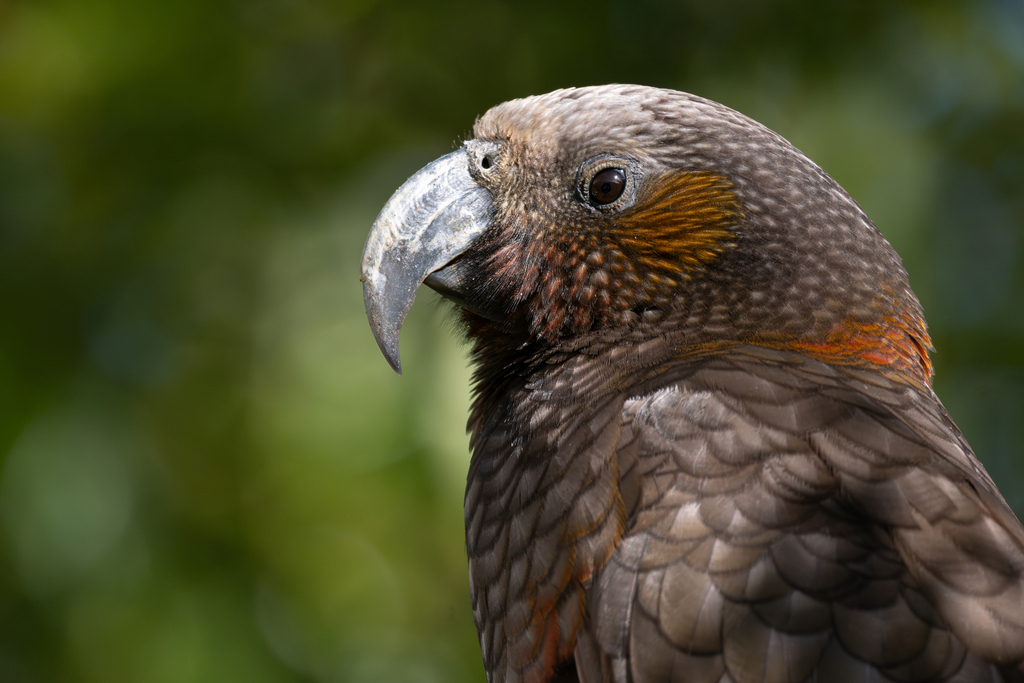
The New Zealand kākā (Nestor meridionalis) is a large species of parrot of the family Strigopidae found in native forests of New Zealand. The species is often known by the abbreviated name kākā, although it shares this name with the Norfolk kākā and Chatham kākā, both recently extinct. Two subspecies of New Zealand kākā are recognised. It is endangered and has disappeared from much of its former range, though the re-introduction of North Island kākā at Zealandia in Wellington has led to an increasing population of the birds across the city.
From the article Kākā on Wikipedia (CC BY-SA), quoted section by section
Description
The New Zealand kākā is a medium-sized parrot, measuring 45 cm (18 in) in length and weighing from 390 to 560 g (14 to 20 oz), with an average of 452 g (0.996 lb). It is closely related to the kea, but has darker plumage and is more arboreal. The forehead and crown are greyish-white and the nape is greyish brown. The neck and abdomen are more reddish, while the wings are more brownish. Both sub-species have a strongly patterned brown/green/grey plumage with orange and scarlet flashes under the wings; colour variants that show red to yellow colouration especially on the breast are sometimes found.
The calls include a harsh ka-aa and a whistling u-wiia. Kākā beak morphology also differs slightly from its closest relatives, the kea and kākāpō. The rhinotheca (upper part of the beak) of the kākā is narrower than the kākāpō and slightly longer. However, it is not as long and sharp as the rhinotheca seen in kea. Therefore, the kākā's bill is between the kea and kākāpō in length, sharpness, and width. There is some evidence of sexual dimorphism in the North Island kākā, with males tending to have larger bills than females. Male culmen lengths tended to be, on average, 13.6% and 12.4% larger than female culmen lengths. …
Range & habitat
The New Zealand kākā lives in lowland and mid-altitude native forest. They tend to inhabit mature native forests with a more complex canopy. The kākā was once widespread throughout most of New Zealand; however, due to habitat modification, predation and resource competition from introduced animals, its distribution has now significantly decreased. Its strongholds are currently the offshore reserves of Kapiti Island, Codfish Island / Whenua Hou and Little Barrier Island. As of 2021, less than 50% of the kākā population was found on the mainland. It is breeding rapidly in the mainland island sanctuary at Zealandia with over 800 birds banded since their reintroduction in 2002. From their reintroduction in 2002, North Island kākā continue to recolonise Wellington and a 2015 report showed a significant increase in their numbers over the preceding 12 years.
South Island kākā. New Zealand kākā are still considered common and easy to find in certain large forested areas of the South Island. Kākā can be found in Rotoiti Nature Recovery Project, along the Milford Track and in the Eglinton Valley in Fiordland National Park. The South Island kākā, N. m. meridionalis, can be distinguished from the North Island kākā by slight differences in its plumage. …
Wikipedia: “Distribution and habitat”
What it does
New Zealand kākā are mainly arboreal and occupy mid-to-high canopy. They are often seen flying across valleys or calling from the top of emergent trees. They are very gregarious and move in large flocks that often include kea, where they are present. They are not obligate social animals and go between living in groups and being solitary, where they vocalise less. Their behaviour in group environments shows their high cognition by demonstrating their complex interactions through social play and communication. They are partially nocturnal, and are highly active at dawn and dusk and can sometimes be heard calling loudly. Kākā usually can be seen in groups of 3-5 and often forage alone but can form large groups around food sources like flowering or fruiting trees.
Breeding. The New Zealand kākā nests in cavities in hollow trees. These trees are often mataī, rimu, tōtara, miro, hīnau and sometimes dead trees. The entrance hole is often three to six metres above the ground, but can be as low as ground level on predator-free offshore islands. The nest floor is lined with small wood chips and powder. This is intentionally created by the mother stripping wood and chewing wood chips from the cavity walls. Large wood chips on the cavity floor can be further chewed and broken down to create a consistent base for the nestlings. …
Wikipedia: “Behaviour”
In human culture
The kākā is a taonga species recognised as a species of high cultural significance in New Zealand. The kākā plays a significant part in Māori mythology, with it often being seen as a symbol of power, authority, and prestige. The kākā also has a personified parent named Tū Mātāika with a Māori proverb about the kākā describing the great number of descendants of Tū Mātāika. This refers to the once great abundance of kākā across New Zealand. Kākā pōria, which are small rings made from bone, pounamu, and other stones, were used to keep kākā as mōkai (captives or pets). They were usually captured as nestlings and grew tame as they progressed into adulthood.
Wikipedia: “Māori culture”
Listen
Looking for field recordings…
Where it lives
Recorded sightings
—
geo-referenced records in GBIF, from museums, herbaria and field observers.
Drag the globe to turn it. Dots are where records exist, not a range map; darker means more records.
In the stacks
Searching the stacks…
Every page naming Nestor meridionalis in the Biodiversity Heritage Library →
This page is assembled live from iNaturalist, GBIF, Wikipedia, the Source Library and the Internet Archive. It is not yet part of the hand-edited codex. iNaturalist taxon 18943.