- Animals
- ›Chordates
- ›Vertebrates
- ›Birds
- ›Parrots
- ›Old World Parrots
- ›Broad-tailed Parrots and Allies
- ›Platycercus
On eBird ↗
Eastern Rosella
Live sightings near you, the range map, bar charts of when it is seen, and Macaulay Library photos and recordings.
Eastern Rosella
Platycercus eximius
The eastern rosella (Platycercus eximius) is a parrot native and endemic to south-eastern Australia. It was first introduced to New Zealand in cages, and individuals were subsequently intentionally released or accidentally escaped into the wild. In New Zealand, it is now established in the North Island (notably in the northern half of the island, Taranaki, Waikato and in the Hutt Valley) and in the hills around Dunedin in the South Island.
From the article Eastern rosella on Wikipedia (CC BY-SA), quoted section by section
Description
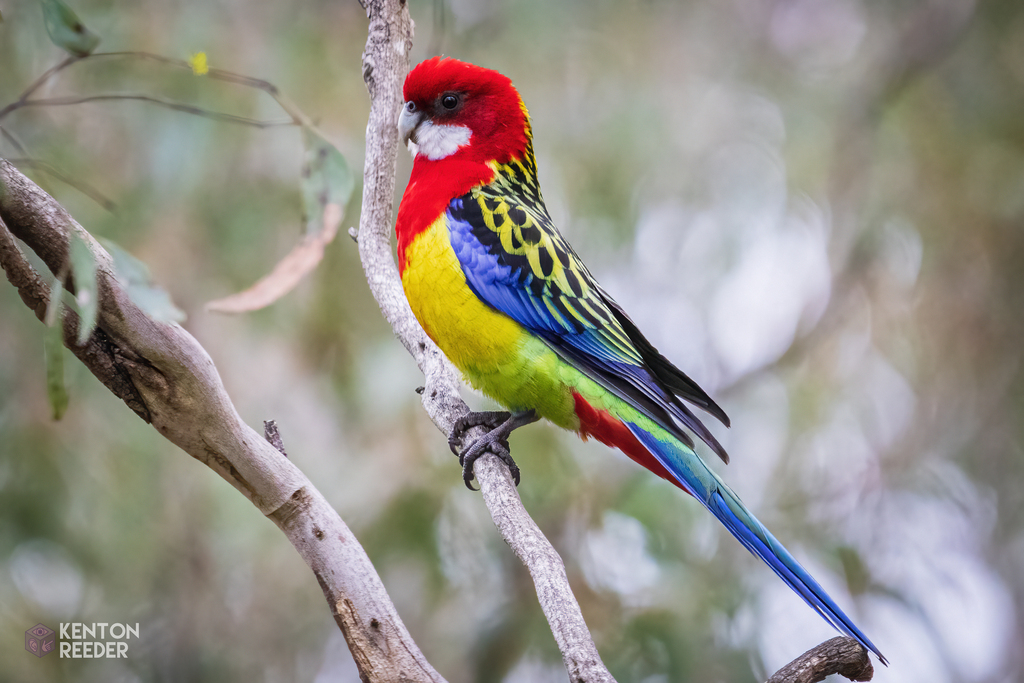
The eastern rosella is 30 cm (12 in) long. Its cheeks are white, and it has a red-coloured head. The beak is white, and the irises are brown. Its upper breast is red, and its lower breast is yellow and fades to pale green over the abdomen. The black feathers on the back and shoulders have yellowish and greenish margins which gives the scalloped look that differs between the sexes and subspecies. The wings and lateral tail feathers are bluish, the tail is dark green, and the legs are grey. Female colouration is similar to the males of the species, but their plumage is duller overall, and they sport an underwing stripe. Juveniles are duller than the females and have an underwing stripe.
Range & habitat
The eastern rosella (Platycercus eximius) has become naturalised in New Zealand. Its first introduction occurred around 1910, when a small shipment of eastern rosellas, as well as a few crimson rosellas (P. elegans), was prohibited entry into New Zealand by the Customs Department. The birds were released off Otago Heads by the ship's crew before returning to Sydney. In another incident, approximately 12 captive rosellas escaped in Dunedin when their cages were damaged in a gale. By the 1970s, the population of eastern rosella had become well-established throughout Auckland, Northland, and the far north, extending into western Waikato as far south as Kawhia and Te Kūiti, and east to the Coromandel Peninsula. The species was also seen in the Wellington-Hutt Valley Region, and began colonizing the foothills of the Tararua Range, extending east to Eketāhuna, and west to Ōtaki by 1985. Sightings also have been reported in the areas like New Plymouth, Taupō, Gisborne, Tiritea, Banks Peninsula, Nelson area, and Stewart Island. In Otago in the South Island, the eastern rosella population has remained relatively small, in contrast to North Island populations, which are widely distributed and currently inhabit most of the island. …
Wikipedia: “Distribution in New Zealand”
What it does
Being an arboreal bird, the eastern rosella mostly feeds on grass seeds, buds, flowers, nectars, fruits, as well as insects and their larvae. Their diet is composed of a wide range of food, with reports of them feeding on 50 different plant species and 15 species of animals. Their diet may include both native and non-native plant species in New Zealand such as eucalypts (Eucalyptus spp.), ngaio (Myoporum laetum), willow (Salix spp.), poplar (Populus spp.), and karaka (Corynocarpus laevigatus).
Wikipedia: “Diet and foraging behaviour”
Listen
Looking for field recordings…
Where it lives
Recorded sightings
—
geo-referenced records in GBIF, from museums, herbaria and field observers.
Drag the globe to turn it. Dots are where records exist, not a range map; darker means more records.
In the stacks
Searching the stacks…
Every page naming Platycercus eximius in the Biodiversity Heritage Library →
This page is assembled live from iNaturalist, GBIF, Wikipedia, the Source Library and the Internet Archive. It is not yet part of the hand-edited codex. iNaturalist taxon 18920.