- Animals
- ›Chordates
- ›Vertebrates
- ›Birds
- ›Woodpeckers and Allies
- ›Woodpeckers
- ›Typical woodpeckers
- ›Antillean piculets
- ›Nesoctites
On eBird ↗
Antillean Piculet
Live sightings near you, the range map, bar charts of when it is seen, and Macaulay Library photos and recordings.
Antillean Piculet
Nesoctites micromegas
The Antillean piculet (Nesoctites micromegas) is a species of bird in the woodpecker family Picidae. It is monotypic within the genus Nesoctites. The species is evolutionarily distinct from the other piculets and is afforded its own subfamily Nesoctitinae. It is endemic to the Caribbean island of Hispaniola. A fossil feather in amber attributed to the genus has been found in the Dominican Republic, showing that the ancestors of the species have been isolated on Hispaniola for...
From the article Antillean piculet on Wikipedia (CC BY-SA), quoted section by section
Description
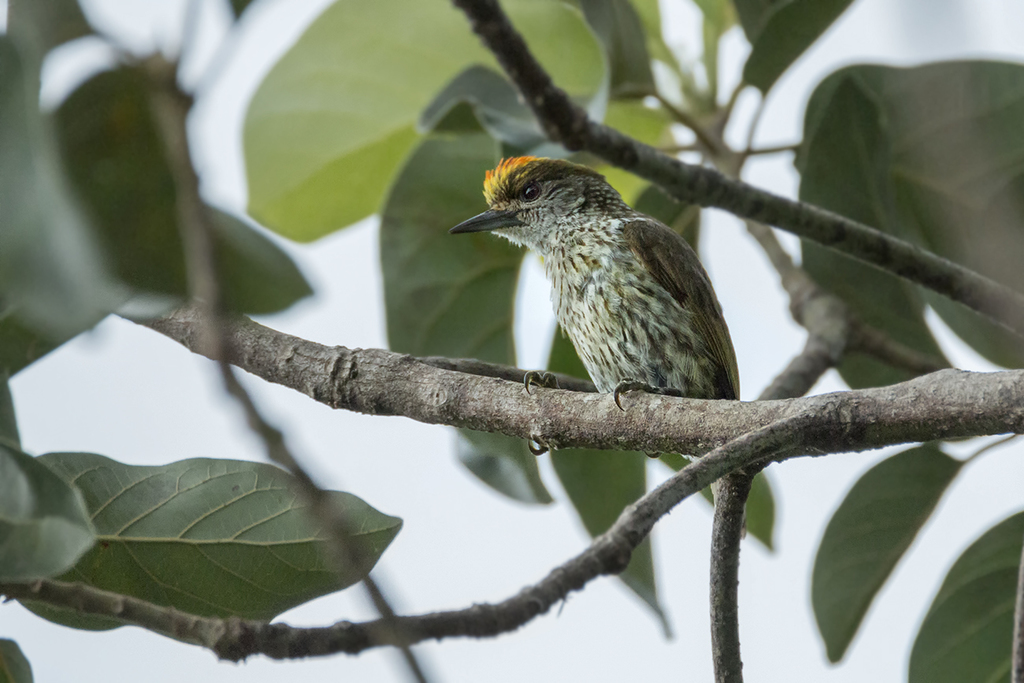
The Antillean piculet is 14 to 16 cm (5.5 to 6.3 in) long and weighs 26 to 33 g (0.92 to 1.2 oz). It is the largest piculet, and is about double the size of the Neotropical piculets of genus Picumnus. Adult males of the nominate subspecies have a lemon yellow crown with an orange-red to red patch in the center. Their hindneck is yellowish green and their upperparts dull olive green to yellow-green with a faint rusty-bronze tinge. Their wings are olive green and the flight feathers have yellow-green edges. Their tail is browish olive with a bronze cast. Their cheeks are dull whitish with olive barring, their chin and throat white with a faint yellow tinge, and the rest of their underparts pale yellowish white. The throat has a few small dark spots and the breast and belly have wide dark streaks. Adult females are larger than males and have the same plumage except without the red crown spot. Juveniles are overall duller than adults, do not have a red crown spot, and have obscure barring rather than streaks on their underparts. Subspecies N. m. abbotti is paler than the nominate and has less yellow on the crown, grayer upperparts, a plainer white throat, and less heavy streaks on the underparts.
Range & habitat
The nominate subspecies of Antillean piuculet is found throughout the main island of Hispaniola. N. m. abbotti is restricted to Gonâve Island off the west coast of Haiti. The species inhabits a variety of landscapes including humid and dry broadleaf forests, Hispaniolan pine forests dominated by Pinus occidentalis, semi-arid scrubland, and thorn forest. It also occurs in mangrove forest and occasionally in orchards and plantations. In all habitats it favors dense undergrowth. In elevation it is most numerous between about 400 and 800 m (1,310 and 2,620 ft) but occurs as high as 1,770 m (5,800 ft) in Sierra de Bahoruco of southwestern Dominican Republic.
Wikipedia: “Distribution and habitat”
What it does
The Antillean piculet mostly forages in the forest understorey below about 8 m (26 ft), but will feed in the crown as well. It mostly hunts by gleaning small branches, twigs, and vines rather than tree trunks, and also probes flowers and clusters of leaves and pine needles. It hunts singly or in pairs. Its diet is mostly insects, especially ants and beetles, and includes other arthropods and a relatively large amount of fruit.
Wikipedia: “Feeding”
Listen
Looking for field recordings…
Where it lives
Recorded sightings
—
geo-referenced records in GBIF, from museums, herbaria and field observers.
Drag the globe to turn it. Dots are where records exist, not a range map; darker means more records.
In the stacks
Searching the stacks…
Every page naming Nesoctites micromegas in the Biodiversity Heritage Library →
This page is assembled live from iNaturalist, GBIF, Wikipedia, the Source Library and the Internet Archive. It is not yet part of the hand-edited codex. iNaturalist taxon 18471.