On eBird ↗
Rainbow Bee-eater
Live sightings near you, the range map, bar charts of when it is seen, and Macaulay Library photos and recordings.
Rainbow Bee-eater
Merops ornatus
The rainbow bee-eater (Merops ornatus) is a near passerine bird in the bee-eater family Meropidae. It is the only species of Meropidae found in Australia.
From the article Rainbow bee-eater on Wikipedia (CC BY-SA), quoted section by section
Description
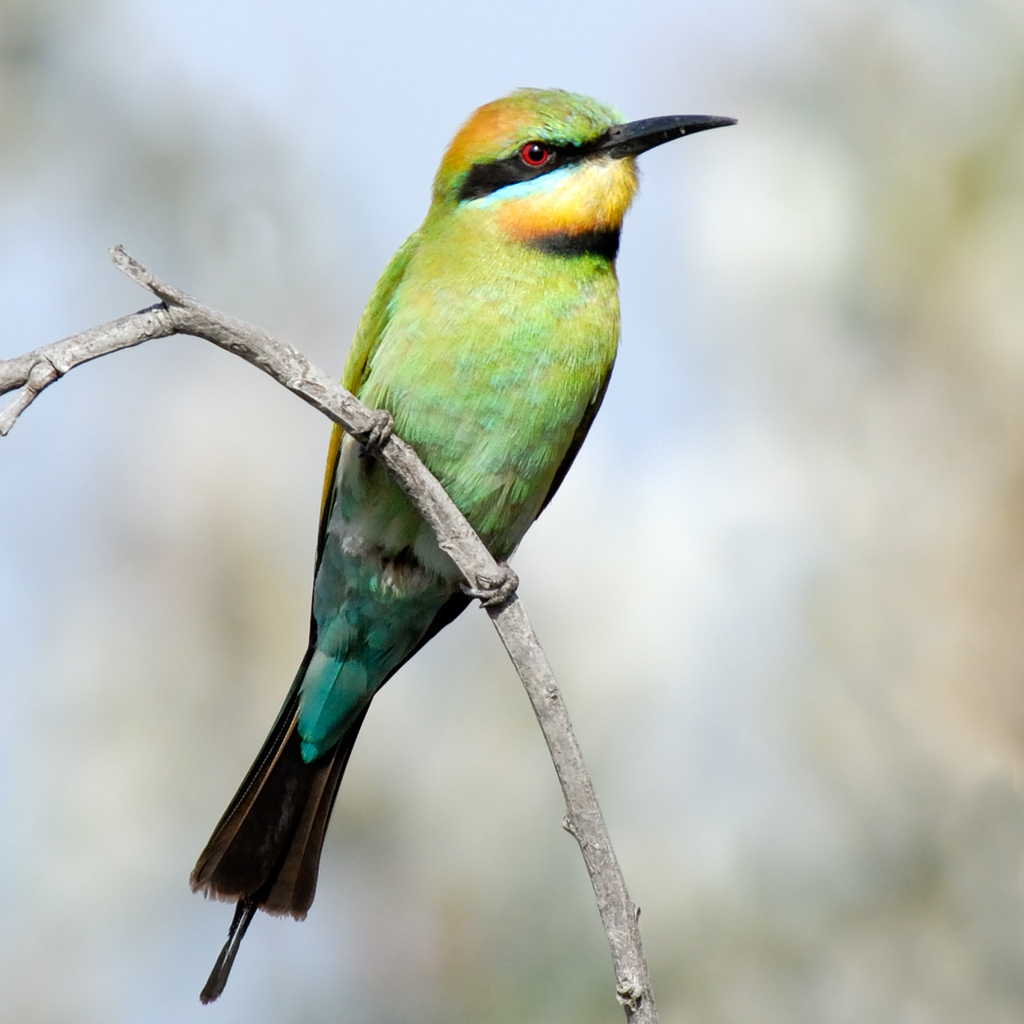
Rainbow bee-eaters are brilliantly coloured birds that grow to be 23–28 cm (9.1–11.0 in) in length, including the elongated tail feathers, and weighing 20–33 g (0.71–1.16 oz). The upper back and wings are green, and the lower back and under-tail coverts are bright blue. The undersides of the wings and primary flight feathers are rufous to copper with green edges and tipped with black, and the tail is black to deep violet. The rainbow bee-eater's two central tail feathers are longer than the other tail feathers, and are longer in the male rainbow bee-eaters than in the females. The crown of the head, the stomach and breast, and the throat are pale yellow-orange, and it has a black crescent-shaped gorget and a black stripe, edged with blue, extending through its bright red eye. They have small, syndactylous feet (i.e., with toes partly united). The juvenile has overall duller plumage, a greener crown, and lacks throat bands and tail streamers.
Range & habitat
Rainbow bee-eaters are a common species and can be found during the summer in forested areas in most of southern Australia, excluding Tasmania. They migrate north during the winter into northern Australia, New Guinea, and some of the southern islands of Indonesia. Vagrants have been recorded on Miyako Island, Japan, and Luidao (Green Island) off south-east Taiwan. They may be found in open woodlands, beaches, dunes, cliffs, mangroves, and farmlands, and they often visit parks and private gardens.
Wikipedia: “Distribution and habitat”
What it does
Like all bee-eaters, rainbow bee-eaters are very social birds. When they are not breeding they roost together in large groups in dense undergrowth or large trees.
Vocal behaviour. The rainbow bee-eater makes a series of loud, melodious "pir-r-r" calls, characterised by rapid vibrating and high pitch, usually in flight. A softer, slower call is exchanged between perching birds.
Nesting. Rainbow bee-eaters are ground-nesting birds, like all bee-eaters. Breeding season is before and after the rainy season in the north, and from November to January in the south. Rainbow bee-eaters are believed to mate for life. The male will bring the female insects while she digs the burrow that will be their nest. The bee-eater digs its burrow by balancing on its wings and feet, and digs with its bill, then pushing loose soil backwards with its feet while balancing on its bill. The female bee-eater can dig about 7–8 centimetres down every day. The nest tunnel is very narrow, and the birds' bodies press so tightly against the tunnel walls that when the birds enter and exit their movement acts like a piston, pumping in fresh air and pushing out stale air. Rainbow bee-eaters have also been known to share their nest tunnels with other bee-eaters and sometimes even other species of birds. …
Wikipedia: “Behaviour”
Listen
Looking for field recordings…
Where it lives
Recorded sightings
—
geo-referenced records in GBIF, from museums, herbaria and field observers.
Drag the globe to turn it. Dots are where records exist, not a range map; darker means more records.
In the stacks
Searching the stacks…
Every page naming Merops ornatus in the Biodiversity Heritage Library →
This page is assembled live from iNaturalist, GBIF, Wikipedia, the Source Library and the Internet Archive. It is not yet part of the hand-edited codex. iNaturalist taxon 2238.