On eBird ↗
Eurasian Coot
Live sightings near you, the range map, bar charts of when it is seen, and Macaulay Library photos and recordings.
Common Coot
Fulica atra
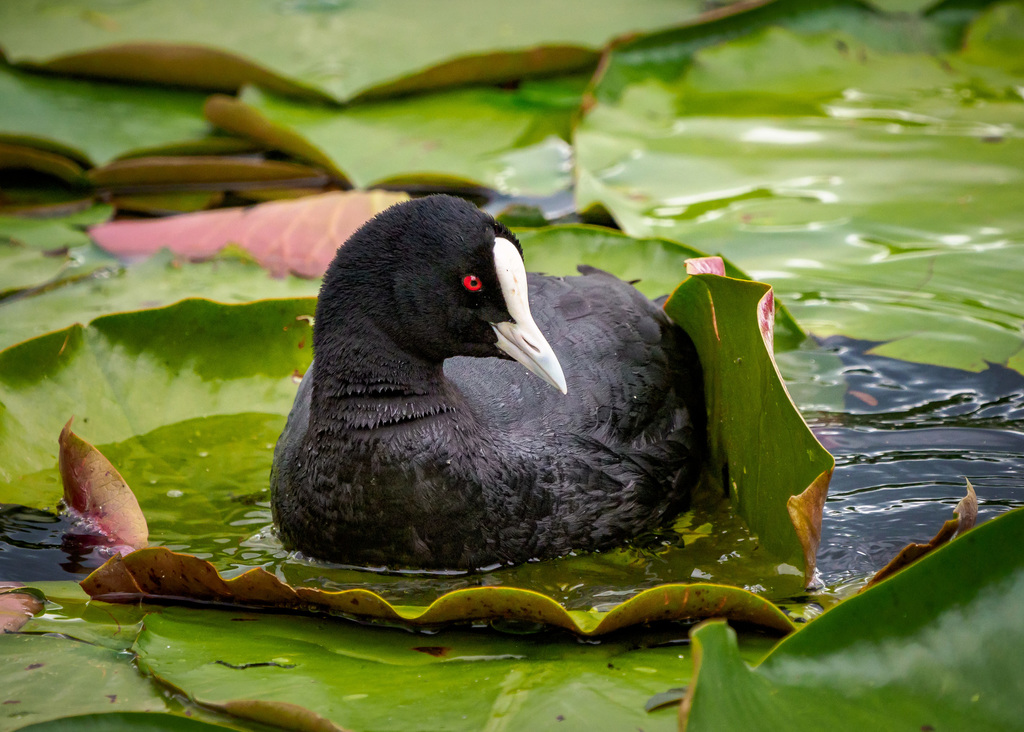
The Eurasian coot (Fulica atra), also known as the common coot or Australian coot, is a member of the rail and crake bird family, the Rallidae. It is found in Europe, Asia, Australia, New Zealand and parts of North Africa. It has a slaty-black body, a glossy black head and a white bill with a white frontal shield. The sexes are similar in appearance.
From the article Eurasian coot on Wikipedia (CC BY-SA), quoted section by section
Description
The Eurasian coot is 36–38 cm (14–15 in) in length with a wing-span of 70–80 cm (28–31 in); males weigh around 890 g (31 oz) and females 750 g (26 oz). It is largely black except for the white bill and frontal shield (which gives rise to the phrase "as bald as a coot", in use as early as 1430). As a swimming species, the coot has partial webbing on its long, strong toes. The sexes are similar in appearance. The juvenile is paler than the adult, has a whitish breast, and lacks the facial shield; the adult black plumage develops when about 3–4 months old, but the white shield is only fully developed at about one year old. The Eurasian coot is a noisy bird with a wide repertoire of crackling, explosive, or trumpeting calls, often given at night.
Range & habitat
The coot breeds across much of the Old World on freshwater lakes and ponds, and like its relative the common moorhen, has adapted well to living in urban environments, often being found in parks and gardens with access to water. It occurs and breeds in Europe, Asia, Australia, and Africa. The species has recently expanded its range into New Zealand. It is resident in the milder parts of its range, but migrates further south and west from much of Asia in winter as the waters freeze. It is known to occur as a vagrant in North America.
Wikipedia: “Distribution and habitat”
What it does
The Eurasian coot is much less secretive than most of the rail family, and can be seen swimming on open water or walking across waterside grasslands. It is an aggressive species, and strongly territorial during the breeding season, and both parents are involved in territorial defence. During the non-breeding season they may form large flocks, possibly related to predator avoidance. It is reluctant to fly and when taking off runs across the water surface with much splashing. It does the same, but without actually flying, when travelling a short distance at speed in territorial disputes or on land to escape from intruders. As with many rails, its weak flight does not inspire confidence, but on migration, usually at night, it can cover surprisingly large distances. It bobs its head as it swims, and makes short dives from a little jump. When fighting other waterbirds (especially other coots), the coot attacks by charging its opponent and striking them with its long legs.
Breeding. The nest is a bulky structure that either floats on the water or is built in shallow water on a low or barely submerged stump or log, making a neat, large bowl. It is constructed of plant stems and leaves with a lining of finer material. Normally concealed in vegetation the nest can sometimes be placed in the open. …
Wikipedia: “Behaviour and ecology”
Listen
Looking for field recordings…
Where it lives
Recorded sightings
—
geo-referenced records in GBIF, from museums, herbaria and field observers.
Drag the globe to turn it. Dots are where records exist, not a range map; darker means more records.
In the stacks
Searching the stacks…
Every page naming Fulica atra in the Biodiversity Heritage Library →
This page is assembled live from iNaturalist, GBIF, Wikipedia, the Source Library and the Internet Archive. It is not yet part of the hand-edited codex. iNaturalist taxon 482.