- Animals
- ›Chordates
- ›Vertebrates
- ›Reptiles
- ›Snakes and Lizards
- ›Lizards
- ›Iguanas and Allies
- ›Iguanas, Anoles, and Allies
- ›Anoles
- ›Anolis
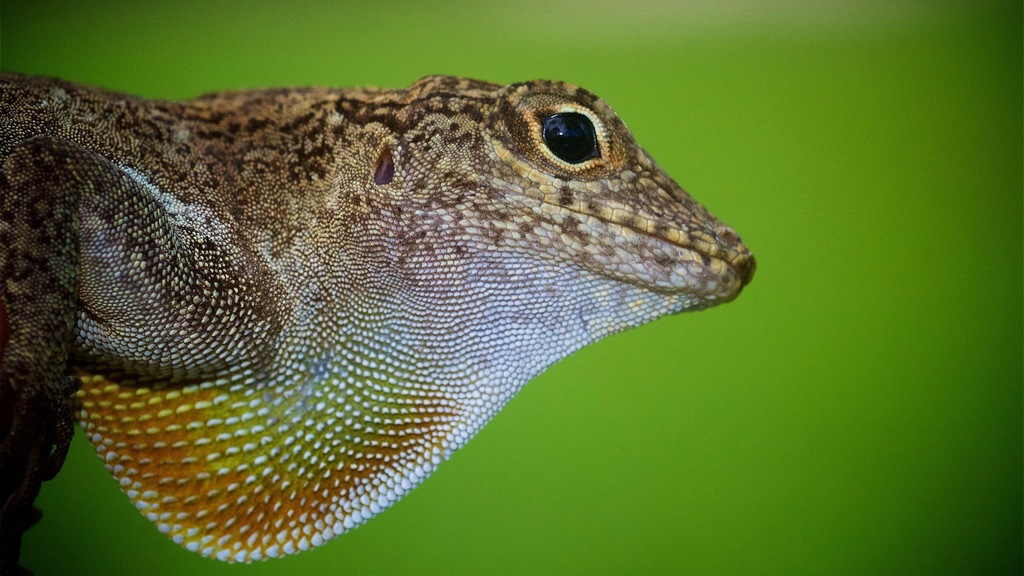
Crested Anole
Anolis cristatellus
Anolis cristatellus is a small species of anole, belonging to the Dactyloidae family of reptiles. The species is native to Puerto Rico and the U.S. and British Virgin Islands, with introduced populations in locations around the Caribbean. The males of A. cristatellus are easily recognizable by the fin running down the top of the tail, which is known as a "caudal crest". The females also have this crest, but it is smaller than that of the males. The species is often quite common in many areas on Puerto Rico, where it can be seen during the day passing the time on the lower parts of tree trunks, or on fences and the walls of buildings in urban areas, sometimes venturing down onto the ground in order to lay eggs, have a snack, or do other cursorial activities. Like many anoles, this species displays the characteristic behaviour of doing push-ups as well as inflating a pizza-like flap of coloured skin on its throat, known as a dewlap, in order to show others how dominant it is, and thus attract mates or intimidate rivals.
The species is known locally as the lagartijo común, and in English it is sometimes called the crested anole, the common Puerto Rican anole, and the Puerto Rican crested anole. There are two allopatric subspecies found in different geographical areas, with slightly different coloured dewlaps and crests.
From the article Anolis cristatellus on Wikipedia (CC BY-SA), quoted section by section
Description
Compared to many other anoles, it is a stocky, muscular and aggressive, although it is a small (compared to Central American anoles) to moderately-sized species (compared to insular Caribbean anoles). Measurements in 2015 found the animals to have a snout-vent length (SVL) which can reach to 75 mm (3.0 in) in males, and up to 73 mm (2.9 in) in females, although most females are much smaller. It is sexually dimorphic, with the males being larger and more ornate than the females. The juvenile lizards are also coloured differently than adults. The males of this species are easily recognizable by their permanently erect caudal crests -which is a high sail- or fin-like structure running down the top of their tails, which is supported anatomically by bony extensions of the vertebrae. The crest is very short along the animals back, and gets higher again on the nape of the neck. The tail is compressed in cross-section. The colour is variable; the head and body are bronze to greenish grey, with faint and irregular brownish spots, and the belly is greenish-yellow and the throat is whitish. The iris is dark brown. The male dewlaps is coloured mustard or greenish yellow, with a burnt-orange, reddish-orange to reddish-coloured band along the margin. Females have a well developed but smaller dewlap and a low caudal crest. …
Range & habitat
This anole is found in almost all habitats throughout Puerto Rico and the Virgin Islands, from open fields to rainforest, except some of the high altitude elfin forests in the mountainous regions of Puerto Rico. The species is found from sea level upwards, decreasing in abundance at higher elevations, with the animals having been found at maximum altitudes of 2,800 ft (850 m) in the Reserva Forestal de Maricao as of 1988, and later 980 m (3,220 ft) in the Los Tres Picachos State Forest (2000).
The introduced population in Costa Rica appears to prefer urban habitats, being mostly found on tree trunks or buildings in towns or cities, and rarely in more rural areas or in forests, and population on Dominica appears to have similar preferences. In general, introduced populations appear to strongly prefer, or be restricted to, urban and other disturbed areas. Anoles of this species found in the urban habitats of the cities of Puerto Rico are found to have lost and regrown their tails more often than those of the natural forests, this may be due to a higher density of urban predators such as house cats, or less places to escape predators, or might indicate urban predators are less accomplished at actually catching their prey. In some parks, such as Los Tres Picachos State Forest, it may be less common than species such as A. cuvieri, A. evermanni, A. gundlachi and A. …
Wikipedia: “Habitat”
What it does
It is oviparous (egg-laying). The lizards shed their skin as they grow, and eat their old skins when they do so, perhaps to conserve the nutrients. Compared to some other species of anoles, this species is not so vocal, although it can make some chirping sounds. As a defence against predators, they can autotomize (break off) their tails, and later grow a new replacement tail which gets longer each time they shed their skin. These new tails do not have the bony vertebrae of the original, and instead only have a rod of cartilage. This growth of cartilage does not have the ability to autotomise, so in order to do the same trick again, an individual lizard must lose more and more of its tail vertebrae. Because the regrown tails of urban lizards contain on average a similar amount of vertebrae as those of the forests, this indicates that individual lizards lose their tail just as often in either habitat. When looking for a mate or defending its territory, the males of many anole species may display their dewlap and perform "push-ups" to establish dominance. Males of many species may aggressively defend territories when mating, but only rarely does this result in physical combat. Like many anole species, this lizard can change colour from dark brown to tan -this is in response to emotions, rather than a method of camouflaging itself such as true chameleons.
Wikipedia: “Behaviour”
Where it lives
Recorded sightings
—
geo-referenced records in GBIF, from museums, herbaria and field observers.
Drag the globe to turn it. Dots are where records exist, not a range map; darker means more records.
In the stacks
Searching the stacks…
Every page naming Anolis cristatellus in the Biodiversity Heritage Library →
This page is assembled live from iNaturalist, GBIF, Wikipedia, the Source Library and the Internet Archive. It is not yet part of the hand-edited codex. iNaturalist taxon 36488.