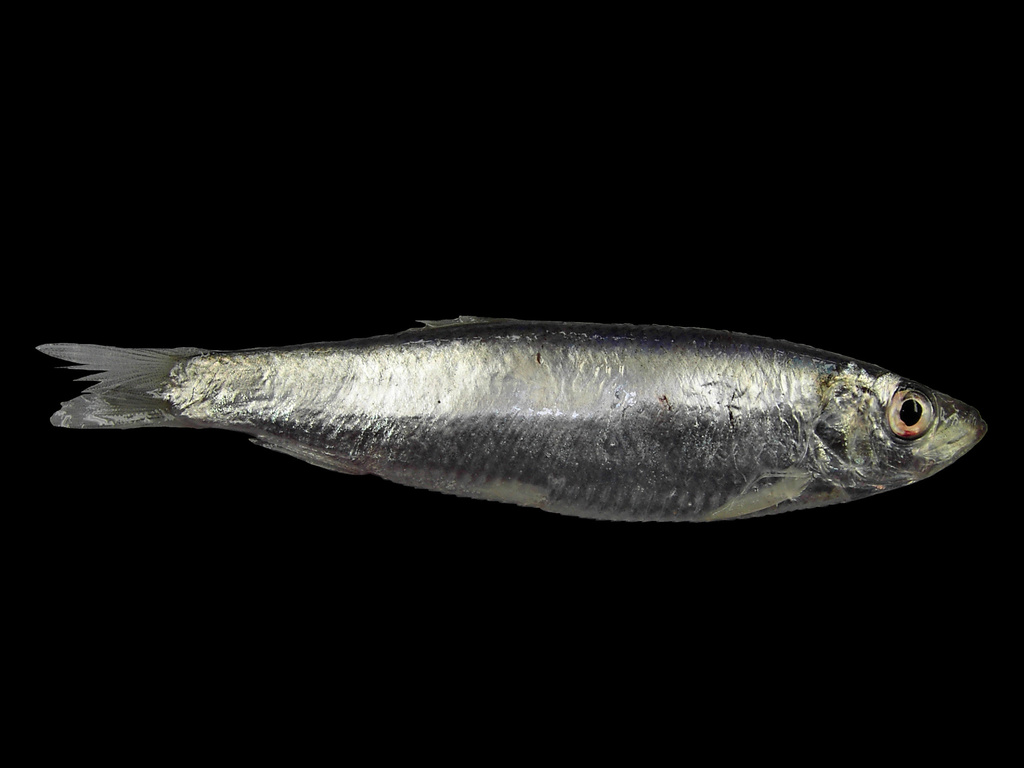
European Sprat
Sprattus sprattus
The European sprat (Sprattus sprattus), also known as the Baltic herring, brisling, brisling sardine, bristling, garvie, garvock, Russian sardine, russlet, skipper or whitebait, is a species of small marine fish in the herring family Clupeidae. It is found in European, West Asian and North African waters. The fish is the subject of fisheries, particularly in Scandinavia, and is made into fish meal, as well as being used for human consumption. When used for food, it can be prepared in various ways, including canning, smoking and frying.
From the article European sprat on Wikipedia (CC BY-SA), quoted section by section
Description
The European sprat is a small fish growing to a maximum length of 16 cm (6.3 in), but more often in the 8–12 cm (3.1–4.7 in) range. It is fairly elongate and rather laterally compressed, with a keel-like row of sharp scales along the belly. The lower jaw projects slightly, there are rarely any vomerine teeth on the roof of the mouth and the hind edge of the gill covers is smoothly rounded, without any fleshy protuberances. The dorsal and anal fins have no spines, and contains 13-21 and 12-23 soft rays respectively. The origin of the pelvic fins, which have 7 (occasionally 8) soft rays, is immediately below or in front of the dorsal-fin origin. This fish has a bluish or greenish back and silvery flanks, with no dark spotting.
Range & habitat
The European sprat is native to the northeastern Atlantic Ocean. Its range includes the Baltic Sea, the North Sea, southern Norway and Sweden, the coasts of the British Isles, the Iberian Peninsula, Morocco, the Mediterranean Sea (including the Adriatic Sea) and the Black Sea. It occurs both in open water well away from the coast and in bays and estuaries, being able to tolerate salinities as low as 4 parts per thousand. It is a schooling fish (like many other species in its family) and migrates between its winter feeding grounds and its summer breeding grounds. The European sprat also makes vertical migrations, rising to near the surface at night to feed.
Wikipedia: “Distribution”
What it does
Adult European sprats feed on copepods, such as species in the genera Calanus, Pseudocalanus and Temora; on the other hand, juveniles feed on the eggs and larvae of these crustaceans, and on diatoms. Breeding takes place at any time of the year, but peaks between December and April in the Mediterranean and between April and August in the Baltic Sea and northeastern Atlantic. Spawning may take place in inshore waters or up to 100 km (60 mi) off the coast. This fish is sometimes parasitised by the copepod Lernaeenicus sprattae. That animal burrows into the eyes of the European sprat, causing loss of visual acuity or even blindness. Heavy infestations can even result in death.
Wikipedia: “Ecology”
Where it lives
Recorded sightings
—
geo-referenced records in GBIF, from museums, herbaria and field observers.
Drag the globe to turn it. Dots are where records exist, not a range map; darker means more records.
In the stacks
Searching the stacks…
Every page naming Sprattus sprattus in the Biodiversity Heritage Library →
This page is assembled live from iNaturalist, GBIF, Wikipedia, the Source Library and the Internet Archive. It is not yet part of the hand-edited codex. iNaturalist taxon 324532.