- Animals
- ›Chordates
- ›Vertebrates
- ›Ray-finned Fishes
- ›Spiny-rayed fishes
- ›Jacks, Flounders, Barracudas, and Allies
- ›Flatfishes
- ›Righteye Flounders
- ›Pleuronectinae
- ›Parophrys
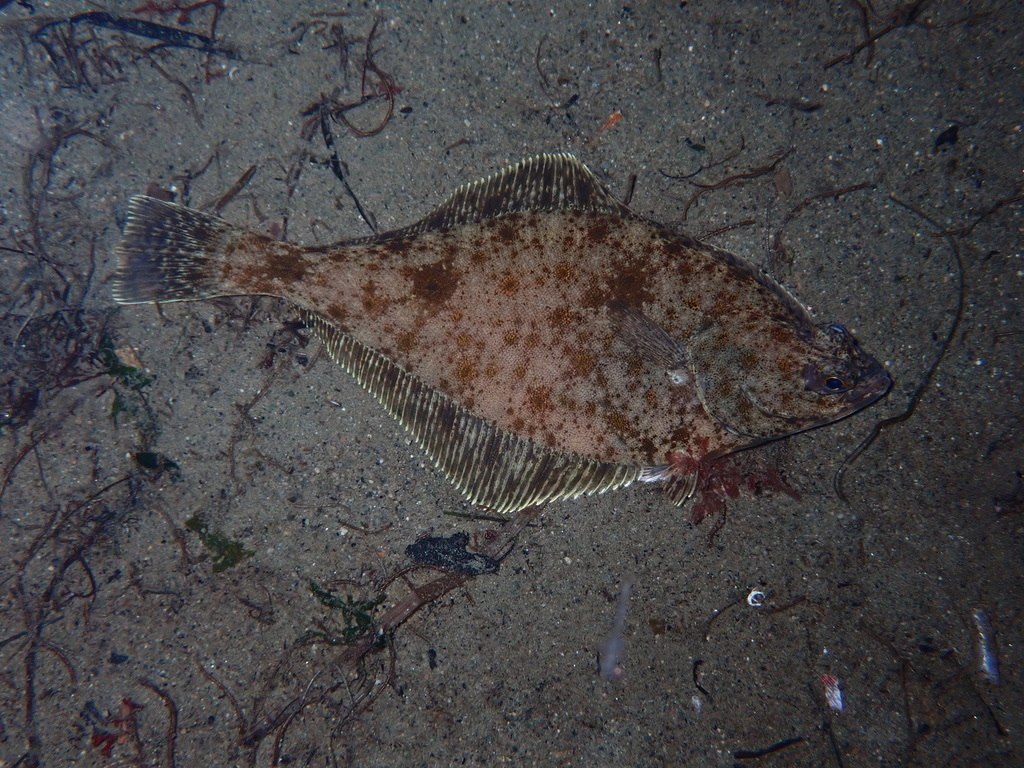
English Sole
Parophrys vetulus
The English sole (Parophrys vetulus) is a species of flatfish in the family Pleuronectidae. It is a demersal fish that lives on sandy and muddy bottoms in estuaries and near shore areas, at depths of up to 550 metres (1,800 ft). It reaches up to 57 centimetres (22 in) in length, and can weigh up to 1.5 kilograms (3.3 lb). Its native habitat is the eastern Pacific, stretching from the coast of Baja California in the south to the Bering Sea in the north.
The English sole is an important commercial fish, primarily caught off Washington, Oregon and California. Though biomass is increasing, catches have been declining since the 1960s and are currently almost at an all-time low.
From the article English sole on Wikipedia (CC BY-SA), quoted section by section
Description
The English sole is a right-eyed flatfish with a compressed, diamond-shaped body and a small head with a pointed snout and small, asymmetric mouth. The upper surface is covered in rough scales and is usually uniformly brown, but occasionally speckled; the lower surface is smooth, and white to pale yellow in colour. The dorsal and ventral fin edges are dark. The lateral line is mostly straight, but curves slightly around the pectoral fin.
What it does
The diet of the English sole consists of zoobenthos organisms, primarily marine worms, molluscs, crustaceans and echinoderms. English sole feed by day, using both sight and smell, and often dig for food.
Wikipedia: “Diet”
In human culture
The genus name is derived from the Greek para, meaning "near", ophrys, meaning "eyebrow", and the species name vetulus is a word meaning "old man".
Wikipedia: “Etymology”
Where it lives
Recorded sightings
—
geo-referenced records in GBIF, from museums, herbaria and field observers.
Drag the globe to turn it. Dots are where records exist, not a range map; darker means more records.
In the stacks
Searching the stacks…
Every page naming Parophrys vetulus in the Biodiversity Heritage Library →
This page is assembled live from iNaturalist, GBIF, Wikipedia, the Source Library and the Internet Archive. It is not yet part of the hand-edited codex. iNaturalist taxon 117545.