- Animals
- ›Chordates
- ›Vertebrates
- ›Ray-finned Fishes
- ›Spiny-rayed fishes
- ›Puffers and Filefishes
- ›Spikefishes and Tripodfishes
- ›Tripodfishes
- ›Pseudotriacanthus
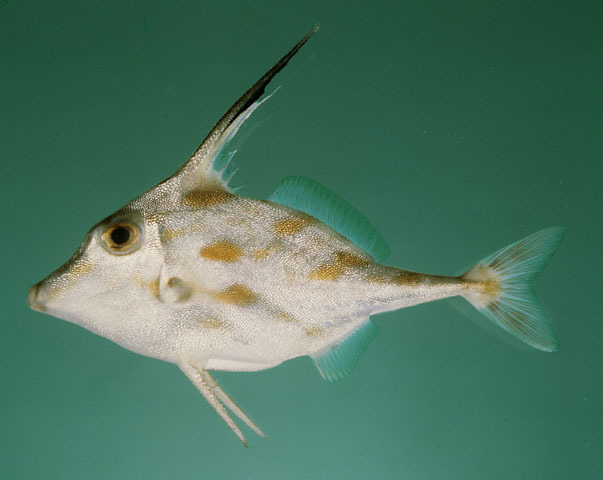
Long-spined Tripodfish
Pseudotriacanthus strigilifer
Pseudotriacanthus strigilifer, the Long-spined Tripodfish, is a species of Triacanthidae native to the Indian Ocean and the central western Pacific Ocean where it is found in coastal marine waters, also entering brackish waters in estuaries, at depths of from 2 to 110 metres (6.6 to 360.9 ft). This species grows to a length of 25 centimetres (9.8 in) TL though it more usually does not exceed 20 centimetres (7.9 in) TL. It is of minor commercial importance and is...
From the article Pseudotriacanthus on Wikipedia (CC BY-SA), quoted section by section
Description
Pseudotriacanthus has 6 spines in the dorsal fin, the second spine is half the length of the first spine, and between 20 and 24 soft rays while the anal fin has 13 and 17 soft rays. The pelvis has a scale covered ventral surface which is wider to the front than at the rear. The scales have high, thin rides on their margins. The overall colour of the body is silvery-grey, darker dorsally. with a scattering of yellowish orange blotches. The upper two-thirds of the first spine of the dorsal fin are dusky, the soft part of the dorsal fin and the anal and pectoral fins are pale, and the caudal fin is yellowish. P. strigilifer has a maximum published total length of 25 cm (9.8 in), although 20 cm (7.9 in) is more typical.
Range & habitat
Pseudotriacanthus has an Indo-West Pacific distribution and has been recorded in the Persian Gulf, the Gulf of Oman, the Arabian Sea, Bay of Bengal, Philippines, the South China Sea including the Gulf of Thailand, Indonesia, and northern Australia. It is found in coastal waters and estuaries, on sand or mud flats typically no deeper than 60 m (200 ft).
== References ==
Wikipedia: “Distribution and habitat”
In human culture
Pseudotriacanthus comes from Ancient Greek ψεύδος (pseúdos), meaning "false", and Triacanthus, because although this taxon resemble Triacanthus and was previously placed in it, its resemblance and placement are false. The specific name strigilifer, which means "scraper bearer", the scales of this species were said to resemble small currycombs, and make the skin rough to the touch in every direction.
Wikipedia: “Etymology”
Where it lives
Recorded sightings
—
geo-referenced records in GBIF, from museums, herbaria and field observers.
Drag the globe to turn it. Dots are where records exist, not a range map; darker means more records.
In the stacks
This page is assembled live from iNaturalist, GBIF, Wikipedia, the Source Library and the Internet Archive. It is not yet part of the hand-edited codex. iNaturalist taxon 196846.