- Animals
- ›Chordates
- ›Vertebrates
- ›Ray-finned Fishes
- ›Tarpons, Eels, and Allies
- ›True Eels
- ›Congroidei
- ›Congers and Garden Eels
- ›Typical Congers
- ›Conger
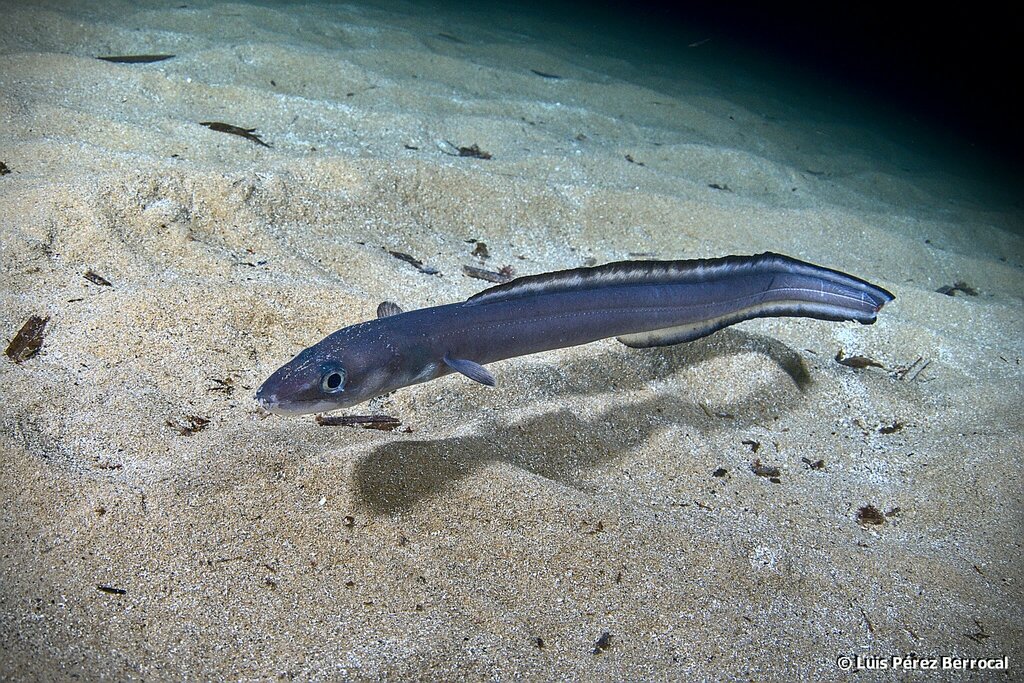
European Conger
Conger conger
The European conger (Conger conger) is a species of conger of the family Congridae. It is the heaviest eel in the world and native to the northeast Atlantic, including the Mediterranean Sea.
From the article European conger on Wikipedia (CC BY-SA), quoted section by section
Description
European congers have an average adult length of 1.5 m (5 ft), a maximum known length of around 3 m (9.8 ft) and maximum weight of roughly 72 kg (159 lb), but possibly up to 160 kg (350 lb), making them the largest eels in the world by weight. They can be rivaled or marginally exceeded in length by the largest species of moray eel but these tend to be slenderer and thus weigh less than the larger congers. Average specimens caught will weigh only 2.5 to 25 kg (5.5 to 55.1 lb). Females, with an average length at sexual maturity of 2 m (6 ft 7 in), are much larger than males, with an average length at sexual maturity of 1.2 m (3 ft 11 in). The body is very long, anguilliform, and is without scales. The colour is usually grey, but can also be blackish. The belly is white. A row of small white spots is aligned along the lateral line. The head is almost conical, and slightly depressed. The snout is rounded and prominent, with lateral olfactory holes. The large gill openings are in the lateral position. The conical teeth are arranged in rows on the jaws. The dorsal and anal fins are confluent with the caudal fin. Pectoral fins are present, while ventral fins are absent.
Conger eels have habits similar to moray eels. They usually live amongst rocks in holes, or "eel pits", sometimes in one hole together with moray eels. They come out from their holes at night to hunt. …
Wikipedia: “Description and behaviour”
Range & habitat
This species can be found in the eastern Atlantic from Norway and Iceland to Senegal, and also in the Mediterranean and Black Sea at 0–500 m (0–1,640 ft) of depth, although they may reach depths of 3,600 m (11,800 ft) during their migrations. It is sometimes seen in very shallow water by the shore, but can also go down to 1,170 m (3,840 ft). It is usually present on rough, rocky, broken ground, close to the coast when young, moving to deeper waters when adult.
Wikipedia: “Distribution”
What it does
When conger eels are between 5 and 15 years old, their bodies undergo a transformation, with the reproductive organs of both males and females increasing in size and the skeleton reducing in mass and the teeth falling out. Females appear to increase in weight and size more than the males. Conger eels then make migrations to spawning areas in the Mediterranean and the Atlantic, "although the existence of one or multiple spawning grounds for the species remains uncertain". The female conger eels produce several million eggs, and both the females and males die after spawning. Once hatched, the larval conger eels begin to swim back to shallower waters, where they live until they reach maturity. They then migrate to repeat the cycle.
Wikipedia: “Migration and reproduction”
Where it lives
Recorded sightings
—
geo-referenced records in GBIF, from museums, herbaria and field observers.
Drag the globe to turn it. Dots are where records exist, not a range map; darker means more records.
In the old herbals & bestiaries

In the stacks
Searching the stacks…
Every page naming Conger conger in the Biodiversity Heritage Library →
This page is assembled live from iNaturalist, GBIF, Wikipedia, the Source Library and the Internet Archive. It is not yet part of the hand-edited codex. iNaturalist taxon 118589.