- Animals
- ›Chordates
- ›Vertebrates
- ›Ray-finned Fishes
- ›Spiny-rayed fishes
- ›Pipefishes and Allies
- ›Goatfishes
- ›Goatfishes
- ›Parupeneus
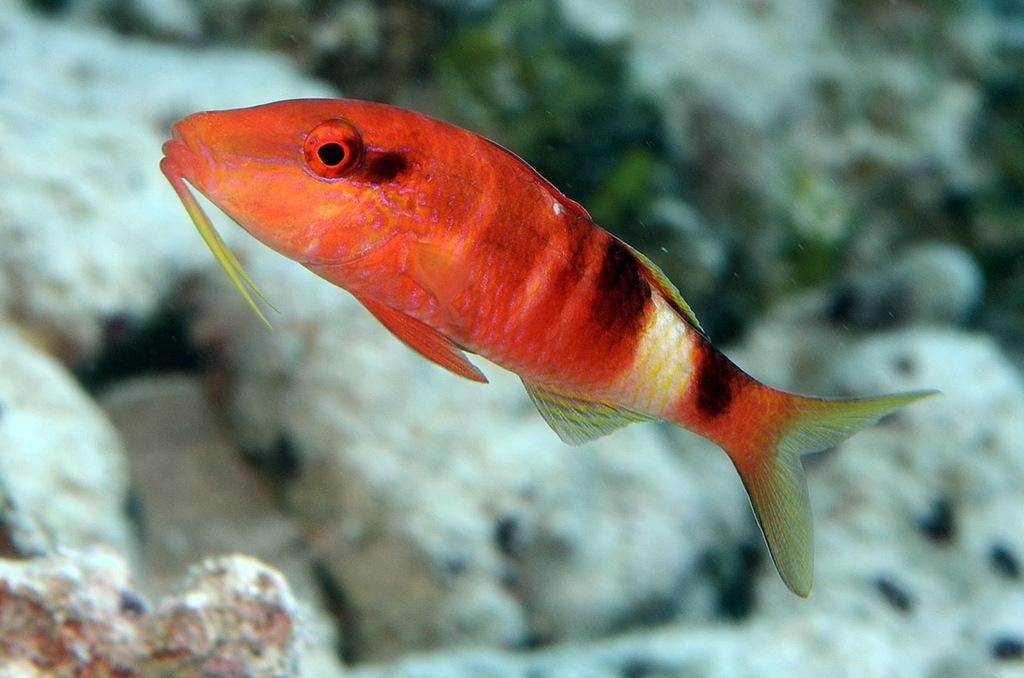
Manybar Goatfish
Parupeneus multifasciatus
Parupeneus multifasciatus, the manybar goatfish, is a species of goatfish native to the eastern Indian Ocean Pacific Ocean where it is found from Christmas Island to the Hawaiian Islands and from southern Japan to Lord Howe Island. It is an inhabitant of coral reefs and can be found at depths of from 3 to 161 metres (9.8 to 528.2 ft). Males of this species can reach a length of 35 centimetres (14 in) TL while females only reach...
From the article Parupeneus multifasciatus on Wikipedia (CC BY-SA), quoted section by section
Description
A recognizable feature of the goatfish is their chin whiskers. Some common features are yellow or blue accents on the edges of scales, dark spots around the eyes, dark spots around the base of the pectoral fin, and white and dark bars. Some common color variations include: red with black spots; light red with no spots; black with yellow spot near the tail; and purple-red with yellow and black spots. Males of this species can reach a length of 35 centimetres (14 in) TL while females only reach 17.9 centimetres (7.0 in) SL. Their reproductive size is 7 inch (17.8 cm). The heaviest recorded moano was 453 g (0.9987 lb). The life history of the moano has a pelagic larval duration of 24 – 28 days in captivity.
What it does
Moano are common reef fish found in shallow water environments, reef flats, and outside reefs. They spend a lot of their time in the benthic zone. They can be found at depths 0 – 161 m deep (0 – 528 ft). They are endemic in three regions: Hawaiʻi, Marquesas, and the Indo-Polynesian Province.
Wikipedia: “Ecology”
At the table
Moano are game fish that can be eaten raw, broiled, or baked. This is a commercially important species, and can be found in the aquarium trade.
Wikipedia: “Human uses”
Where it lives
Recorded sightings
—
geo-referenced records in GBIF, from museums, herbaria and field observers.
Drag the globe to turn it. Dots are where records exist, not a range map; darker means more records.
In the stacks
Searching the stacks…
Every page naming Parupeneus multifasciatus in the Biodiversity Heritage Library →
This page is assembled live from iNaturalist, GBIF, Wikipedia, the Source Library and the Internet Archive. It is not yet part of the hand-edited codex. iNaturalist taxon 131234.