- Animals
- ›Chordates
- ›Vertebrates
- ›Ray-finned Fishes
- ›Spiny-rayed fishes
- ›Butterflyfishes, Angelfishes, and Allies
- ›Angelfishes
- ›Centropyge
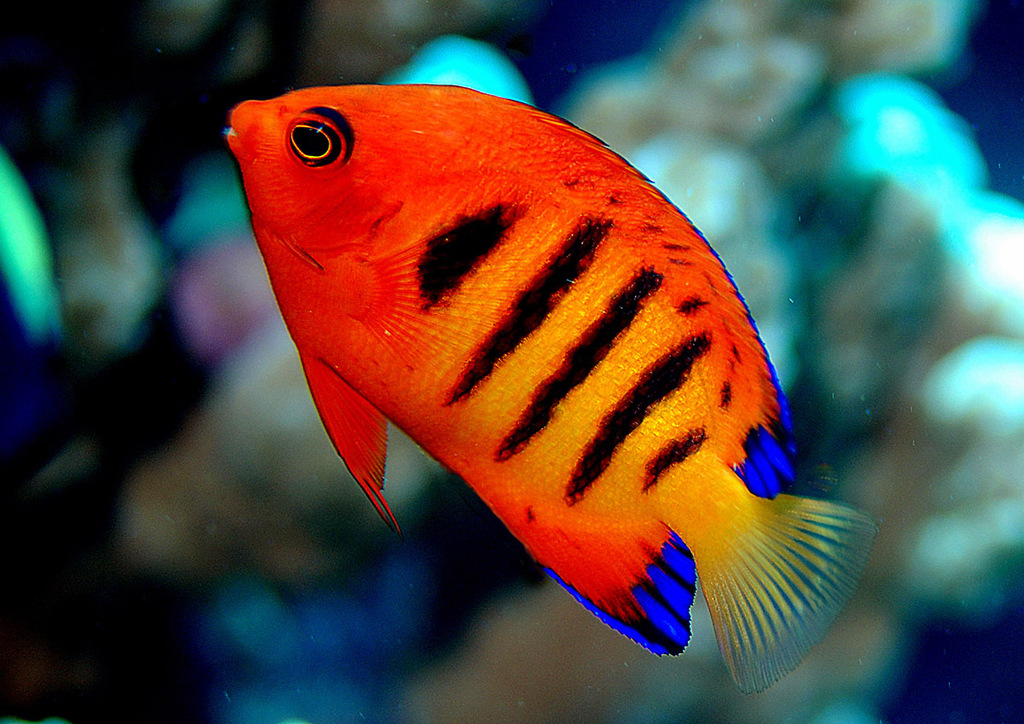
Flame Angelfish
Centropyge loriculus
The flame angelfish (Centropyge loriculus) is a marine angelfish of the family Pomacanthidae found in tropical waters of the Pacific Ocean. Other common names include flame angel, flaming angelfish, and Japanese pygmy angelfish.
From the article Flame angelfish on Wikipedia (CC BY-SA), quoted section by section
Description
The flame angelfish's coloration is bright orange-red with a vertical elongated black spot and four or five bars on the sides, the posterior part of the dorsal, and anal fins, with alternating short purple-blue and black bands. Specimens from the Marquesas lack the vertical black bars. Males are generally larger and slightly more colored than females. The life span of the flame angelfish is 5–7 years or more.
Range & habitat
It is found in various reefs of Oceania, most common in Marshall, Line and Cook Islands. The fish is also less commonly found in the Hawaiian Islands. Particularly, the flame angelfish can be found on the foreslope of coral reefs and clear lagoons.
Wikipedia: “Distribution”
What it does
In the wild, the flame angelfish has a varied diet consisting of algae and crustaceans. There are occasional specimens that live very long lives in reef aquaria, but the majority of these fish will often die for no apparent reason when they are older. This may be easily explained as many of the Centropyge family are predominantly plankton eaters as juveniles and will switch to consuming its natural adult diet once fully grown. Sometimes, all it takes is for an underfed individual to "test" a food source. This being the case, angelfish are usually added to a well established tank and fed frozen mysis shrimp or meaty crustaceans such as shrimp and clam.
Wikipedia: “Diet”
Where it lives
Recorded sightings
—
geo-referenced records in GBIF, from museums, herbaria and field observers.
Drag the globe to turn it. Dots are where records exist, not a range map; darker means more records.
In the stacks
Searching the stacks…
Every page naming Centropyge loriculus in the Biodiversity Heritage Library →
This page is assembled live from iNaturalist, GBIF, Wikipedia, the Source Library and the Internet Archive. It is not yet part of the hand-edited codex. iNaturalist taxon 358414.