- Animals
- ›Chordates
- ›Vertebrates
- ›Ray-finned Fishes
- ›Spiny-rayed fishes
- ›Butterflyfishes, Angelfishes, and Allies
- ›Angelfishes
- ›Centropyge
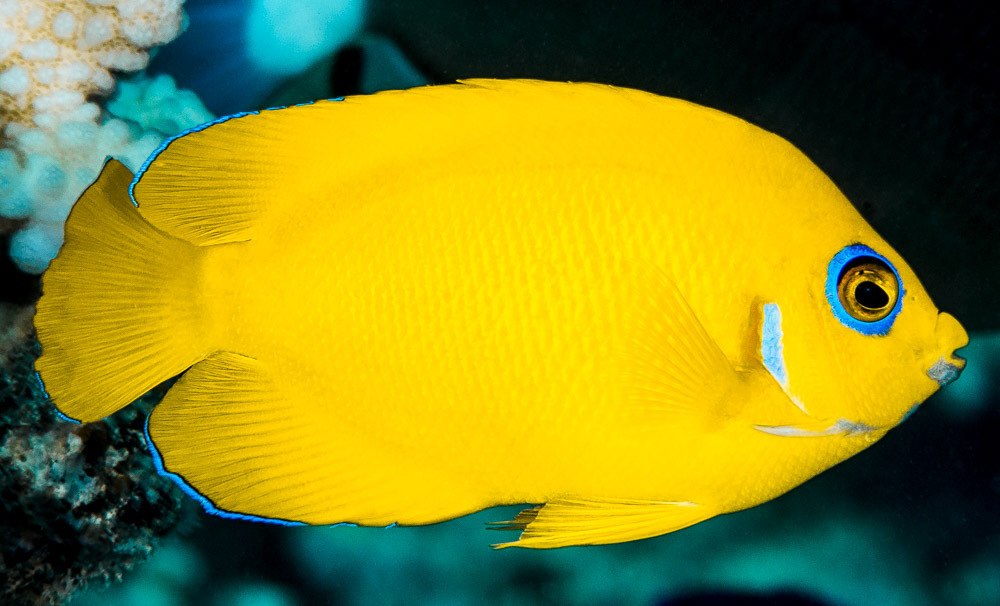
Lemonpeel Angelfish
Centropyge flavissima
The lemonpeel angelfish (Centropyge flavissima) is an omnivorous marine angelfish. Its body is a distinctive bright yellow in colour, with a blue or white circle around the eyes and blue behind the operculum. Juveniles have a blue ring on each side. It is native to the Indo-Pacific region, where it lives in lagoons and reefs and eats marine algae.
From the article Lemonpeel angelfish on Wikipedia (CC BY-SA), quoted section by section
Description
The lemonpeel angelfish is bright yellow in colour with a bluish or whitish ring surrounding the eye. There is a black blotch on the rear margin of the gill cover. The spine on the preoperculum is blue, and the dorsal, anal and caudal fins have blue margins. Juveniles have an ocellus on the flank that is black with blue edges. The dorsal fin contains 14 spines and 15-16 soft rays, while the anal fin has 3 spines and 16 soft rays. This species attains a maximum total length of 14 centimetres (5.5 in).
Range & habitat
The lemonpeel angelfish is found in the Indo-Pacific; the core of its distribution is in the Central Pacific from the Ryukyu Islands and Ogasawara Islands of Southern Japan in the north, east to the Tuamotu Islands and south to Australia. It also occurs around some Indian Ocean islands. In Australia, it occurs from the northern Great Barrier Reef south to Moreton Bay in Queensland and the Solitary Islands in New South Wales. In addition, it is found off Lord Howe Island in the Tasman Sea and the Australian Indian Ocean territories of Christmas Island and Cocos (Keeling) Islands. Sightings in parts of the western Pacific Ocean likely represent vagrants rather than established populations. It is absent from Hawaii and Johnston Atoll.
Wikipedia: “Distribution”
Where it lives
Recorded sightings
—
geo-referenced records in GBIF, from museums, herbaria and field observers.
Drag the globe to turn it. Dots are where records exist, not a range map; darker means more records.
In the stacks
Searching the stacks…
Every page naming Centropyge flavissima in the Biodiversity Heritage Library →
This page is assembled live from iNaturalist, GBIF, Wikipedia, the Source Library and the Internet Archive. It is not yet part of the hand-edited codex. iNaturalist taxon 96948.