- Animals
- ›Chordates
- ›Vertebrates
- ›Ray-finned Fishes
- ›Spiny-rayed fishes
- ›Perches, Scorpionfishes, Sticklebacks, and Allies
- ›Perches, groupers and allies
- ›Sea Basses
- ›Hypoplectrus
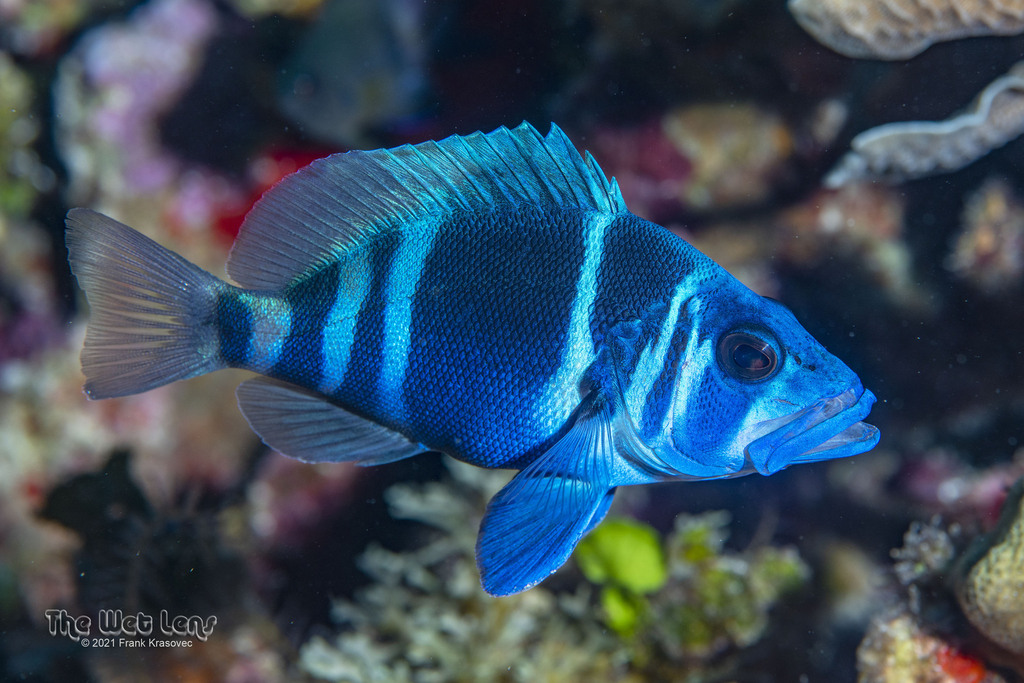
Indigo Hamlet
Hypoplectrus indigo
Hypoplectrus indigo, the indigo hamlet, is a species of marine ray-finned fish, a sea bass from the family Serranidae. It is found in the central western Atlantic Ocean. It occasionally makes its way into the aquarium trade.
From the article Hypoplectrus indigo on Wikipedia (CC BY-SA), quoted section by section
Description
Hypoplectrus indigo has a deep body and head which is highly laterally compressed with a straight forehead and a rather short snout and a protrusible upper jaw. It has an angular preoperculum which has serrations on its edge and a number of small forward pointing spines on its lower margin close to the angle. The continuous dorsal fin has ten spines and 14-17 soft rays. It has long pelvic fins which extend as far as or beyond the anus. The caudal fin is slightly forked. The body and fins are dark blue and there is a pattern of seven dark blue-black vertical bars on the head and body. The details of the patterning and intensity of the blue background colour on the body and fins shows individual variation with some fish having barrow black stripes running along the upper and lower margins of the caudal fin. This species attains a maximum recorded total length of 14.3 centimetres (5.6 in).
Range & habitat
Hypoplectrus indigo is found in the western Atlantic. Its ranges extends from the Bahamas in the north through the Gulf of Mexico along the Florida Keys and from Tuxpan in Mexico and the northern Yucatan Peninsula to northwestern Cuba. In the Caribbean Sea it has been recorded throughout the Antilles as far south as Tobago. It also occurs along the mainland coasts of Central and South America from Mexico to Mamitupo in Panama and among the offshore islands of Venezuela.
Wikipedia: “Distribution”
Where it lives
Recorded sightings
—
geo-referenced records in GBIF, from museums, herbaria and field observers.
Drag the globe to turn it. Dots are where records exist, not a range map; darker means more records.
In the stacks
Searching the stacks…
Every page naming Hypoplectrus indigo in the Biodiversity Heritage Library →
This page is assembled live from iNaturalist, GBIF, Wikipedia, the Source Library and the Internet Archive. It is not yet part of the hand-edited codex. iNaturalist taxon 180709.