- Animals
- ›Chordates
- ›Vertebrates
- ›Ray-finned Fishes
- ›Spiny-rayed fishes
- ›Wrasses and allies
- ›False scorpionfishes, wrasses, and parrotfishes
- ›Wrasses and Parrotfishes
- ›North Atlantic wrasses
- ›Labrus
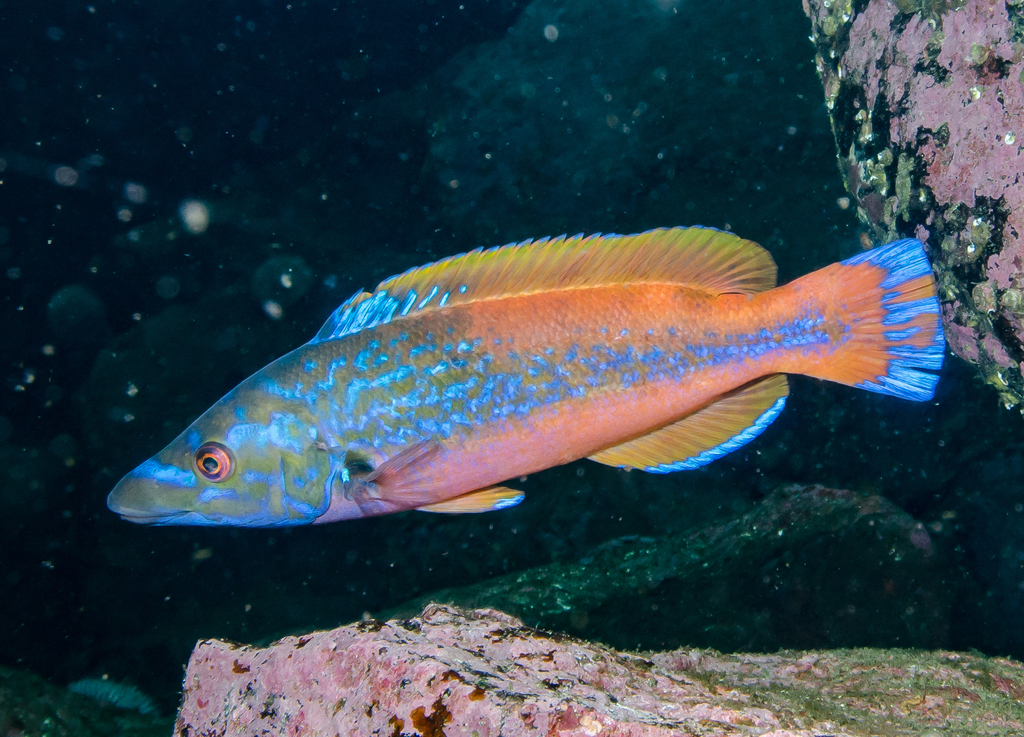
Cuckoo Wrasse
Labrus mixtus
The cuckoo wrasse (Labrus mixtus) is a species of wrasse native to the eastern Atlantic Ocean from Norway to Senegal, including the Azores and Madeira. It is also found in the Mediterranean Sea. They can be found amongst the algae on rocky shores at depths from 2 to 200 m (6.6 to 656.2 ft), though mostly between 40 and 80 m (130 and 260 ft). This species is an important food fish for local populations and is also popular as...
From the article Cuckoo wrasse on Wikipedia (CC BY-SA), quoted section by section
Description
The cuckoo wrasse has a long, pointed head, its body is slimmer and more elongated in shape than the ballan wrasse (Labrus bergylta), with which it is sympatric in the north eastern Atlantic. It is a very colourful fish which shows clear sexual dimorphism. The young males and the females are coloured with a mix of pink, orange and red. The females possess three black spots on their back to the rear of the dorsal fin, with white colouration between then which stretch to the tail which are not present on males. The males have blue heads and orange bodies, blue stripes and mottled patterns run along the body and there are blue lines on the margins of the fins. Like the ballan wrasse, the cuckoo wrasse has a small mouth with thick fleshy, folded lips and a single row of canine-like teeth in each jaw. The maximum total length for a male is 40 centimetres (16 in) and for females it is 30 centimetres (12 in), although the common total length for males is 30 centimetres (12 in). The long dorsal fin is even in height along its length and this species has large scales which are bigger than the pupil of the eye.
Range & habitat
The cuckoo wrasse occurs in the north east Atlantic Ocean along the coast of Europe from Norway south to Andalusia and along the Atlantic coast of north Africa south to Senegal. It occurs off the Canary Islands, the Azores and Madeira too. Its range extends into the Mediterranean Sea as far as Cyprus, where it is common, but it is absent from the Levantine Sea.
Wikipedia: “Distribution”
In human culture
The name cuckoo wrasse comes from Cornish fishermen who associated the blue markings with bluebell flowers. In the Cornish language, a bluebell is bleujenn an gog, literally "the cuckoo flower".
Wikipedia: “Etymology”
Where it lives
Recorded sightings
—
geo-referenced records in GBIF, from museums, herbaria and field observers.
Drag the globe to turn it. Dots are where records exist, not a range map; darker means more records.
In the stacks
Searching the stacks…
Every page naming Labrus mixtus in the Biodiversity Heritage Library →
This page is assembled live from iNaturalist, GBIF, Wikipedia, the Source Library and the Internet Archive. It is not yet part of the hand-edited codex. iNaturalist taxon 103913.