- Animals
- ›Chordates
- ›Vertebrates
- ›Ray-finned Fishes
- ›Spiny-rayed fishes
- ›Wrasses and allies
- ›False scorpionfishes, wrasses, and parrotfishes
- ›Wrasses and Parrotfishes
- ›North Atlantic wrasses
- ›Labrus
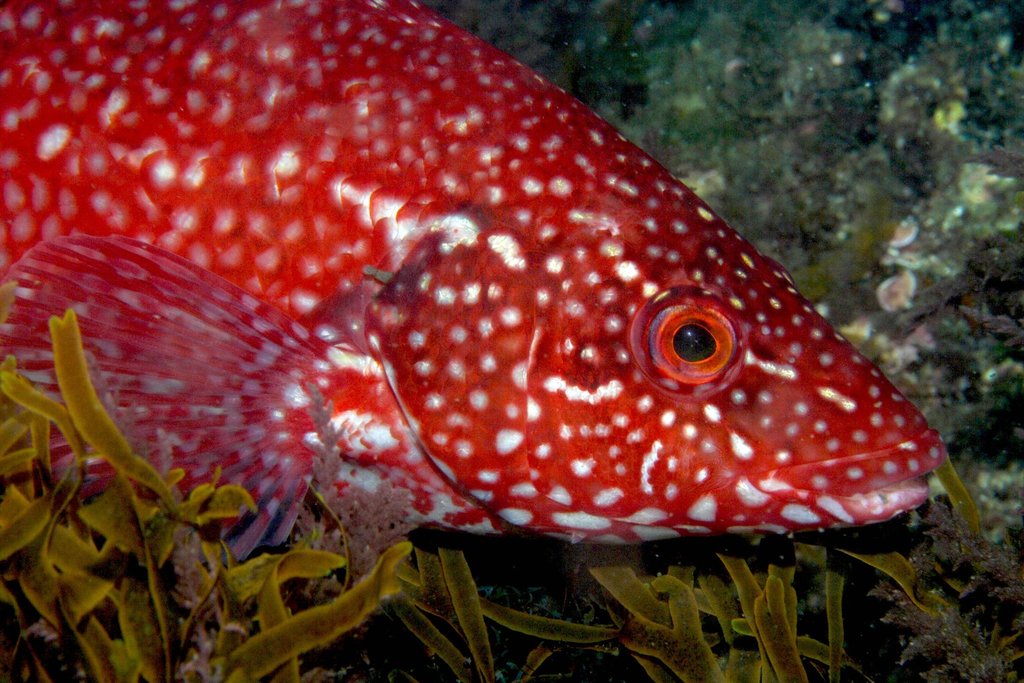
Ballan Wrasse
Labrus bergylta
The ballan wrasse (Labrus bergylta) is a species of marine ray-finned fish from the family Labridae, the wrasses. It is found in the eastern Atlantic Ocean, where it inhabits rocky areas. Like many wrasse species, it is a protogynous hermaphrodite—all fish start life as females, and some dominant fish later become males. It is used as a food fish in some areas and it is also finding use as a cleaner fish in the aquaculture of Atlantic salmon (Salmo salar) in northwestern Europe.
From the article Ballan wrasse on Wikipedia (CC BY-SA), quoted section by section
Description
The ballan wrasse is a large, heavy bodied wrasse with a relatively deep body and large head. It has a smallish mouth which is surrounded by thick, fleshy, rather wrinkled lips, and the jaws are armed with a single row of robust teeth which are sharp and pointed in young fish but blunter and more worn in older fish. It has a long dorsal fin which has 18–21 spines in its anterior portion and 9–13 branched rays in the rear part. The anal fin is markedly shorter and has three spines. It has large scales with 41–47 of them in the lateral line. The juvenile fish are coloured to match their habitat and vary in from light green to dark green, with some being described as bright emerald green. Adult Ballan wrasse are highly variable in colouration, but have two main colour forms, which exist in sympatry with each other. One is plain green or brown, and the other is reddish with white spots. This is not a result of sexual dimorphism, as males and females can both exhibit either colour form. Spotted Ballan wrasse grow larger than plain coloured individuals. The two colour forms are commercialized separately in places such as Galicia, where local fishermen often treat them as separate species. It can grow to 65.9 cm (25.9 in) in total length (though most do not exceed 50 cm (20 in) standard length), and the greatest recorded weight of this species is 4.4 kg (9.7 lb). …
Range & habitat
Ballan wrasse are native to the northeastern Atlantic Ocean from Norway to Morocco, including the islands of Madeira, the Azores and the Canary Islands. There are records from the Mediterranean Sea but these are regarded as questionable and may be misidentifications of the brown wrasse (Labrus merula).
Wikipedia: “Distribution”
In human culture
This fish is one of 5 key species used as cleaner fish to remove sea lice from Norwegian and Scottish farmed salmon, with 3,317,000 fish used in Atlantic salmon and rainbow trout sea pens in 2020 in Norway alone. Along with lumpfish, this species is farmed for this purpose as there were concerns regarding overharvest of wild populations. As with many farmed marine species, commercial larval rearing utilises live prey before transitioning to dry feeds after metamorphosis is complete. The majority of the industry currently uses enriched rotifers and Artemia, but copepod nauplii (Acartia tonsa) and barnacle nauplii (Semibalanus balanoides) are becoming more common as alternatives. This species can also be found in the aquarium trade.
Wikipedia: “Aquaculture”
Where it lives
Recorded sightings
—
geo-referenced records in GBIF, from museums, herbaria and field observers.
Drag the globe to turn it. Dots are where records exist, not a range map; darker means more records.
In the stacks
Searching the stacks…
Every page naming Labrus bergylta in the Biodiversity Heritage Library →
This page is assembled live from iNaturalist, GBIF, Wikipedia, the Source Library and the Internet Archive. It is not yet part of the hand-edited codex. iNaturalist taxon 103911.