- Animals
- ›Chordates
- ›Vertebrates
- ›Ray-finned Fishes
- ›Spiny-rayed fishes
- ›Wrasses and allies
- ›False scorpionfishes, wrasses, and parrotfishes
- ›Wrasses and Parrotfishes
- ›Hogfishes, Cales and Tuskfishes
- ›Lachnolaimus
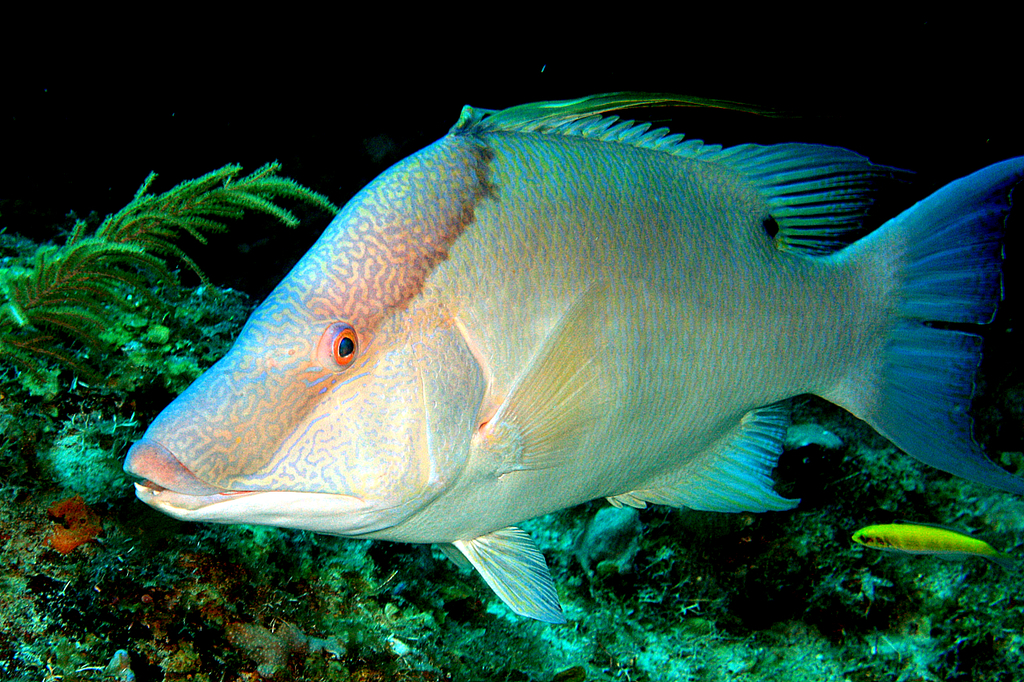
Hogfish
Lachnolaimus maximus
The hogfish (Lachnolaimus maximus), also known as boquinete, doncella de pluma, or pez perro in Mexico is a species of wrasse native to the western Atlantic Ocean, living in a range from Nova Scotia, Canada, to northern South America, including the Gulf of Mexico. This species occurs around reefs, especially preferring areas with plentiful gorgonians. It is a carnivore that feeds on molluscs, crabs, and sea urchins. This species is currently the only known member of its genus.
From the article Hogfish on Wikipedia (CC BY-SA), quoted section by section
Description
The hogfish possesses a very elongated snout, which it uses to search for crustaceans buried in the sediment. This very long "pig-like" snout and its rooting behavior give the hogfish its name. A prominent black spot behind the pectoral fins differentiates males from females. The dorsal fin usually is composed of three or four long dorsal spines followed by a series of shorter dorsal spines. Hogfish reach a maximum of 90 cm (35 in) in total length and a weight around 11 kg (24 lb). Females and juveniles usually start out as pale gray, brown, or reddish-brown in color, with a paler underside and no distinct patterns. Males are distinguished by a deep, dark band spanning from the snout to the first dorsal spine, and by a lateral black spot behind the pectoral fins. Hogfish also have a form of active camouflage with the assist of dermal photoreception, a sensory capability allowing them to detect light through their skin. Specialized cells containing opsins, located beneath chromatophores, enable hogfish to perceive changes in ambient light.
Where it lives
Recorded sightings
—
geo-referenced records in GBIF, from museums, herbaria and field observers.
Drag the globe to turn it. Dots are where records exist, not a range map; darker means more records.
In the stacks
Searching the stacks…
Every page naming Lachnolaimus maximus in the Biodiversity Heritage Library →
This page is assembled live from iNaturalist, GBIF, Wikipedia, the Source Library and the Internet Archive. It is not yet part of the hand-edited codex. iNaturalist taxon 49432.