- Animals
- ›Chordates
- ›Vertebrates
- ›Ray-finned Fishes
- ›Spiny-rayed fishes
- ›Perches, Scorpionfishes, Sticklebacks, and Allies
- ›Perches, groupers and allies
- ›Perches, Darters, and allies
- ›Darters
- ›Etheostoma
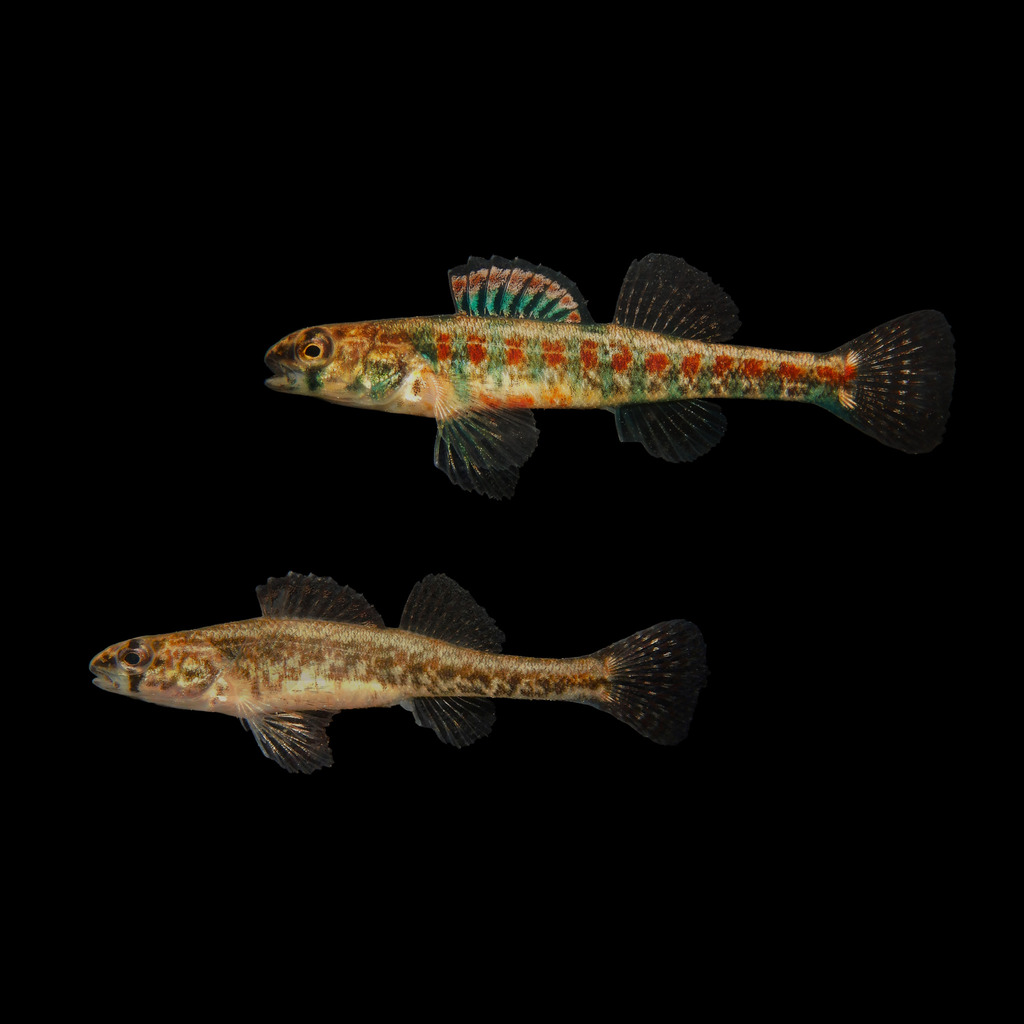
Iowa Darter
Etheostoma exile
Etheostoma exile, the Iowa darter, is a species of freshwater ray-finned fish, a darter from the subfamily Etheostomatinae, part of the family Percidae, which also contains the perches, ruffes and pikeperches. It is native to the lakes and streams of Iowa, along with about 17 other species of darters.
In some parts of its range, the Iowa darter is also known as the weed darter, red-sided darter, or yellowbelly. Iowa darters, like many other darters, are about 2–3 in (51–76 mm) in length and may be easily confused with other darters of similar color.
From the article Etheostoma exile on Wikipedia (CC BY-SA), quoted section by section
Description
The Iowa darter has a very slim, small body. Its common length is around 5.5 cm and its maximum age is three years. It has a small mouth and snout with scaled opercles and cheeks, two dorsal fins, one which is a spinous-rayed fin and another soft-rayed fin. Its caudal fin is squarish and the pectoral fins and pelvic fins are located close to each other behind the gills. It has an anal fin with two (rarely one) spines and an incomplete lateral line. The male and female Iowa darters have different color patterns. During breeding, males are olivaceous dorsally with darker splotches across the top of their backs. Their sides are red with blue rectangular blotches and ventrally they are whitish with a dark wedge shape below the eyes. The bottom half of the spiny dorsal fin has blue spots between the spines and above the spots is a succession of three bands, orange on the bottom, clear in the middle, and then blue on the outside. Females are olive-brown dorsally with darker splotches across the top of their backs. Their sides are mottled and fade into a silver-white on their bellies. They also have a dark wedge shape below the eyes that is well developed.
Range & habitat
Native distribution of the Iowa darter extends north to central Canada, east to New York, and south to central Illinois, and the species is particularly common in the western Great Lakes drainages and Iowa. Western populations are distributed patchily in Colorado, Wyoming, Montana, and Alberta. They are native in Colorado only in the South Platte River drainage, but recent research has also placed them in the Yampa River (Colorado) and the Green River.
Wikipedia: “Range”
What it does
The Iowa darter eats copepods, water fleas, and midge and mayfly larvae it finds in underwater vegetation. It has never been found in the stomach of any fish-eating animal because it is too quick to catch.
Wikipedia: “Diet”
In human culture
The genus name, Etheostoma, is from the Greek etheo meaning strain or filter and stoma meaning mouth. The species name, exile, also Greek, means slim or slender.
== References ==
Wikipedia: “Etymology”
Where it lives
Recorded sightings
—
geo-referenced records in GBIF, from museums, herbaria and field observers.
Drag the globe to turn it. Dots are where records exist, not a range map; darker means more records.
In the stacks
Searching the stacks…
Every page naming Etheostoma exile in the Biodiversity Heritage Library →
This page is assembled live from iNaturalist, GBIF, Wikipedia, the Source Library and the Internet Archive. It is not yet part of the hand-edited codex. iNaturalist taxon 58631.