- Animals
- ›Chordates
- ›Vertebrates
- ›Ray-finned Fishes
- ›Spiny-rayed fishes
- ›Perches, Scorpionfishes, Sticklebacks, and Allies
- ›Perches, groupers and allies
- ›Perches, Darters, and allies
- ›Darters
- ›Etheostoma
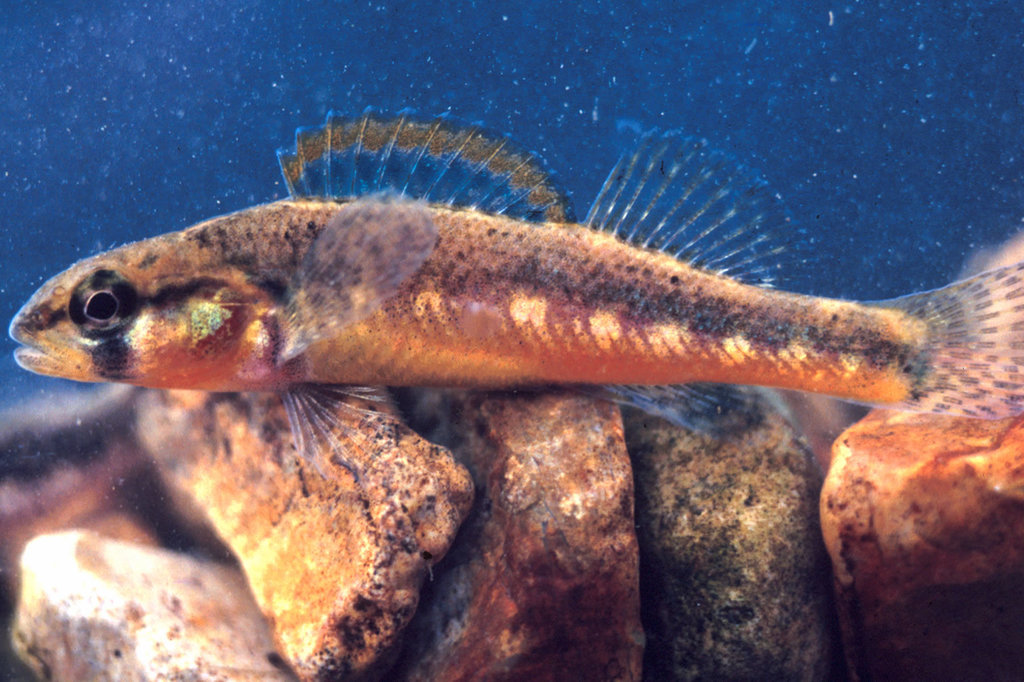
Slackwater Darter
Etheostoma boschungi
The slackwater darter (Etheostoma boschungi) is a small species of the freshwater ray-finned fish and a darter from the subfamily Etheostomatinae, part of the family Percidae, which also contains the perches, ruffes and pikeperches. Some authors consider it to be a member of the stippled darter group. The slackwater darter has a conspicuous dark subocular bar and three prominent saddles. It is rather drab in color, with the dorsum being dusky, olivaceous, or brownish. The lateral blotches are dark brown to blue-black. The venter is slightly dusky and may have some orange and yellow pigments, which are more intense in males than in females. Maximum size is about 55 millimetres (2.2 in) standard length.
From the article Slackwater darter on Wikipedia (CC BY-SA), quoted section by section
Range & habitat
The geographic range of the slackwater darter is five tributaries to the southern bend of the Tennessee River in northern Alabama and southwestern Tennessee. The species is known from one locality in the headwaters of the Buffalo River in Lawrence County, Tennessee, nineteen localities in the Cypress Creek drainage in Wayne County, Tennessee and Lauderdale County, Alabama, three localities in Swan Creek, Limestone County, Alabama, and three localities in the Flint River drainage in Madison County, Alabama. Moreover, one specimen was found in Shoal Creek, Lawrence County, Tennessee. Nothing is known of this darter's past distribution and abundance. Periodic sampling in the headwaters of the Buffalo River in Lawrence County has indicated its population of slackwater darters is extremely small and limited. In this area, the species is confined to a short segment of a very small stream, and the number of individuals is apparently quite low. The population in the Flint River drainage in Madison County, Alabama, is similarly small and limited. The largest population and the stronghold of the species is in the Cypress Creek drainage system, Wayne County, Tennessee, and Lauderdale County, Alabama.
Wikipedia: “Range and population”
What it does
The reproductive behavior of the slackwater darter varies with the temperature of the breeding habitat and the amount of rainfall. Spawning has not been recorded in water less than 14 °C (57 °F). In addition, heavy rainfall must cause enough flooding to lift the darters into the breeding area. Usually, adult darters begin their migration to the breeding area in mid-January. They reach the breeding habitat in February and begin spawning in March. By April, the darter progeny is developing and ready to leave the breeding area in May. Young darters double in size between April and June. Evidence suggests the slackwater darter is a short-lived species with a lifespan of only three years.
Wikipedia: “Reproduction”
Where it lives
Recorded sightings
—
geo-referenced records in GBIF, from museums, herbaria and field observers.
Drag the globe to turn it. Dots are where records exist, not a range map; darker means more records.
In the stacks
Searching the stacks…
Every page naming Etheostoma boschungi in the Biodiversity Heritage Library →
This page is assembled live from iNaturalist, GBIF, Wikipedia, the Source Library and the Internet Archive. It is not yet part of the hand-edited codex. iNaturalist taxon 100449.