- Animals
- ›Chordates
- ›Vertebrates
- ›Ray-finned Fishes
- ›Spiny-rayed fishes
- ›Perches, Scorpionfishes, Sticklebacks, and Allies
- ›Perches, groupers and allies
- ›Perches, Darters, and allies
- ›Darters
- ›Etheostoma
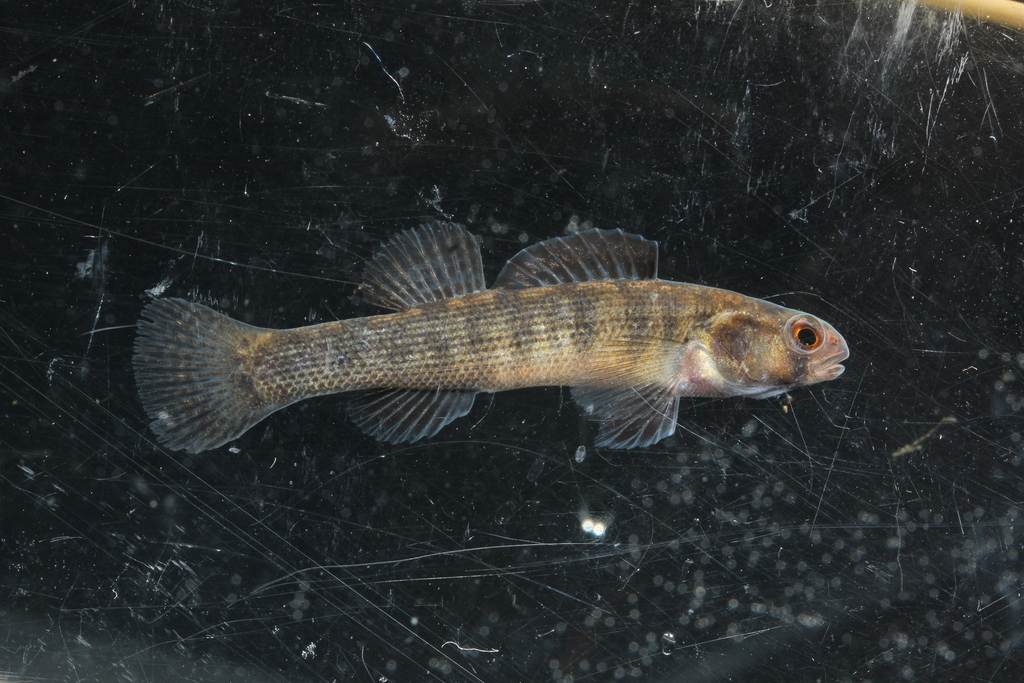
Goldstripe Darter
Etheostoma parvipinne
The goldstripe darter (Etheostoma parvipinne) is a species of freshwater ray-finned fish, a darter from the subfamily Etheostomatinae, part of the family Percidae, which also contains the perches, ruffes and pikeperches. It is endemic to the southeastern United States where it is found in Gulf Slope streams from the Colorado River drainage in Texas to the Flint River in Georgia, the Atlantic Slope in Ocmulgee River system, Georgia, and the Mississippi embayment north as far as southeastern Missouri and western Kentucky. It is typically found in small springs, streams, and creeks with aquatic and marginal vegetation and detritus. The female spawns on multiple occasions between about mid-March and June, sticking the adhesive eggs to plants, gravel and the sides of rocks. The goldstripe darter is a common species with a wide range and numerous sub-populations, and the International Union for Conservation of Nature has assessed its conservation status as being of "least concern".
From the article Goldstripe darter on Wikipedia (CC BY-SA), quoted section by section
Range & habitat
The goldstripe darter inhabits the Gulf Coastal Plain, including parts of Alabama, Mississippi, Tennessee, Kentucky, Arkansas, Louisiana, and Oklahoma, and lower Mississippi drainages westward as far as the Colorado River Basin in Texas. Most recently, goldstripe darters have been confirmed in these drainages:
Savannah River Ogeechee-Altamaha River (including drainages from south of the Savannah River to and including the Altamaha River) Apalachicola Basin (including the Chipola, Chattahoochee, Flint, and Apalachicola Rivers) St. Andrew-Choctawhatchee-Pensacola Bays Coosa-Tallapoosa River Alabama-Cahaba River Tombigbee-Black Warrior River Pascagoula-Biloxi-Bay St. Louis Pearl River Lake Pontchartrain Minor Mississippi Tributaries South Black-Yazoo River Minor Mississippi Tributaries North Lower Tennessee River St. Francis River White River Ouachita River Red River Sabine Lake Galveston Bay San Jacinto River Brazos River Colorado River Other than occasional passing mention, little historical records exist of goldstripe darter distribution, making it difficult to determine in what ways, if any, the distribution has changed over time. Populations are currently believed to be stable.
Wikipedia: “Distribution”
What it does
The goldstripe darter feeds on midge larvae, dipteran pupae, caddisfly larvae, dytiscid beetle larvae, and small crayfish.
Wikipedia: “Feeding”
Where it lives
Recorded sightings
—
geo-referenced records in GBIF, from museums, herbaria and field observers.
Drag the globe to turn it. Dots are where records exist, not a range map; darker means more records.
In the stacks
Searching the stacks…
Every page naming Etheostoma parvipinne in the Biodiversity Heritage Library →
This page is assembled live from iNaturalist, GBIF, Wikipedia, the Source Library and the Internet Archive. It is not yet part of the hand-edited codex. iNaturalist taxon 100519.