- Animals
- ›Chordates
- ›Vertebrates
- ›Ray-finned Fishes
- ›Spiny-rayed fishes
- ›Perches, Scorpionfishes, Sticklebacks, and Allies
- ›Perches, groupers and allies
- ›Perches, Darters, and allies
- ›Darters
- ›Etheostoma
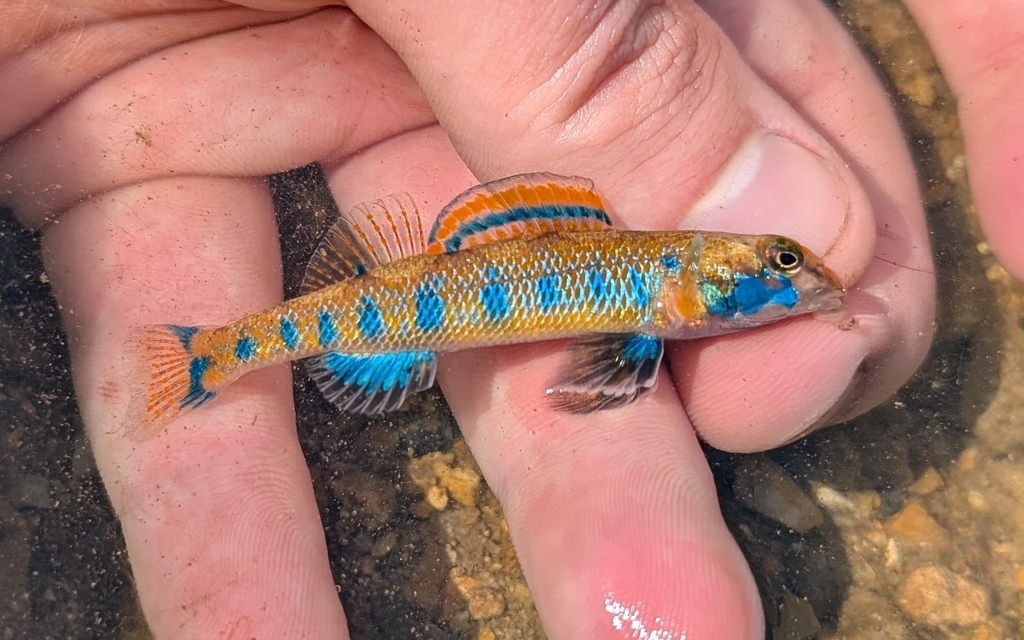
Blueside Darter
Etheostoma jessiae
The blueside darter (Etheostoma jessiae) is usually found in the Tennessee River drainage in Tennessee, Alabama, North Carolina, and Virginia, and less commonly found in Bear Creek, Shoal Creek, and Barren Fork.
From the article Blueside darter on Wikipedia (CC BY-SA), quoted section by section
Range & habitat
The range of the blueside darter is maintained in the Southeastern portion of North America. The blueside darter inhabits most of the middle and upper Tennessee River drainage in Tennessee, Alabama, Georgia, North Carolina, Virginia, and Mississippi. It has also been reported in scattered collections in Bear, Barren Fork, Second, and Shoal creek systems, which are all tributaries of the Tennessee River. The extent of the occurrence is approximately 20,000 square kilometres (7,700 sq mi).
Wikipedia: “Geographic Distribution”
What it does
The blueside darter thrives in benthopelagic freshwater systems. Their preferred habitat is in rocky pools and adjacent riffles of clear creeks and small fast rivers with sand and gravel substrate and moderate gradient, and commonly in slow to moderate flow, in shallow margins of pools and runs, as well as in streams characterized in general by moderate to swift flows. The differences in substrate are dependent upon depth and movement of water so it is difficult to determine whether substrate or water flow is a defining characteristic in habitat choice. A study completed by Schilling in 2009 conveyed that blueside darters seemed to maintain a fairly shallow depth in the water column with a maximum depth of 60 cm (24 in). Due to the seasonal variations in the regions where blueside darters occur, temperatures vary depending on the time of year and do not limit micro-habitat selection. The Schilling experiment also indicated that the blueside darter did show tolerance to conductivity changes with an average pH for micro-sites being slightly basic which is indicative to limestone rock substrate. Populations have been relatively stable in most areas where the blueside occurs however, in a few areas scientists have noted a downward trend in population sizes. Anthropogenic factors that may be to blame for this decline are water pollution, run-off from agriculture, and siltation.
Wikipedia: “Ecology”
In human culture
The specific name jessiae refers to Jessie Brayton, wife of the junior author of the species.
Wikipedia: “Etymology”
Where it lives
Recorded sightings
—
geo-referenced records in GBIF, from museums, herbaria and field observers.
Drag the globe to turn it. Dots are where records exist, not a range map; darker means more records.
In the stacks
Searching the stacks…
Every page naming Etheostoma jessiae in the Biodiversity Heritage Library →
This page is assembled live from iNaturalist, GBIF, Wikipedia, the Source Library and the Internet Archive. It is not yet part of the hand-edited codex. iNaturalist taxon 100489.