- Animals
- ›Chordates
- ›Vertebrates
- ›Ray-finned Fishes
- ›Spiny-rayed fishes
- ›Perches, Scorpionfishes, Sticklebacks, and Allies
- ›Perches, groupers and allies
- ›Perches, Darters, and allies
- ›Darters
- ›Etheostoma
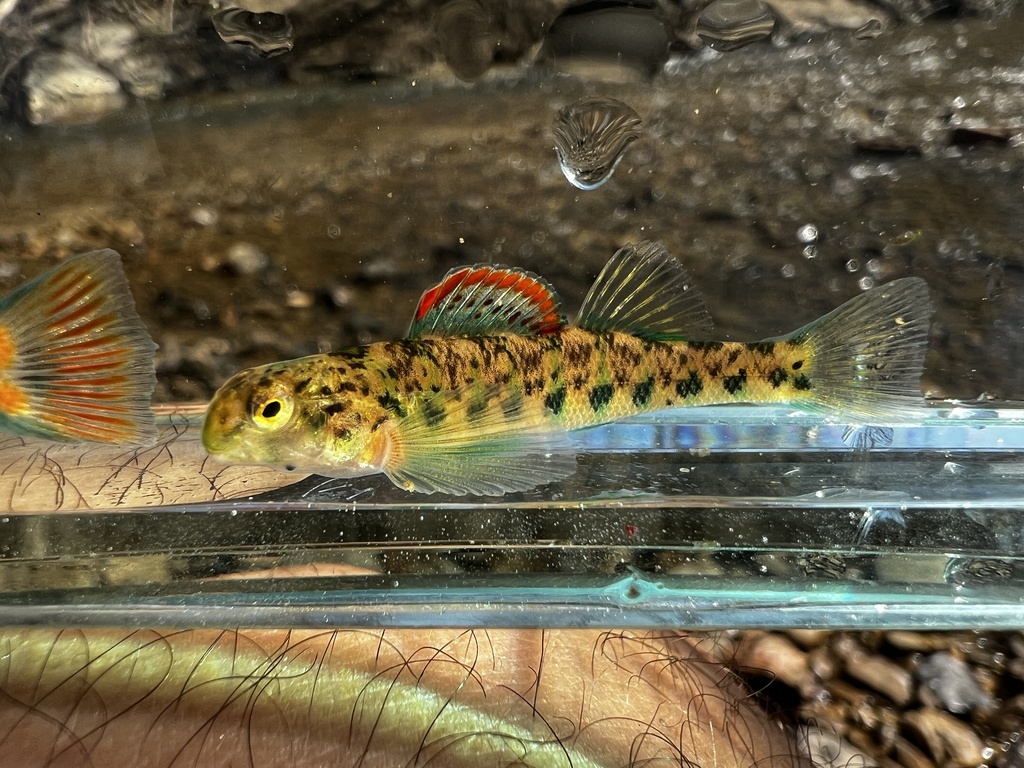
Emerald Darter
Etheostoma baileyi
The emerald darter (Etheostoma baileyi), a fish species in the family Percidae found only in northern and eastern Kentucky and northeastern Tennessee. E. baileyi is a member of the snubnose darter subgenus (Ulocentra) and shares many similarities with other species in the group, such as eight or nine dorsal saddles, a blunt nose, scales on the belly, and other distinguishing characteristics. Emerald darters are moderate-sized darters, ranging from 2.9 to 5.0 cm. Males are generally slightly larger...
From the article Emerald darter on Wikipedia (CC BY-SA), quoted section by section
Description
The emerald darter males are generally slightly larger and are more dramatically colored than females, with green accents on various parts of their bodies. Emerald darters can be found in rocky pools of small to medium creeks and rivers that maintain temperatures ranging from 0 to 25 °C (32 to 77 °F).
Range & habitat
The emerald darter is restricted to the Cumberland Plateau, including only the upper Cumberland River drainages in eastern Kentucky and northeastern Tennessee. Rivers where emerald darters can be found include the Red River, Jacks Creek, Indian Creek in Kentucky, and Clear Creek, Elk Creek, Poor Creek, and other small water systems. Though populations have fluctuated through the years, the emerald darter's geographic range has stayed the same, and in some areas they can even be found in abundance. Populations may have experienced declines in the past due to strip-mining and siltation in the gravel substrates in which it spawns.
Wikipedia: “Distribution”
What it does
Emerald darters compete heavily with other benthic freshwater fish in the southeastern United States. They are known as opportunistic feeders, relying on food and prey availability which fluctuates drastically throughout seasonal changes. Emerald darters are primarily insectivorous, and depending on size class, 80% to 100% of their diets can consist of small invertebrates. Emerald darters can be found in a variety of clear freshwater habitats with moderately low siltation. The fish can generally be found in water that ranges from 8 to 45 cm (3.1 to 17.7 in) in depth, though they are known to retreat to deeper, rock-lined pools during colder months and when floods alter current velocity. Emerald darters inhabit waters that range from 0 to 25 °C (32 to 77 °F), and can be found in riffles and runways up to 0.61 m/s (2.0 ft/s) flow velocity. As suggested by the emerald darter's subterminal mouth, they are benthic feeders, primarily consuming small invertebrates such as microcrustaceans, various types of larvae, and nematodes. Emerald darters tend to feed during the day, and their diets largely depend on the time of year, as prey availability changes due to season. They prefer streams with open sunlight and dense vegetation. No predators of emerald darters are known, and their cryptic coloration may help to conceal them in riffles with brightly colored rocks.
Wikipedia: “Ecology”
In human culture
Emerald darters spawn in late April and early May. Though actual spawning has not been observed, attempts by males to mate include swimming from side to side over the female's back. Further, males have been observed in the wild trying to mount unresponsive females from behind or from the side. Emerald darter larvae usually measure 4.5 to 6 mm (0.18 to 0.24 in) in length and emerge from the egg with yolk sacs still attached. Water temperature has a direct correlation with juvenile development, with warmer water temperatures resulting in a faster development and smaller sizes. Warmer temperatures can have even more detrimental effects on populations. Warmer temperatures in the later weeks of the breeding season can cause females to reabsorb their eggs and become unreceptive. Spawning occurs in the center of riffles. Larger males place themselves in pools near the middle of these turbulent areas so they will have a higher probability of encountering more females, which tend to use these areas. Emerald darters prefer gravel substrates that lack silt. Eggs and sperm are released simultaneously through mutual vibration and are attached by the female directly onto the gravel substrate. Emerald darters generally average 36 offspring per year. Most captured emerald darters have been aged at up to three years old. …
Wikipedia: “Life history”
Where it lives
Recorded sightings
—
geo-referenced records in GBIF, from museums, herbaria and field observers.
Drag the globe to turn it. Dots are where records exist, not a range map; darker means more records.
In the stacks
Searching the stacks…
Every page naming Etheostoma baileyi in the Biodiversity Heritage Library →
This page is assembled live from iNaturalist, GBIF, Wikipedia, the Source Library and the Internet Archive. It is not yet part of the hand-edited codex. iNaturalist taxon 100440.