- Animals
- ›Chordates
- ›Vertebrates
- ›Ray-finned Fishes
- ›Spiny-rayed fishes
- ›Perches, Scorpionfishes, Sticklebacks, and Allies
- ›Perches, groupers and allies
- ›Perches, Darters, and allies
- ›Darters
- ›Percina
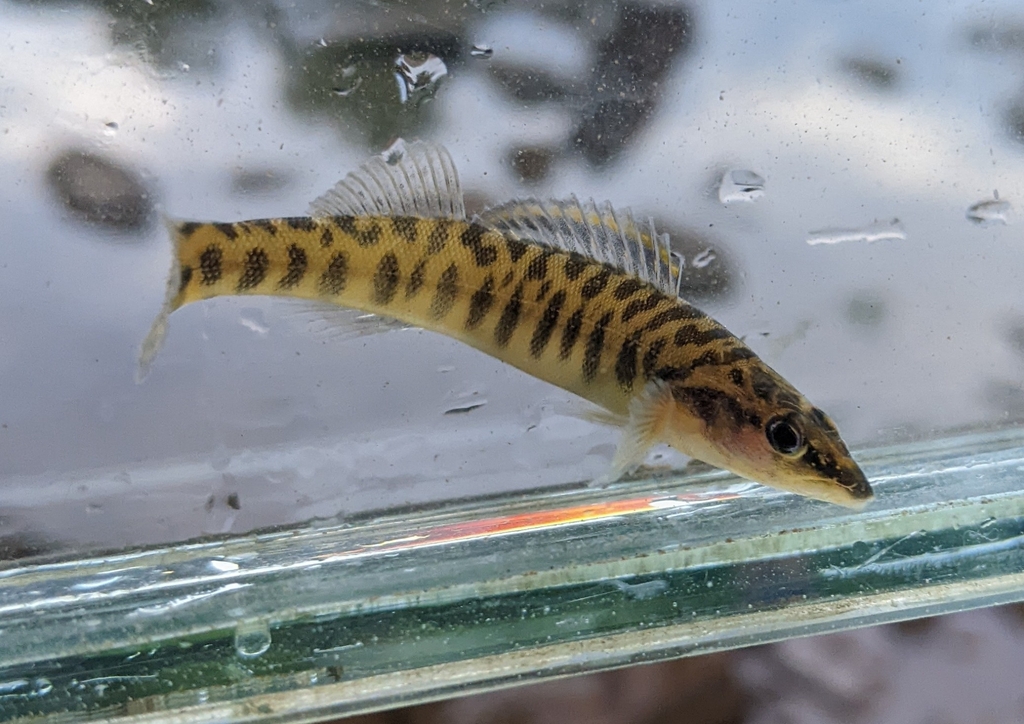
Longnose Darter
Percina nasuta
The longnose darter (Percina nasuta) is a species of freshwater ray-finned fish, a darter from the subfamily Etheostomatinae, part of the family Percidae, which also contains the perches, ruffes and pikeperches. It is endemic to the United States.
From the article Longnose darter on Wikipedia (CC BY-SA), quoted section by section
Description
The longnose darter is mostly yellow with a stripe of dark blotches down the lateral line. It has a bright yellow stripe on a mostly translucent first dorsal fin, and a block spot at the center of the base of the caudal fin. The rays of the second dorsal fin and the caudal fin are black and yellow striped like the color pattern along the lateral line. This fish can be characterized by a long, pointed snout that can be darker colored than the rest of its body and has been recorded to reach lengths of up to 11 cm.
Wikipedia: “Appearance & Autonomy”
Range & habitat
Longnose darters are known to occur in thirteen different streams in three river systems across the southern Missouri Ozarks and the Ouachita mountains in Arkansas and eastern Oklahoma. Populations are sporadic and occur in small pockets in these streams and seem to only dwell in upland environments.
Wikipedia: “Distribution”
What it does
Not much is known about diet, but it is speculated that adults consume macro-invertebrates.
Wikipedia: “Diet”
In human culture
These darters are endemic to upland streams and prefer riffles and pools with clean gravel and boulders to spawn and inhabits the slower pools over sand and silt in the fall. Like most darters, they spawn in clean, silt free crevices and males guard the nest until eggs are hatched.
Wikipedia: “Habitat & Life History”
Where it lives
Recorded sightings
—
geo-referenced records in GBIF, from museums, herbaria and field observers.
Drag the globe to turn it. Dots are where records exist, not a range map; darker means more records.
In the stacks
Searching the stacks…
Every page naming Percina nasuta in the Biodiversity Heritage Library →
This page is assembled live from iNaturalist, GBIF, Wikipedia, the Source Library and the Internet Archive. It is not yet part of the hand-edited codex. iNaturalist taxon 109090.