- Animals
- ›Chordates
- ›Vertebrates
- ›Ray-finned Fishes
- ›Spiny-rayed fishes
- ›Mackerels, Tunas, Butterfishes, and Allies
- ›Scombroidei
- ›Australian Salmons
- ›Arripis
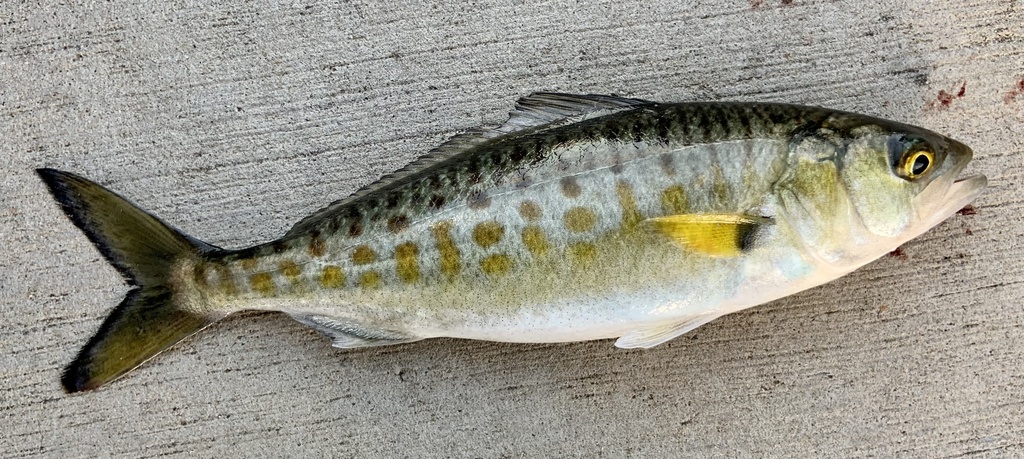
Western Australian Salmon
Arripis truttacea
Arripis truttacea, the Western Australian salmon, is a species of marine ray-finned fish within the genus Arripis, the only genus within the family Arripidae. It is endemic to the seas off southern Australia.
From the article Arripis truttacea on Wikipedia (CC BY-SA), quoted section by section
Description
Arripis truttacea has a streamlined, moderately deep, slightly elongate body which is a little compressed with a relatively narrow caudal peduncle and a moderately small head. The eyes are quite small with an obvious growth of transparent adipose tissue on the anterior and posterior edges of the eye on larger fish. There is a series of fine serrations along the lower edge of the preorbital bone but these largely disappear in larger fish. The mouth is moderate in size and is oblique, its maxillae reaches a level below the centre of eyes. There is a narrow band of small pointed teeth in each jaw. The body, except for the lower jaw, snout and area above the eyes is covered with moderately small, very finely ctenoid and larger specimens feel smooth to the touch. The lateral line is almost straight. There is a long dorsal fin which has a slight notch separating the spiny and soft-rayed parts of the fin and the spiny part is markedly higher than the soft-rayed part. It has a small anal fin which is about half the length of the soft part of the dorsal fin. It has a deeply forked tail. The adults have a greyish green to steely blue back and normally have yellow to slate grey spots and they are silvery white on the underparts. The pectoral fin is pale yellowish and the other fins are translucent. …
Range & habitat
Arripis truttacea is endemic to the coastal waters of southern Australia where it is found from Lakes Entrance in Victoria to Kalbarri in Western Australia, although it is rare north of Lancelin in Western Australia.
Wikipedia: “Distribution”
In human culture
Arripis truttacea was first formally described as Centropristis truttaceus in 1829 by George Cuvier with the type locality being given as Port Western, Victoria. The specific name is given by some authorities as truttaceus but since this species was placed in the genus Arripis then the feminine form should be used as Arripis is feminine. Although the common name calls it a "salmon" it is unrelated to the true salmons of the family Salmonidae and it is one of four species in the genus Arripis from the monogeneric family Arripidae, a group of scombriforms endemic to Australia and New Zealand. Other colloquial names for this species include bay trout, blackback, buck salmon, cockie salmon, colonial salmon, jack salmon, jacky, kahawais, lumpy, ocean trout, poundies, salmon trout, Southern Australian salmon and trout.
== References ==
Wikipedia: “Taxonomy and etymology”
Where it lives
Recorded sightings
—
geo-referenced records in GBIF, from museums, herbaria and field observers.
Drag the globe to turn it. Dots are where records exist, not a range map; darker means more records.
In the stacks
Searching the stacks…
Every page naming Arripis truttacea in the Biodiversity Heritage Library →
This page is assembled live from iNaturalist, GBIF, Wikipedia, the Source Library and the Internet Archive. It is not yet part of the hand-edited codex. iNaturalist taxon 85294.