- Animals
- ›Chordates
- ›Vertebrates
- ›Ray-finned Fishes
- ›Spiny-rayed fishes
- ›Freshwater Sunfishes, Grunters, and Allies
- ›Freshwater Sunfishes and relatives
- ›Temperate Perches
- ›Maccullochella
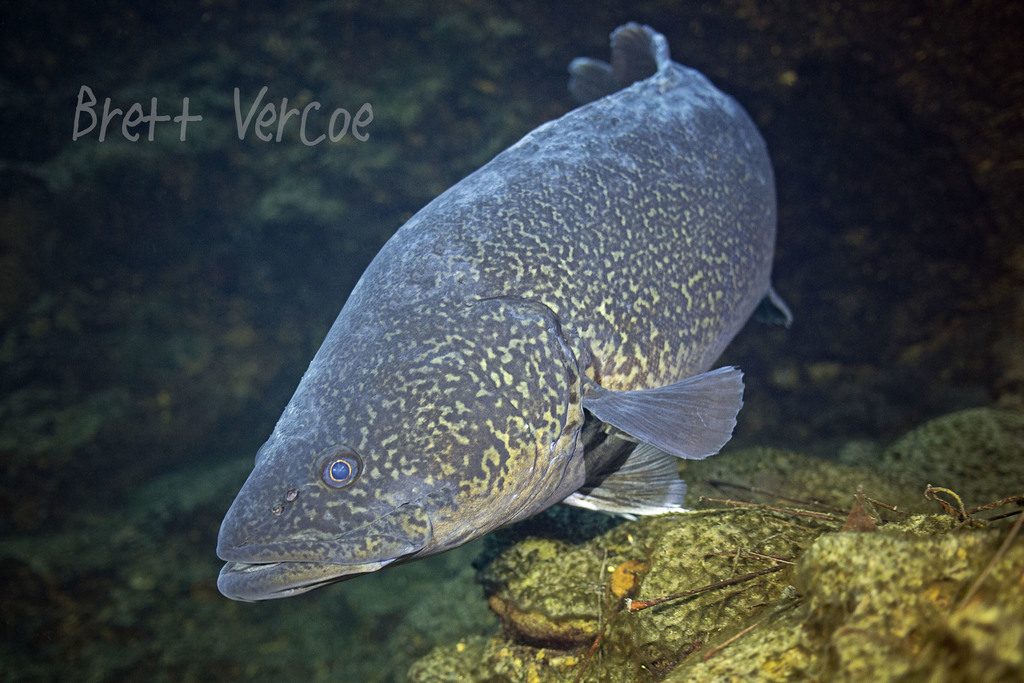
Clarence River Cod
Maccullochella ikei
The eastern freshwater cod (Maccullochella ikei), also known as the eastern cod or Clarence River cod, is a large predatory freshwater fish of the genus Maccullochella and the family Percichthyidae, that occur in the coastal Clarence River system of north-eastern New South Wales. Eastern freshwater cod are closely related to the Murray cod of the Murray-Darling River system, and are considered an icon of the Clarence River system.
A long-lived, slow-growing species, eastern freshwater cod are threatened by poaching [i.e. illegal take], habitat degradation, catastrophic natural events such as bushfires, and inbreeding from low genetic diversity. They are currently classified as endangered and protected by law from human exploitation of any kind.
From the article Eastern freshwater cod on Wikipedia (CC BY-SA), quoted section by section
Description
The eastern freshwater cod is a small to medium-sized grouper-like fish with a deep, elongated body that is round in cross section and a broad, scooped head, and a large mouth lined with pads of very small needle-like teeth. The jaws are equal, or the lower jaw may protrude slightly. The eyes are slightly larger and more prominent than in Murray cod. The spiny dorsal fin is moderate in height and is partially separated by a notch from the high, rounded soft dorsal fin. Soft dorsal, anal, and caudal (tail) fins are all large and rounded, and are dusky grey or black with distinct white edges. The large, rounded pectoral fins are usually similar in colour to flanks. The pelvic fins are large and angular, set forward of the pectoral fins, and are usually a translucent greyish-white colour, tending toward opacity in large fish. The leading greyish-white coloured rays on the pelvic fins split into two trailing filaments. These filaments are significantly longer than in Murray cod. Eastern freshwater cod are vary from cream or greyish-white to yellow on their ventral ("belly") surfaces. Their backs and flanks are usually an intense yellow or gold in colour, overlain with a dense pattern of black to very dark green mottling. The effect is a marbled appearance sometimes reminiscent of a leopard's markings. …
Wikipedia: “Appearance and size”
Range & habitat
Eastern freshwater cod are native to the Clarence River system in northern New South Wales, Australia. The Clarence River system is an extensive East Coast drainage with many tributaries of differing size. By Australian standards, the Clarence River and its major tributaries the Mann and Nymboida Rivers are extremely large rivers with extremely large flow volumes. Eastern freshwater cod originally occurred in great abundance throughout the system, to significant altitudes. Though reportedly M. ikei were never found above the large falls in some headwaters, the uppermost reaches of many tributaries feature in this species' range. The indigenous cod population of the Richmond River system (Richmond River cod), now extinct, are believed to have been a sub-population of eastern freshwater cod. The Richmond River has been restocked with fingerlings (juvenile fish) produced from Clarence River cod, but no evidence of breeding has been found. A closely related freshwater cod was historically common in the Brisbane River system, however the exact taxonomic status of the now-extinct Brisbane River cod is not known.
Wikipedia: “Range”
What it does
Eastern freshwater cod are found in clear-flowing rivers and streams with rocky beds and deep holes within the Clarence River system, to significant altitudes. They inhabit all sizes of rivers and streams. Eastern freshwater cod are territorial and aggressive. The bulk of their diet is based on crustaceans (the large, clawed Macrobrachium shrimp and the small, clawless Paratya shrimp) and other fish, but they are powerful opportunistic predators and are also known to take insects (e.g. cicadas), frogs, snakes, lizards, birds, and small mammals.
Wikipedia: “Habitat and diet”
In human culture
The Eastern freshwater cod was first formally described in 1986 by Stuart J. Rowland with the type locality given as the confluence of the Nymboida River with the Mann River in New South Wales. Rowland gave it the specific name ikei in honour of his father Isaac "Ike" Morgan Rowland who was an angler and who enjoyed catching freshwater cod.
Wikipedia: “Species description and etymology”
Where it lives
Recorded sightings
—
geo-referenced records in GBIF, from museums, herbaria and field observers.
Drag the globe to turn it. Dots are where records exist, not a range map; darker means more records.
In the stacks
Searching the stacks…
Every page naming Maccullochella ikei in the Biodiversity Heritage Library →
This page is assembled live from iNaturalist, GBIF, Wikipedia, the Source Library and the Internet Archive. It is not yet part of the hand-edited codex. iNaturalist taxon 104979.