- Animals
- ›Chordates
- ›Vertebrates
- ›Ray-finned Fishes
- ›Spiny-rayed fishes
- ›Butterflyfishes, Angelfishes, and Allies
- ›Snappers
- ›Fusiliers
- ›Caesio
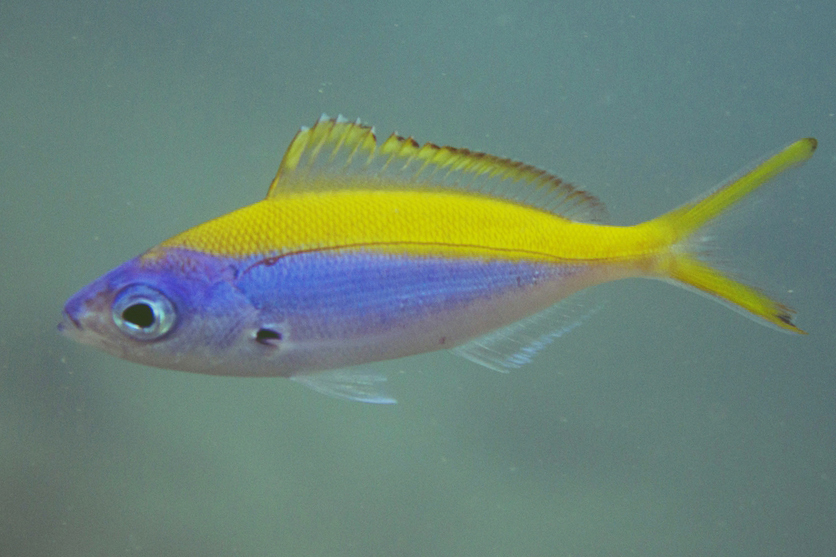
Yellowback Fusilier
Caesio xanthonota
The yellowback fusilier (Caesio xanthonota) is a pelagic marine ray-finned fish, a fusilier belonging to the family Caesionidae. It is native to the tropical Indo-Pacific, being found in shallow water from the East African coast to Indonesia.
From the article Yellowback fusilier on Wikipedia (CC BY-SA), quoted section by section
Description
The yellowback fusilier is a small to medium-sized fish which grows to about 40 cm (16 in) long. The mouth is small and terminal and is protusible, being able to be extended forward to swallow food. The body is fusiform or spindle-shaped. The dorsal fin has 10 spines and 14–15 soft rays. The anal fin has three spines and 11 or 12 soft rays. The caudal fin is deeply forked. The body coloration is greyish blue with a bright yellow zone on the back. The yellow area goes from the forehead, between the eyes, to the tail, and includes the dorsal fin and the caudal fin. This area corresponds more or less to the upper third of the body. The belly is plain white.
Range & habitat
Caesio xanthonota is widely distributed throughout the tropical waters of the Indian Ocean, the Red Sea and Persian Gulf excluded, to Indonesia in the western Pacific Ocean. It lives in mid-water in deep lagoons and close to external reefs from the surfaceto 50 m deep.
Wikipedia: “Distribution and habitat”
What it does
The yellowback fusilier is diurnal, and lives in groups and forms schools with other caesionids such as Caesio teres.
Wikipedia: “Behaviour”
Where it lives
Recorded sightings
—
geo-referenced records in GBIF, from museums, herbaria and field observers.
Drag the globe to turn it. Dots are where records exist, not a range map; darker means more records.
In the stacks
Searching the stacks…
Every page naming Caesio xanthonota in the Biodiversity Heritage Library →
This page is assembled live from iNaturalist, GBIF, Wikipedia, the Source Library and the Internet Archive. It is not yet part of the hand-edited codex. iNaturalist taxon 208069.