- Animals
- ›Chordates
- ›Vertebrates
- ›Ray-finned Fishes
- ›Spiny-rayed fishes
- ›Mackerels, Tunas, Butterfishes, and Allies
- ›Scombroidei
- ›Mackerels, Tunas, and Bonitos
- ›Scombrinae
- ›Scomberomorus
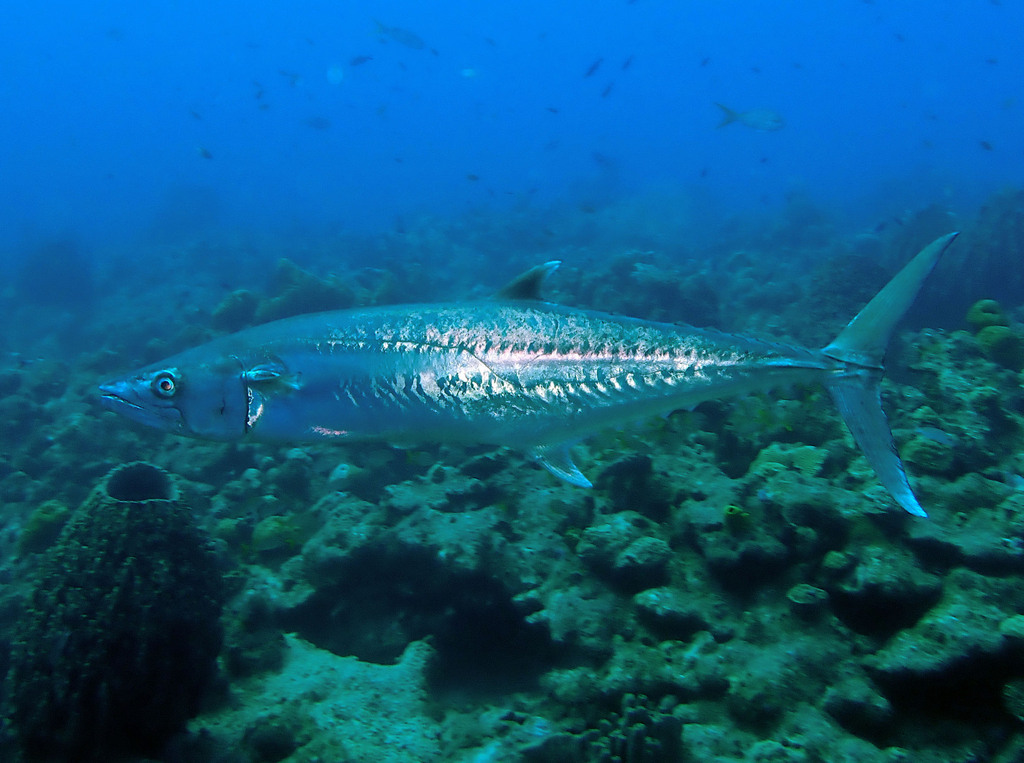
King Mackerel
Scomberomorus cavalla
The king mackerel (Scomberomorus cavalla), kingfish or carite lucio is a migratory species of mackerel of the western Atlantic Ocean and Gulf of Mexico. It is an important species to both the commercial and recreational fishing industries.
From the article King mackerel on Wikipedia (CC BY-SA), quoted section by section
Description
The king mackerel is a medium-sized fish, typically encountered from 5 kg (11 lb) to 14 kg (30 lb), but is known to exceed 40 kg (90 lb). The entire body is covered with very small, hardly visible, loosely attached scales. The first (spiny) dorsal fin is entirely colorless and is normally folded back into a body groove, as are the pelvic fins. The lateral line starts high on the shoulder, dips abruptly at mid-body and then continues as a wavy horizontal line to the tail. Coloration is olive on the back, fading to silver with a rosy iridescence on the sides, fading to white on the belly. Fish under 5 kg (11 lb) show yellowish-brown spots on the flanks, somewhat smaller than the spots of the Atlantic Spanish mackerel, Scomberomorus maculatus. Its cutting-edged teeth are large, uniform, closely spaced and flattened from side to side. These teeth look very similar to those of the bluefish, Pomatomus saltatrix.
Similar species. Small king mackerel are similar in appearance to Atlantic Spanish mackerel, Scomberomorus maculatus, and cero mackerel, Scomberomorus regalis, all three species being similar in shape and coloration. They may be distinguished as follows: The lateral line on Atlantic Spanish mackerel and cero slopes gradually from the top edge of the gill to the tail. …
Range & habitat
The king mackerel is a subtropical species of the Atlantic Coast of the Americas. Common in the coastal zone from North Carolina to Brazil, it occurs as far south as Rio de Janeiro, and occasionally as far north as the Gulf of Maine. Records from the Mediterranean Sea are questionable, so it remains a possible vagrant there. Nonetheless, a preference for water temperatures in the range of 20 to 29 °C (68 to 84 °F) may limit distribution. King mackerel commonly occur in depths of 12–45 m (40–150 ft), where the principal fisheries occur. Larger kings (heavier than 9 kg or 20 lb) often occur inshore, in the mouths of inlets and harbors, and occasionally even at the 180 m (590 ft) depths at the edge of the Gulf Stream.
Wikipedia: “Distribution and habitat”
What it does
King mackerel are voracious, opportunistic carnivores. Their prey depends on their size. Depending on area and season, they favor squid, menhaden and other sardine-like fish (Clupeidae), jacks (Carangidae), cutlassfish (Trichiuridae), weakfish (Sciaenidae), grunts (Haemulidae), striped anchovies (Engraulidae), cigar minnows, threadfin, northern mackerel, and blue runners. They do not attack humans but will defend themselves against perceived threats, including humans flailing or thrashing in man-overboard and similar situations, by biting.
Wikipedia: “Feeding habits”
At the table
According to the United States Food and Drug Administration, king mackerel is one of four fishes, along with swordfish, shark, and tilefish, that children and pregnant women should avoid due to high levels of methylmercury found in these fish and the consequent risk of mercury poisoning.
Wikipedia: “Nutrition”
In human culture
Eggs and sperm are shed into the sea and their union is by chance. Depending on size, a female may shed from 50,000 to several million eggs over the spawning season. Fertilized eggs hatch in about 24 hours. The newly hatched larva is about 2.5 mm (0.098 in) long with a large yolk sack. Little is known about king mackerel in their first year of life. Yearling fish typically attain an average weight of 1.4–1.8 kg (3.1–4.0 lb) and a fork length of 60 cm (24 in). At age seven, females average 10 kg (22 lb), males 5 kg (11 lb). King mackerel may attain 40 kg (88 lb), but any over 7 kg (15 lb) is almost certainly a female.
Wikipedia: “Life history”
Where it lives
Recorded sightings
—
geo-referenced records in GBIF, from museums, herbaria and field observers.
Drag the globe to turn it. Dots are where records exist, not a range map; darker means more records.
In the stacks
Searching the stacks…
Every page naming Scomberomorus cavalla in the Biodiversity Heritage Library →
This page is assembled live from iNaturalist, GBIF, Wikipedia, the Source Library and the Internet Archive. It is not yet part of the hand-edited codex. iNaturalist taxon 154499.