- Animals
- ›Chordates
- ›Vertebrates
- ›Ray-finned Fishes
- ›Spiny-rayed fishes
- ›Mackerels, Tunas, Butterfishes, and Allies
- ›Scombroidei
- ›Mackerels, Tunas, and Bonitos
- ›Scombrinae
- ›Scomberomorus
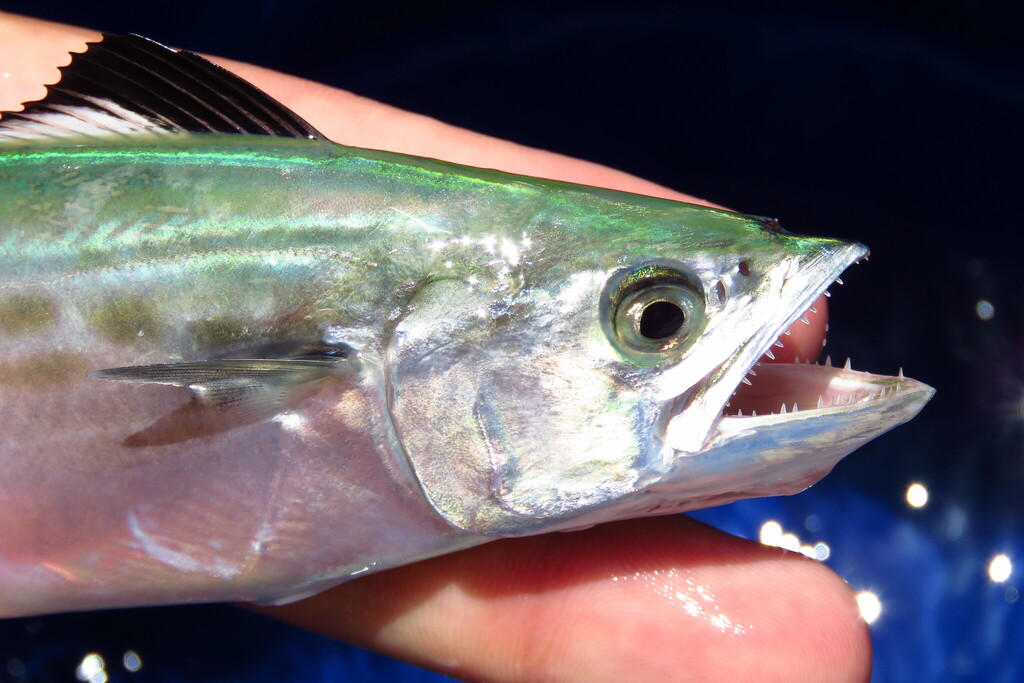
Atlantic Spanish Mackerel
Scomberomorus maculatus
The Atlantic Spanish mackerel (Scomberomorus maculatus) is a migratory species of mackerel that swims to the northern Gulf of Mexico in spring, and returns to southern Florida in the eastern Gulf, and to Mexico in the western Gulf in the fall.
From the article Atlantic Spanish mackerel on Wikipedia (CC BY-SA), quoted section by section
Description
The fish exhibits a green back; its sides are silvery marked with about three rows of round to elliptical yellow spots. The lateral line gradually curves down from the upper end of the gill cover toward caudal peduncle. The first (spiny) dorsal fin is black at the front. Posterior membranes are white with a black edge. Its single row of cutting-edged teeth in each jaw (around 64 teeth in all) are large, uniform, closely spaced, and flattened from side to side. As with the king mackerel and the cero mackerel, these teeth look very similar to those of the bluefish, Pomatomus saltatrix. Spanish mackerel can grow (rarely) to 37 in (940 mm) and weigh up to 14 lb (6.4 kg).
Range & habitat
Spanish mackerel occur seasonally from the Yucatán Peninsula, Mexico, as far north as Cape Cod, Massachusetts. They are a shallow-water species, preferring sand bottom at depths of 10 to 40 ft (3 to 12 m), occasionally found as deep as 80 ft (24 m).
Wikipedia: “Distribution/habitat”
What it does
Spanish mackerel are carnivores. As with other members of the genus, food consists mainly of small fishes with lesser quantities of shrimp and squid. Striped anchovies (Engraulidae) and clupeoids such as menhaden, alewives and thread herring (Opisthonema), are particularly important forage in North Carolina, Florida, Texas, and Veracruz. The percentage of anchovies consumed is higher for juveniles than for adults.
Wikipedia: “Feeding habits”
At the table
Spanish mackerel are primarily marketed fresh or frozen as fillets, as commercially caught fish are too small to sell in the form of steaks. Their raw flesh is white. They may be prepared by broiling, frying, baking, or rarely by smoking. The Spanish mackerel is also a popular sushi fish. By analogy with the Japanese Spanish mackerel, which is a member of the same genus, it is often called sawara on sushi menus.
Wikipedia: “As food”
In human culture
The Gulf group of Spanish mackerel spawn in batches from May to September from off the shore of Texas to off the shore of Florida as early as April in some years. The Atlantic group spawns starting in April off the Carolinas and from late August to late September in the northernmost part of its range. Spanish mackerel mature by 1 year at a fork length of 14 in (36 cm). Females live longer and grow to larger sizes than males. Females may live as long as 11 years, growing to 11 lb (5.0 kg) and 33 in (84 cm) fork length. Males reach about 6 years old and 19 in (48 cm) in fork length.
Wikipedia: “Life history”
Where it lives
Recorded sightings
—
geo-referenced records in GBIF, from museums, herbaria and field observers.
Drag the globe to turn it. Dots are where records exist, not a range map; darker means more records.
In the stacks
Searching the stacks…
Every page naming Scomberomorus maculatus in the Biodiversity Heritage Library →
This page is assembled live from iNaturalist, GBIF, Wikipedia, the Source Library and the Internet Archive. It is not yet part of the hand-edited codex. iNaturalist taxon 179471.