- Animals
- ›Chordates
- ›Vertebrates
- ›Ray-finned Fishes
- ›Spiny-rayed fishes
- ›Mackerels, Tunas, Butterfishes, and Allies
- ›Scombroidei
- ›Mackerels, Tunas, and Bonitos
- ›Scombrinae
- ›Thunnus
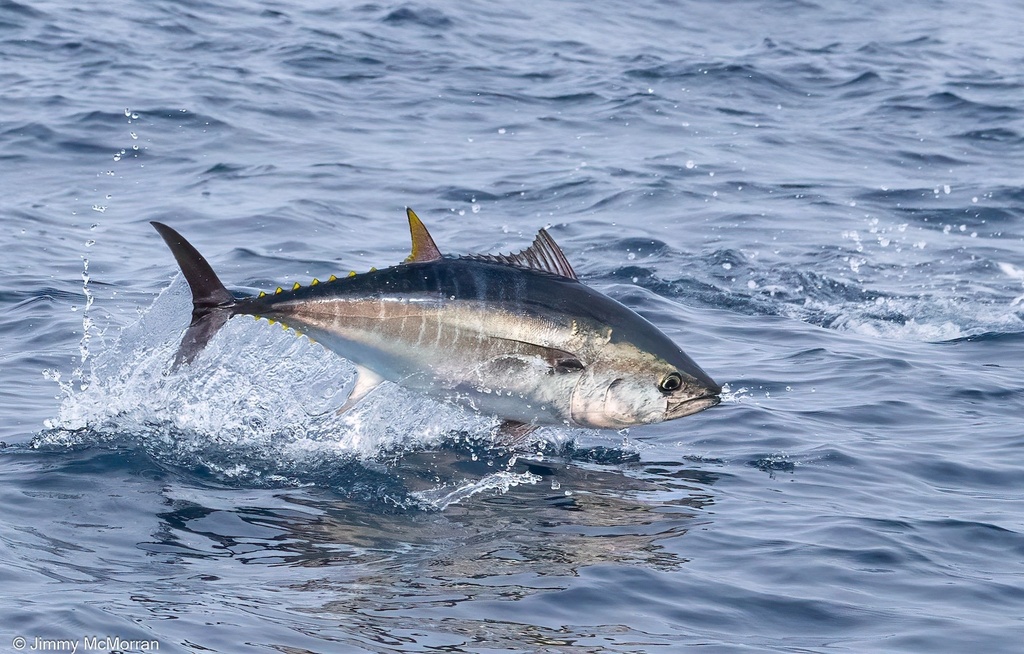
Pacific Bluefin Tuna
Thunnus orientalis
The Pacific bluefin tuna (Thunnus orientalis) is a predatory species of tuna found widely in the northern Pacific Ocean, but it is migratory and also recorded as a visitor to the south Pacific.
In the past it was often included in T. thynnus, the 'combined' species then known as the northern bluefin tuna (when treated as separate, T. thynnus is called the Atlantic bluefin tuna). It may reach as much as 3 m (9.8 ft) in length and 450 kg (990 lb) in weight.
From the article Pacific bluefin tuna on Wikipedia (CC BY-SA), quoted section by section
Range & habitat
The Pacific bluefin tuna is primarily found in the North Pacific, ranging from the East Asian coast to the western coast of North America. It is mainly a pelagic species found in temperate oceans, but it also ranges into the tropics and more coastal regions. It typically occurs from the surface to 200 m (660 ft), but has been recorded as deep as 550 m (1,800 ft). It spawns in the northwestern Philippine Sea (e.g., off Honshu, Okinawa and Taiwan) and in the Sea of Japan. Some of these migrate to the East Pacific and return to the spawning grounds after a few years. It has been recorded more locally as a visitor to the Southern Hemisphere, including off Australia, New Zealand, the Gulf of Papua and French Polynesia. The species is considered to consist of only one stock.
Wikipedia: “Distribution”
What it does
Pacific bluefin tunas reach maturity at about 5 years of age, the generation length is estimated at 7–9 years and based on two separate sources the longevity is 15 years or 26 years. At maturity it is about 1.5 m (4 ft 11 in) long and weighs about 60 kg (130 lb). Individuals that are 2 m (6 ft 7 in) long are regularly seen, and the maximum reported is 3 m (9.8 ft) in length and 450 kg (990 lb) in weight. Elsewhere, a mass of up to 550 kg (1,210 lb) has been reported for the species. According to the International Game Fish Association, the all-tackle game fish record was a 411.6 kg (907 lb) individual (Donna Pascoe) caught on 19 February 2014 onboard charter boat Gladiator during the National Tournament. Spawning occurs from April to August, but the exact timing depends on the region: Early in the northwest Philippine Sea (the southern part of its breeding range) and late in the Sea of Japan (the northern part of its breeding range). …
Wikipedia: “Life cycle”
At the table
About 80% of the Pacific and Atlantic bluefin tunas are consumed in Japan, and tunas that are particularly suited for sashimi and sushi can fetch very high prices. The fatty belly meat is known as toro, and prized by sushi chefs. In Japan, some foods made available for the first time of the year are considered good luck, especially bluefin tuna. Winning these new year auctions is often used as a way to get publicity, which raises the prices considerably higher than their usual market value: on 5 January 2013, a 489-pound (222 kg) Pacific bluefin tuna caught off northeastern Japan was sold in the first auction of the year at the Tsukiji fish market in Tokyo for a record 155.4 million yen (US$1.76 million) – leading to record unit prices of US$3,603 per pound, or ¥703,167 per kilogram. A 618-pound (280 kg) pacific bluefin tuna sold for 333.6 million yen (US$3.1 million) at a Tokyo's Toyosu fish market on 5 January 2019. The price equates to roughly US$5,000 a pound, close to double the previous record. The fish was caught off Oma in northern Japan.
Wikipedia: “Cuisine”
In human culture
Japan is both the biggest consumer and the leader in tuna farming research. Kinki University of Japan first successfully farmed already-hatched bluefin tuna in 1979. In 2002, they succeeded in breeding them, and in 2007, the process was repeated for a third generation. This farm-raised tuna is now known as Kindai tuna. Kindai is a contraction of Kinki University (Kinki daigaku).
Wikipedia: “Aquaculture”
Where it lives
Recorded sightings
—
geo-referenced records in GBIF, from museums, herbaria and field observers.
Drag the globe to turn it. Dots are where records exist, not a range map; darker means more records.
In the stacks
Searching the stacks…
Every page naming Thunnus orientalis in the Biodiversity Heritage Library →
This page is assembled live from iNaturalist, GBIF, Wikipedia, the Source Library and the Internet Archive. It is not yet part of the hand-edited codex. iNaturalist taxon 188560.