- Animals
- ›Chordates
- ›Vertebrates
- ›Ray-finned Fishes
- ›Carps, Characins, Catfishes and Allies
- ›Minnows, Suckers, Carps, and Loaches
- ›Carps and Minnows
- ›Danios
- ›Flying Barbs
- ›Esomus
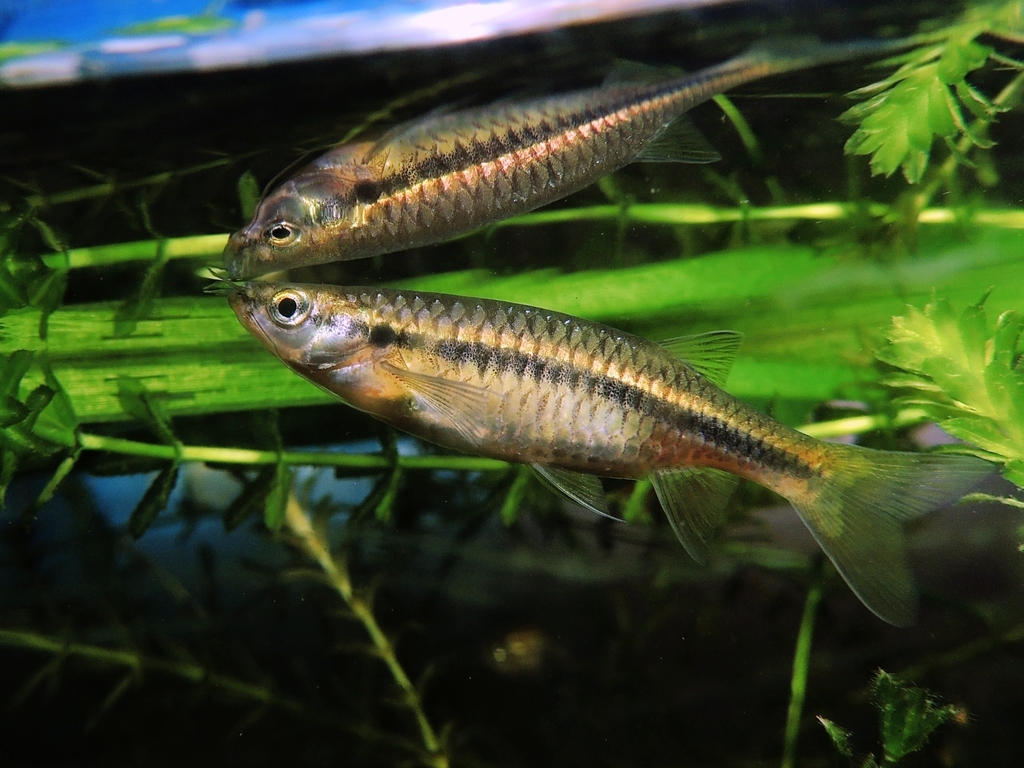
Indian Flying Barb
Esomus danrica
The Indian flying barb (Esomus danrica), historically flying barb, is one of the species known in the group flying barbs owing to their extremely long barbels. It was discovered in 1822 by Francis Hamilton. Not to be mistaken with Esomus metallicus, it is rarely seen in aquaria. It is found in Myanmar, Nepal, Pakistan, Sri Lanka, [[Bangladesh
]] and India, it is found in many of the same localities as Danio rerio and Danio dangila, an example being the Jorai Rivulet, a tributary of the Sankosh river in Coochbehar district, West Bengal, India. It is locally named "Boirali maach". In Nepalese Terai it is called Dedhawa.
From the article Indian flying barb on Wikipedia (CC BY-SA), quoted section by section
Description
This fish reaches a maximum length of 6 in (15 cm). The Indian flying barb is a silver fish with a black line on an elongated body and gold fins. Barbels reach almost to the anal fin.
What it does
This fish has an exceptional ability for jumping, hence its name. Research in 2001 by Fang Fang suggests that Esomus is the genus most closely related to Danio, closer even than Devario.
Temperature preference: 20-25 Celsius pH preference: 7.6 Hardness preference: Soft to medium Salinity preference: Zero Compatibility: Good but fast like most danios, a largeish fish, needs plenty of space Life span: Typically 3 to 5 years Ease of keeping: Moderate Ease of breeding: Moderate to hard A tank with a tight fitting lid with no gaps is recommended.
Wikipedia: “Behaviour”
Where it lives
Recorded sightings
—
geo-referenced records in GBIF, from museums, herbaria and field observers.
Drag the globe to turn it. Dots are where records exist, not a range map; darker means more records.
In the stacks
Searching the stacks…
Every page naming Esomus danrica in the Biodiversity Heritage Library →
This page is assembled live from iNaturalist, GBIF, Wikipedia, the Source Library and the Internet Archive. It is not yet part of the hand-edited codex. iNaturalist taxon 187377.