- Animals
- ›Chordates
- ›Vertebrates
- ›Ray-finned Fishes
- ›Spiny-rayed fishes
- ›Lanterneyes, fangtooths and allies
- ›Slimeheads
- ›Hoplostethus
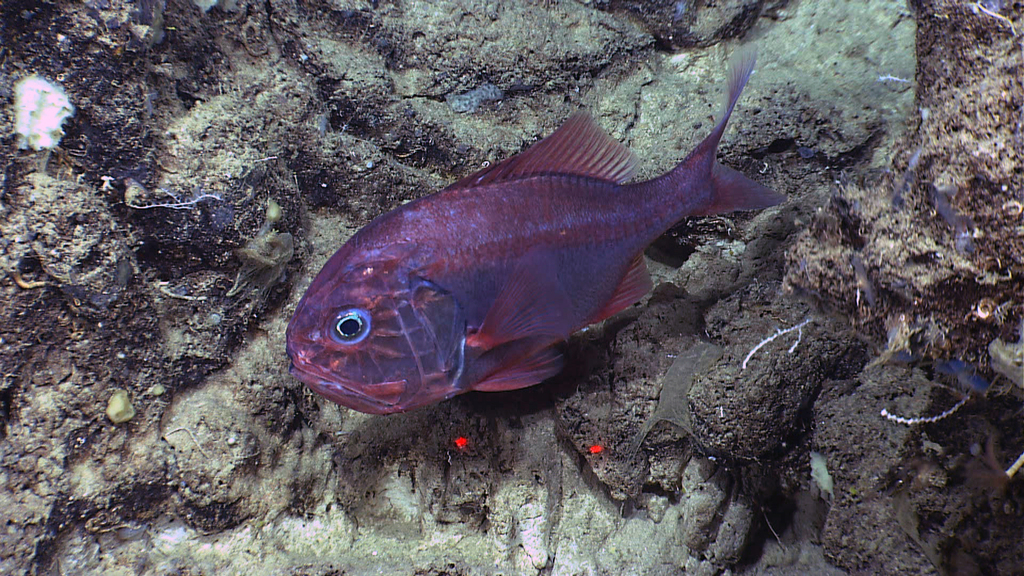
Orange Roughy
Hoplostethus atlanticus
The orange roughy (Hoplostethus atlanticus), also known as the red roughy, slimehead and deep sea perch, is a relatively large deep-sea fish belonging to the slimehead family (Trachichthyidae). It is bathypelagic, found in cold (3 to 9 °C or 37 to 48 °F), deep (180-to-1,800-metre or 590-to-5,910-foot) waters of the Western Pacific Ocean, eastern Atlantic Ocean (from Iceland to Morocco; and from Walvis Bay, Namibia, to off Durban, South Africa), Indo-Pacific (off New Zealand and Australia), and in the eastern Pacific off Chile. The orange roughy is notable for its extraordinary lifespan, attaining over 200 years. The fish has a bright, brick red color, fading to a yellowish-orange after death.
Like other slimeheads, orange roughy is slow-growing and late to mature, resulting in a very low stock resilience, making them extremely susceptible to overfishing. Despite this, the species is important to commercial deep-trawl fisheries; many stocks (especially those off New Zealand and Australia, which were first exploited in the late 1970s) became severely depleted within 3–20 years, but several have subsequently recovered to levels that fisheries management believe are sustainable, although substantially below unfished populations. The UK Marine Conservation Society has categorized orange roughy as "vulnerable to exploitation".
From the article Orange roughy on Wikipedia (CC BY-SA), quoted section by section
Description
The orange roughy is laterally compressed, typical for its family. Its rounded head is riddled with muciferous canals (part of the lateral line system), also typical of slimeheads. The single dorsal fin contains four to six spines and 15 to 19 soft rays; the anal fin contains three spines and 10 to 12 soft rays. The 19 to 25 ventral scutes (modified scales) form a hard, bony median ridge between the pelvic fins and anus. The pectoral fins contain 15 to 18 soft rays each; the pelvic fins are thoracic and contain one spine and six soft rays; the caudal fin is forked. The interior of the mouth and gill cavity is a bluish black; the mouth itself is large and strongly oblique. The scales are ctenoid and adherent. The lateral line is uninterrupted, with 28 to 32 scales whose spinules or 'ctenii' largely obscure the lateral line's pores. The eyes are large. The orange roughy is the largest known slimehead species at a maximum standard length (a measurement that excludes the tail fin) of 75 cm (30 in) and a maximum weight of 7 kg (15 lb). The average commercial catch size is commonly between 35 and 45 centimetres (14 and 18 in) in length, again, varying by area.
What it does
Orange roughy are oceanodromous (wholly marine), pelagic spawners: that is, they migrate several hundred kilometers between localized spawning and feeding areas each year and form large spawning aggregations (possibly segregated according to gender) wherein the fish release large, spherical eggs 2.0–2.5 millimetres (0.079–0.098 in) in diameter, made buoyant by an orange-red oil globule) and sperm en masse directly into the water. The fertilized eggs, (and later larvae) are planktonic, rising to around 200 m (660 ft) to develop, with the young fish eventually descending to deeper waters as they mature. Orange roughy are also synchronous, shedding sperm and eggs at the same time. The time between fertilization and hatching is thought to be 10 to 20 days; fecundity is low, with each female producing only 22,000 eggs per kg of body weight, less than 10% of the average for other species of fish. Females rarely produce more than 90,000 eggs in a single spawning event. Spawning may last up to three weeks and starts around June or July. Orange roughy are very slow-growing and do not begin to breed until they are at least 20 years old, when they are around 30 cm (12 in) in length. …
Wikipedia: “Reproduction”
In human culture
Orange roughy are generally sluggish and demersal; they form aggregations with a natural population density of up to 2.5 fish per m2, now reduced to about 1.0 per m2. These aggregations form in and around geologic structures, such as undersea canyons and seamounts, where water movement and mixing is high, ensuring dense prey concentrations. The aggregations are not necessarily for spawning or feeding; the fish are thought to cycle through metabolic phases (active or feeding and inactive or resting) and seek areas with ideal hydrologic conditions to congregate during each phase. They lose almost all pigmentation while inactive, when they are very approachable. Predators include large, deep-roving sharks, cutthroat eels, merluccid hakes, and snake mackerels such as oilfish. When active, juveniles feed primarily on zooplankton, such as mysid shrimp, euphausiids (krill), mesopelagic and benthopelagic fish, amphipods, and other crustaceans; mature adults consume smaller fish, predominantly of the Butterflyfish and Lanternfish families, and squid, which make up to 20% of their diet. The diet of the orange roughy is depth-related, with adult diets inversely related to that of juveniles. …
Wikipedia: “Life history”
Where it lives
Recorded sightings
—
geo-referenced records in GBIF, from museums, herbaria and field observers.
Drag the globe to turn it. Dots are where records exist, not a range map; darker means more records.
In the stacks
Searching the stacks…
Every page naming Hoplostethus atlanticus in the Biodiversity Heritage Library →
This page is assembled live from iNaturalist, GBIF, Wikipedia, the Source Library and the Internet Archive. It is not yet part of the hand-edited codex. iNaturalist taxon 459402.