- Animals
- ›Chordates
- ›Vertebrates
- ›Ray-finned Fishes
- ›Spiny-rayed fishes
- ›Perches, Scorpionfishes, Sticklebacks, and Allies
- ›Sculpins and Allies
- ›Fathead Sculpins
- ›Icelinus
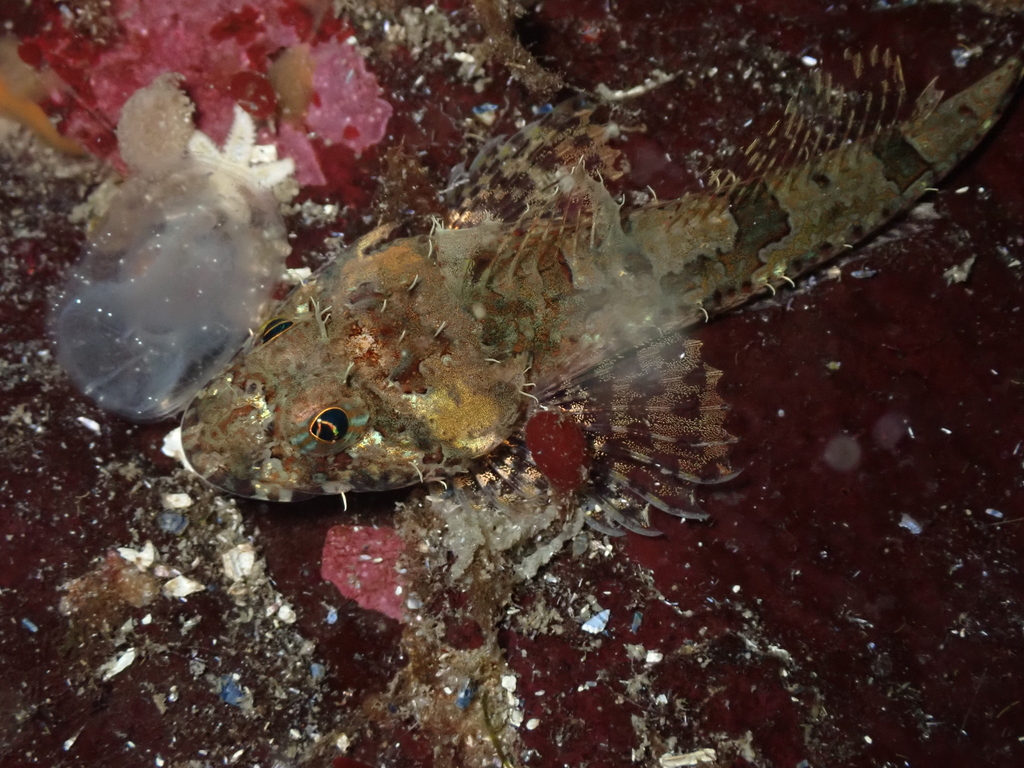
Northern Sculpin
Icelinus borealis
Icelinus borealis, or the northern sculpin or comb sculpin, is a species of fish in the family Cottidae. It can be found in the northeastern Pacific Ocean along the western coast of North America.
From the article Icelinus borealis on Wikipedia (CC BY-SA), quoted section by section
Description
Icelinus borealis has a very small antler-like uppermost spine on the preoperculum. There are 9 or 10 spines and between 15 and 17 soft rays supporting the dorsal fins, while the anal fin has between 12 and 14 soft rays. The caudal fin is clearly rounded and the pelvic fins are small and often curved. The overall color is dark olive gray or brown on the upper body, paler below. There are dark saddle marks, typically four, across the body and thin dark brown bars on the head and the fins except for the anal fin. In males the margin of the has black spots. This species has a maximum published standard length of 10.2 cm (4.0 in).
Range & habitat
Icelinus borealis is found in the temperate eastern Pacific Ocean from the Bering Sea coast of Alaska south as far as Puget Sound, in Washington. It is a demersal fish found at depths between 9 and 310 m (30 and 1,017 ft) on soft or shell substrates.
Wikipedia: “Distribution and habitat”
Where it lives
Recorded sightings
—
geo-referenced records in GBIF, from museums, herbaria and field observers.
Drag the globe to turn it. Dots are where records exist, not a range map; darker means more records.
In the stacks
Searching the stacks…
Every page naming Icelinus borealis in the Biodiversity Heritage Library →
This page is assembled live from iNaturalist, GBIF, Wikipedia, the Source Library and the Internet Archive. It is not yet part of the hand-edited codex. iNaturalist taxon 222140.