- Animals
- ›Chordates
- ›Vertebrates
- ›Ray-finned Fishes
- ›Spiny-rayed fishes
- ›Perches, Scorpionfishes, Sticklebacks, and Allies
- ›Sculpins and Allies
- ›Fathead Sculpins
- ›Oligocottus
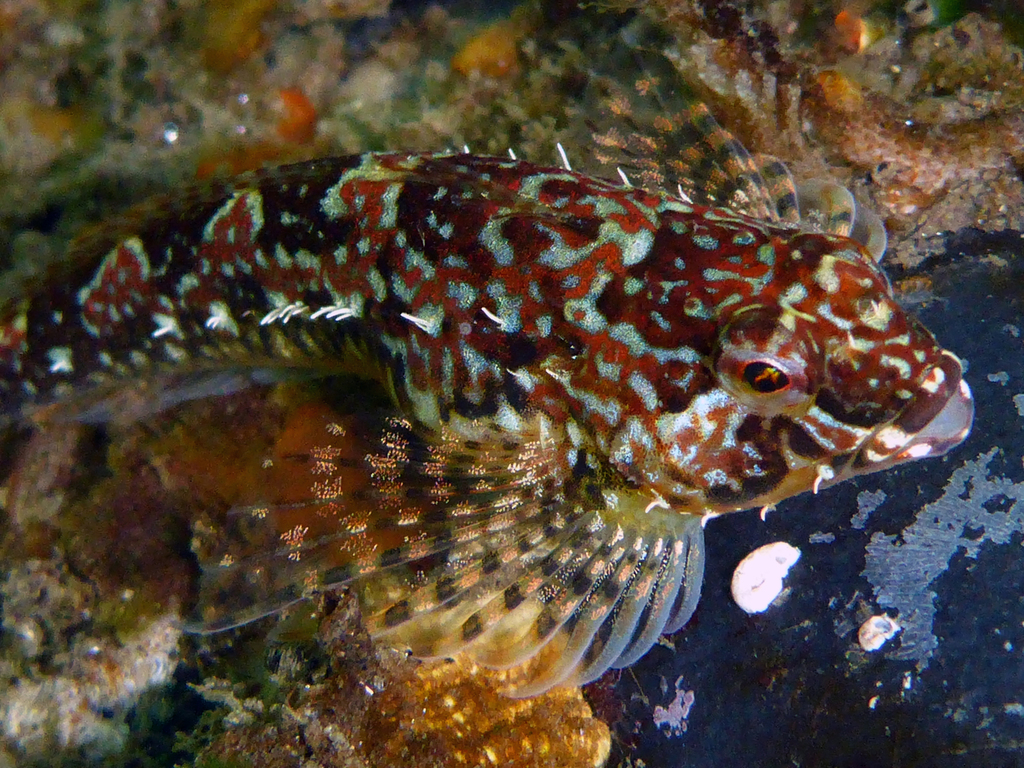
Saddleback Sculpin
Oligocottus rimensis
The saddleback sculpin (Oligocottus rimensis) is a species of fish in the sculpin family Cottidae. It is known to inhabit the North American shore of the Pacific Ocean. It is a very understudied fish with limited knowledge of behavioral patterns, lifecycle and reproduction.
From the article Saddleback sculpin on Wikipedia (CC BY-SA), quoted section by section
Description
Saddleback sculpins are a small fish in size averaging 4cm long but able to grow to a maximum of 6.2cm long [1]. They have an elongated body which tapers off from a blunt round head to tail. The head has a single preopercular spine which can be used to identify the Saddleback from other sculpins [7]. The prickles running along their whole body can also be used to identify them [3]. They have five to six gill rakers and the body is covered in papillae [4] with larger scales running laterally, usually in front of the pores. The dorsal fin has 8-10 spines with 16-19 rays, the pectoral fin has 13-15 rays, the pelvic fin has 1 spine and 3 rays, the anal fin has 13-15 rays, and the caudal fin is slightly rounded [7]. They have an olivaceous color pattern [9] varying from shades of red and green dorsally to tan and green ventrally with dorsal mottlings creating 5 distinct saddle-like markings [1]. The head has a black spot on top and a broken band, sometimes branching down running laterally along the body [5].
Range & habitat
The saddleback sculpin is distributed along the west coast of North America from the sub tropics of Guerra Negro in Mexico [7] up to the temperate seas off Alaska [6]. Their preferred habitat has been the lower part of the intertidal zone among rocky substrates, kelp-based habitats [2], and eel grass. It is possible that their distribution is larger than currently known as research on them is minimal. There is also indication in related works that they may also live in the subtidal zones.
Wikipedia: “Distribution and habitat”
What it does
Very little is known about the details of the Saddleback Sculpin's life-cycle due to few studies on it. Despite this, through related studies there can be some indication of behavioral patterns found. It is indicated that they follow a seasonal migration occurring in much higher densities in the intertidal zone during the months of November to February. This is not in correlation with changing food dynamics and therefore is most likely a result of reproductive patterns. On this theory adults come to the intertidal zone to reproduce as egg predation is greatly reduced compared to subtidal zones [8].
Wikipedia: “Reproduction and life-cycle”
Where it lives
Recorded sightings
—
geo-referenced records in GBIF, from museums, herbaria and field observers.
Drag the globe to turn it. Dots are where records exist, not a range map; darker means more records.
In the stacks
Searching the stacks…
Every page naming Oligocottus rimensis in the Biodiversity Heritage Library →
This page is assembled live from iNaturalist, GBIF, Wikipedia, the Source Library and the Internet Archive. It is not yet part of the hand-edited codex. iNaturalist taxon 69856.