- Plants
- ›Vascular Plants
- ›flowering plants
- ›monocots
- ›Aroids, Water Plantains, Seagrass, and allies
- ›pondweed family
- ›Potamogeton
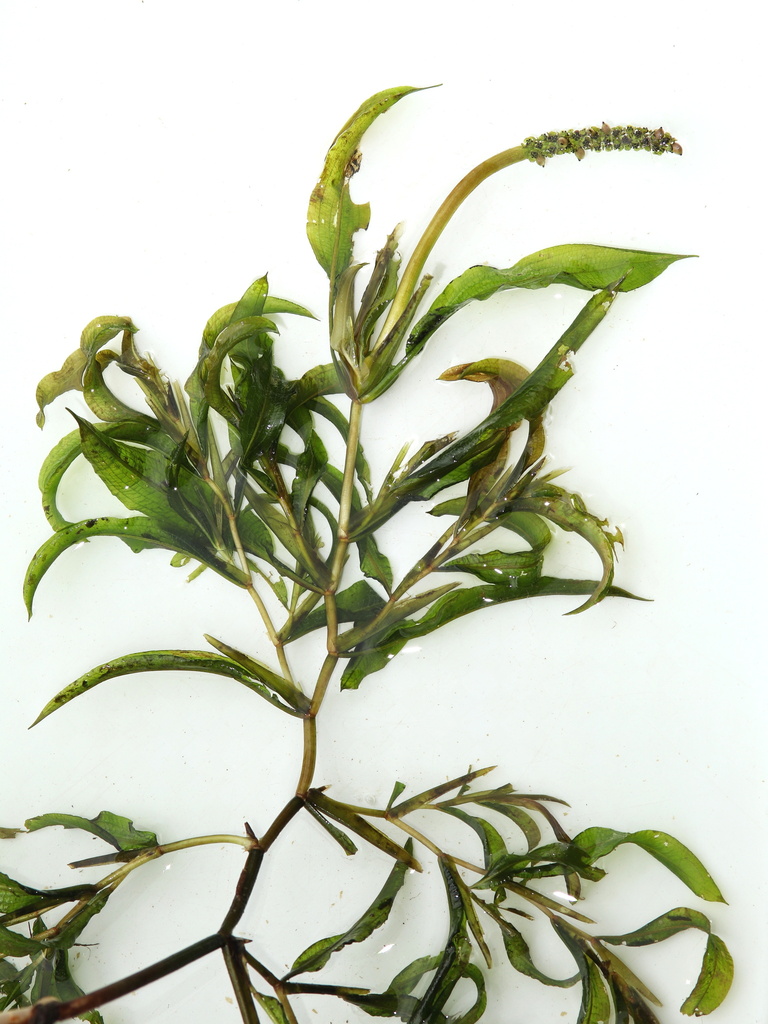
Potamogeton × angustifolius
Potamogeton × angustifolius is a hybrid pondweed between Potamogeton gramineus and Potamogeton lucens, known as long-leaved pondweed. It is widespread in rivers and lakes except where the water is very soft.
From the article Potamogeton × angustifolius on Wikipedia (CC BY-SA), quoted section by section
Description
Potamogeton × angustifolius is a hybrid between shining pondweed Potamogeton lucens and various-leaved pondweed Potamogeton gramineus. It is a perennial, growing from robust rhizomes. The stems are variable: slender to robust, terete, and branching, usually reaching 1.2 m but rarely up to 2m. The submerged leaves are reduced to phyllodes at the base of the stem, but elsewhere are broad and translucent, yellowish to dark green, sometimes with a pinkish tinge. The leaves measure 50-130 × 10–25 mm on the stems and main branches, but may be much smaller on the side branches; they have 4-5 (rarely 6) veins either side of the midrib and are usually sessile but some clones may have a few petiolate leaves. Turions are absent. Unlike P. lucens, Potamogeton × angustifolius sometimes produces floating leaves, which are opaque and typically 55-105 × 22–40 mm. The stipules are persistent, open, green when fresh, drying to olive or brownish. The inflorescences are 20–50 mm long and have inconspicuous greenish flowers on robust peduncles 45–190 mm long. Fruits are not always produced; if present they are approximately 3 × 2 mm. Identification of Potamogeton × angustifolius may require experience. It is larger and more robust than P. gramineus but more slender and graceful than P. lucens. There is a tendency for main stems to more closely resemble P. lucens, and side branches P. gramineus. …
Range & habitat
Potamogeton × angustifolius is one of the most frequent pondweed hybrids, and is widespread globally. It has been recorded from Europe to the western Himalayas, including Great Britain, Ireland, the Netherlands, Denmark, Finland, Norway, Sweden, Czech Republic, Germany, Hungary, Poland, Switzerland, France, Portugal, Italy, former Yugoslavia, European Russia, western Siberia, and the western Himalayas.
Wikipedia: “Distribution”
How it is grown
Potamogeton × angustifolius is not in general cultivation, though like both of its parents it is an attractive plant and easy to grow. It tends to be smaller than P.lucens, which may be an advantage in smaller ponds, but retains the large, netted leaves. In common with other pondweeds of this group it roots poorly from stem cuttings and is best propagated by division of the rhizomes. Good water quality is needed to reduce the risk of turbid water or growth of blanket weed.
== References ==
Wikipedia: “Cultivation”
Where it lives
Recorded sightings
—
geo-referenced records in GBIF, from museums, herbaria and field observers.
Drag the globe to turn it. Dots are where records exist, not a range map; darker means more records.
In the stacks
Searching the stacks…
Every page naming Potamogeton × angustifolius in the Biodiversity Heritage Library →
This page is assembled live from iNaturalist, GBIF, Wikipedia, the Source Library and the Internet Archive. It is not yet part of the hand-edited codex. iNaturalist taxon 994381.