- Animals
- ›Chordates
- ›Vertebrates
- ›Cartilaginous Fishes
- ›Sharks and Rays
- ›Rays
- ›Skates
- ›Hardnose Skates
- ›Dipturus
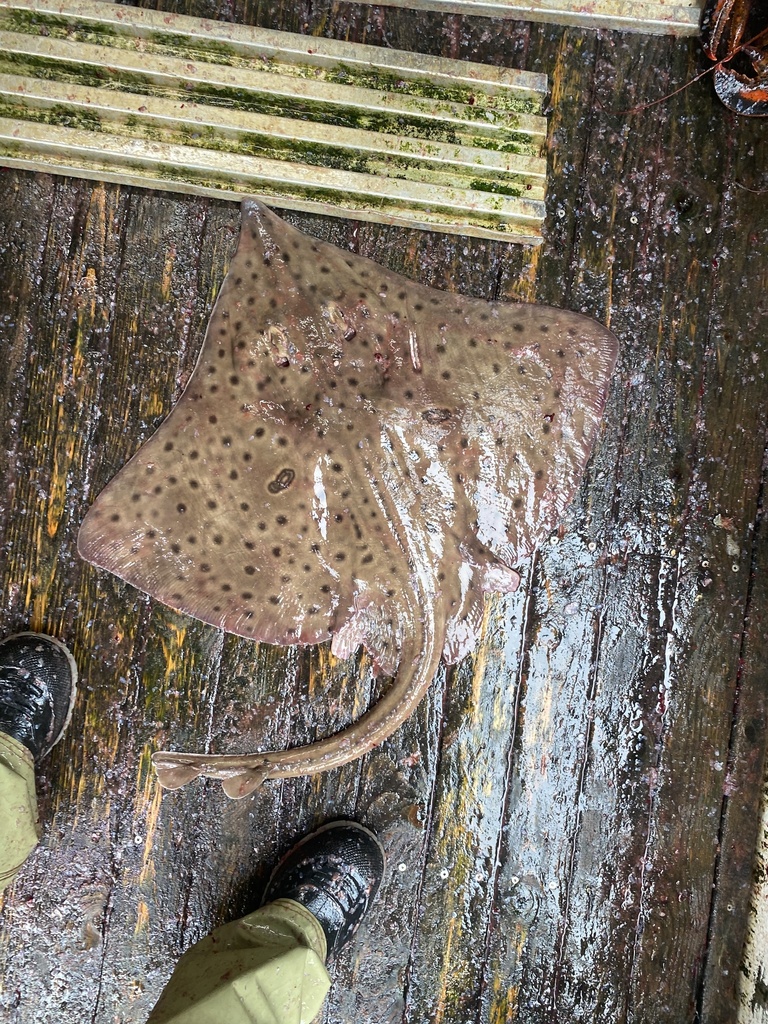
Barndoor Skate
Dipturus laevis
The barndoor skate (Dipturus laevis) is a species of marine cartilaginous fish in the skate family Rajidae of the order Rajiformes. It is native to the northwestern Atlantic Ocean, and is found from the Grand Banks of Newfoundland and the southern side of the Gulf of St. Lawrence south to North Carolina. The fish is one of the largest skates found in the North Atlantic Ocean, reaching lengths up to 1.5 m (5 ft). It is carnivorous, feeding on invertebrates and other fish found near the sea floor.
After peaking in the 1950s, the population of the barndoor skate dramatically declined in the 1960s and early 1970s as a result of overfishing. In 2003, it was listed as endangered by the World Conservation Union. However, barndoor skate populations have increased substantially since 1990 and even surpassed 1960s population size by 2012. In 2019, the barndoor skate was downlisted to least concern by the IUCN based on its largely increased population, new protections within its range, and also minor expansions to its range. In most cases, the barndoor skate is not intentionally harvested by the commercial fishing industry—it is usually considered bycatch in the trawling nets used to target other species of fish.
From the article Barndoor skate on Wikipedia (CC BY-SA), quoted section by section
Description
The barndoor skate is a flat-bodied fish with a large, disk-like body with sharply angled corners and a pointed snout. Its pectoral fins have evolved into broad, flat, wing-like appendages used to propel the fish through the water. These fins have a concave front edge with rounded posterior corners. Like sharks, it has a boneless skeleton made of cartilage, a tough, elastic substance composed of collagenous and/or elastic fibers, cells, and a firm, gel-like substance called the matrix. It has slot-like body openings called gill slits on the underside of the body beneath the pectoral fins that lead from the gills. The dorsal fins are close together and far removed from the tail. It has two eyes on its dorsal surface, located about 5.5 centimeters (2.2 in) apart. The fish's upper surface is brown to reddish brown with many scattered darker spots, lighter streaks, and reticulations. The center of each pectoral fin is marked with an oval spot or blotch. The lower surface is light, white to grey, blotched irregularly with gray spots. The barndoor skate is unique from other species of skate in its having a straight line that begins at the snout and ends at the anterior margin of the outer corner of the disk, but stopping short of the disk. The barndoor skate is one of the largest skates found in the North Atlantic Ocean. …
Range & habitat
The barndoor skate occurs in a range extending from the banks of Newfoundland, the southern Gulf of St. Lawrence, and along the northeastern coast and offshore banks of Nova Scotia south to North Carolina. Reports in the 19th century said the range of the fish extended as far south as northeastern Florida, but more recent research suggests that the Florida discoveries may have actually been a misidentification of R. floridana. It is found on various types of ocean bottoms, including soft muddy, sandy, and rocky bottoms. It can be found from the shoreline to depths to 750 m (2,460 ft), although it is most commonly found at depths less than 150 m (500 ft). It inhabits waters in a broad range of temperatures, from just above freezing to 20 °C (68 °F). It appears to move closer to shore in the autumn and further out to sea in the warmer months. It tolerates brackish water where the salinity is as low as 21 to 24 parts per thousand, but it prefers salinity between 31 and 35 parts per thousand. It is believed to not exhibit any north-south migratory patterns.
Wikipedia: “Habitat”
What it does
The fish is carnivorous, with its prey consisting mainly of benthic invertebrates and fishes. Such food items include polychaetes, gastropods, bivalve mollusks, rock crabs, cancer crabs, spider crabs, lobsters, shrimps, squids, and fishes including spiny dogfish, alewife, Atlantic herring, menhaden, hakes, sculpins, cunner, tautog, sand lance, butterfish, and various flounders. Juveniles primarily subsist on benthic invertebrates such as polychaetes, copepods, amphipods, isopods, crangon shrimp, and euphausiids. Individuals have been found with the denticles on the snout worn smooth, indicating that the snout is used to dig in the mud or sand to obtain bivalve mollusks.
Wikipedia: “Diet”
Where it lives
Recorded sightings
—
geo-referenced records in GBIF, from museums, herbaria and field observers.
Drag the globe to turn it. Dots are where records exist, not a range map; darker means more records.
In the stacks
Searching the stacks…
Every page naming Dipturus laevis in the Biodiversity Heritage Library →
This page is assembled live from iNaturalist, GBIF, Wikipedia, the Source Library and the Internet Archive. It is not yet part of the hand-edited codex. iNaturalist taxon 99407.