- Plants
- ›Vascular Plants
- ›flowering plants
- ›Dicots
- ›proteas, lotuses, planes, and allies
- ›Protea family
- ›Paired Proteas
- ›Banksieae
- ›Banksiinae
- ›Banksia
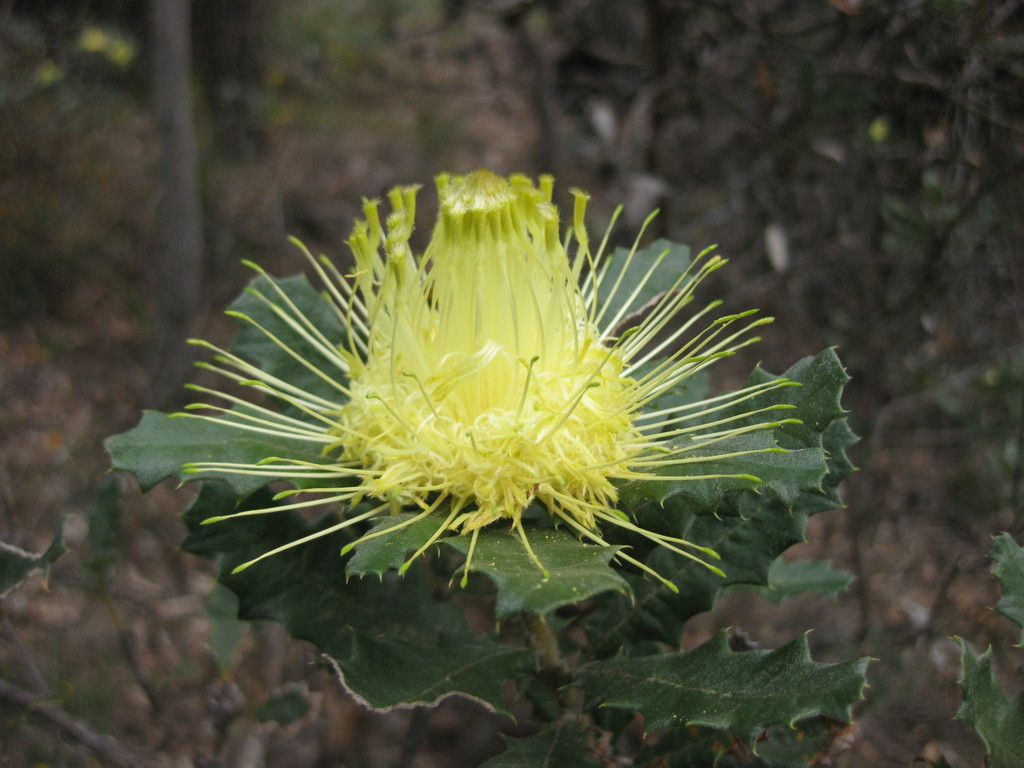
Urchin Dryandra
Banksia undata
Banksia undata, commonly known as urchin dryandra, is a species of shrub that is endemic to the southwest of Western Australia. It has sessile, wedge-shaped, wavy, serrated leaves, pale yellow flowers in heads of between 80 and 160, and later up to eight follicles in each head.
From the article Banksia undata on Wikipedia (CC BY-SA), quoted section by section
Description
Banksia undata is a shrub that typically grows to a height of 3 m (9.8 ft) but does not form a lignotuber. It has wavy, serrated, wedge-shaped leaves that are 25–110 mm (0.98–4.33 in) long and 10–60 mm (0.39–2.36 in) wide and sessile or on a very short petiole. There are between four and nine irregular teeth on each side of the leaves. The flowers are pale yellow, arranged in heads of between 80 and 160 with hairy egg-shaped to narrow lance-shaped involucral bracts 12–15 mm (0.47–0.59 in) long at the base of each head. The perianth is 30–38 mm (1.2–1.5 in) long, sometimes pinkish, and the pistil 31–52 mm (1.2–2.0 in) long. Flowering occurs from July to October up to eight egg-shaped to elliptical follicles, 12–15 mm (0.47–0.59 in) long form in each head.
Range & habitat
Urchin dryandra occurs between Clackline, Dwellingup and Bannister where it grows in jarrah forest. Variety splendens is found from the Brookton Highway south to Bannister and var. undata between Clackline and Dwellingup.
Wikipedia: “Distribution and habitat”
What it does
An assessment of the potential impact of climate change on this species found that its range is likely to contract by between 50% and 80% by 2080, depending on the severity of the change.
Wikipedia: “Ecology”
Where it lives
Recorded sightings
—
geo-referenced records in GBIF, from museums, herbaria and field observers.
Drag the globe to turn it. Dots are where records exist, not a range map; darker means more records.
In the stacks
Searching the stacks…
Every page naming Banksia undata in the Biodiversity Heritage Library →
This page is assembled live from iNaturalist, GBIF, Wikipedia, the Source Library and the Internet Archive. It is not yet part of the hand-edited codex. iNaturalist taxon 976388.