- Animals
- ›Chordates
- ›Vertebrates
- ›Cartilaginous Fishes
- ›Sharks and Rays
- ›Sharks
- ›Galean Sharks
- ›Carpet Sharks
- ›Bamboo Sharks
- ›Chiloscyllium
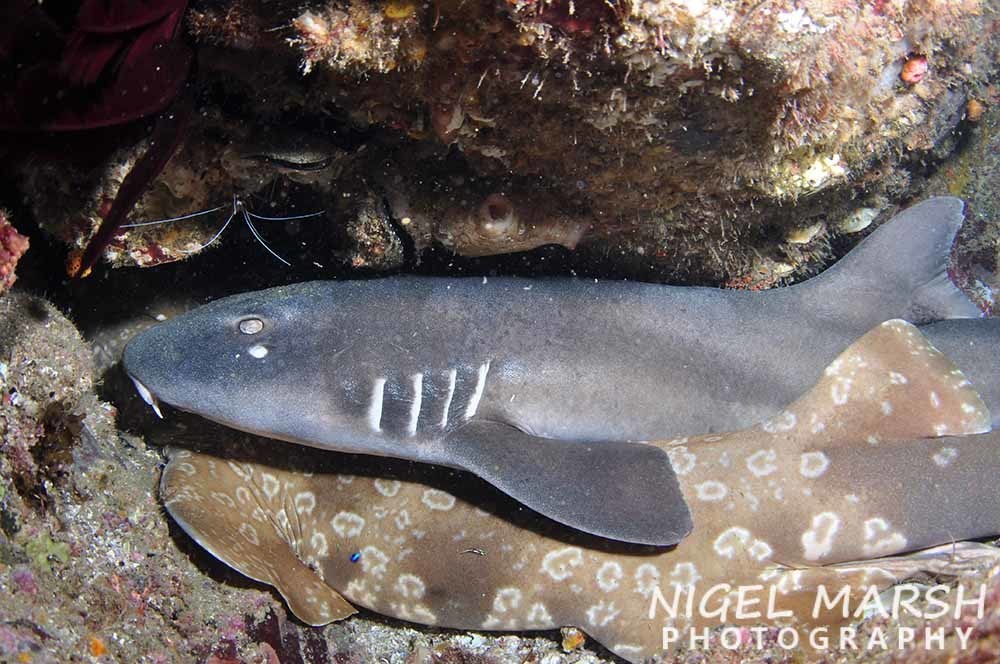
Brown-banded Bamboo Shark
Chiloscyllium punctatum
The brownbanded bamboo shark (Chiloscyllium punctatum), is a bamboo shark in the family Hemiscylliidae that can be found in the Indo-West Pacific from Japan to northern Australia, between latitudes 34° N and 26° S. It is regularly bred in public aquaria, and is arguably one of the sharks most suited to captivity due to its docile disposition, sedentary nature, and relatively small size. In public aquariums, these fish can live up to 25 years.
From the article Brownbanded bamboo shark on Wikipedia (CC BY-SA), quoted section by section
Range & habitat
These sharks live around coral reefs and tide pools. It resides at depths down to 85 metres (279 ft).
Wikipedia: “Habitat”
What it does
These sharks are carnivores that should be fed 2–3 times a week; some of their diet includes fresh shrimp, scallop, squid, and marine fishes. In order to prevent goiter disease, they should take iodine supplements. Two things to be aware of when feeding the shark: one is to make sure that the meals are bite sized or else it will throw it back up and the second is sometimes juveniles are difficult to get to eat so adding a flavor enhances their interest .
Wikipedia: “Feeding”
In human culture
The main protagonist of the 2012 Malaysian animated feature film SeeFood is a talking, sentient young brownbanded bamboo shark named Pup, whose ability to breathe on land plays a major role in the plot.
Wikipedia: “In popular culture”
Where it lives
Recorded sightings
—
geo-referenced records in GBIF, from museums, herbaria and field observers.
Drag the globe to turn it. Dots are where records exist, not a range map; darker means more records.
In the stacks
Searching the stacks…
Every page naming Chiloscyllium punctatum in the Biodiversity Heritage Library →
This page is assembled live from iNaturalist, GBIF, Wikipedia, the Source Library and the Internet Archive. It is not yet part of the hand-edited codex. iNaturalist taxon 97441.