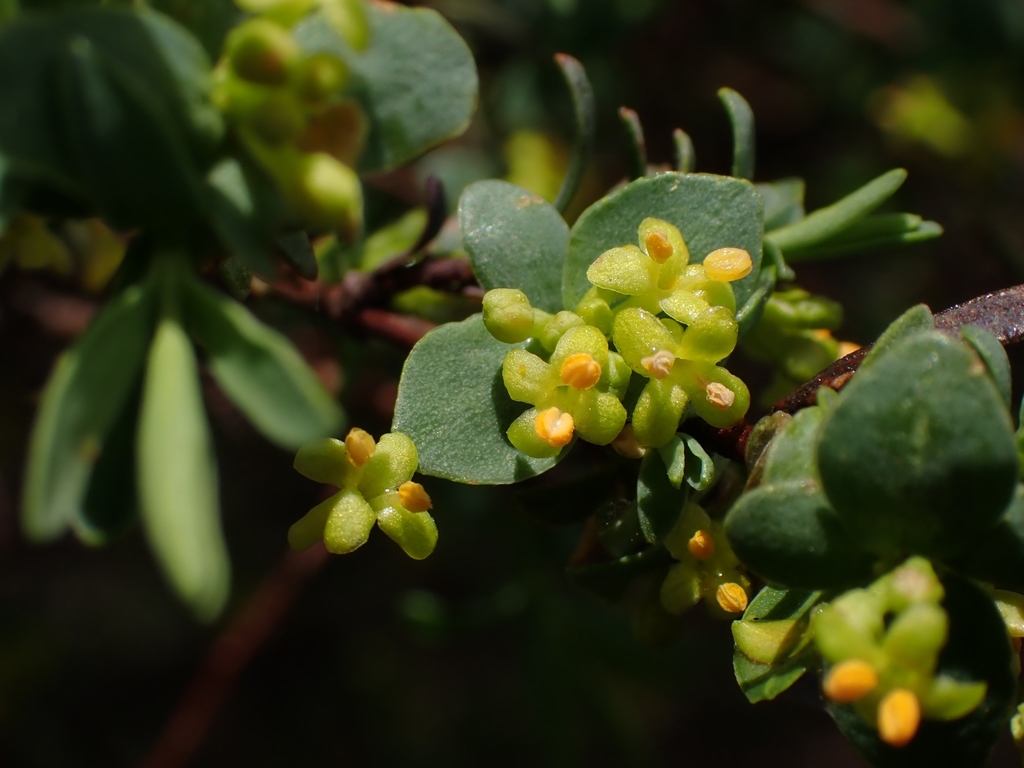
Pimelea pauciflora
Pimelea pauciflora, commonly known as poison rice-flower, is a species of shrub in the family Thymelaeaceae. It has small yellow-lime flowers and green, smooth fleshy leaves, and is endemic to Eastern Australia.
From the article Pimelea pauciflora on Wikipedia (CC BY-SA), quoted section by section
Description
Pimelea pauciflora is a small dioecious shrub that typically grows to a height of 1–3 m (3 ft 3 in – 9 ft 10 in) and has smooth, long, reddish stems. The leaves are arranged in opposite pairs along the branches, and are glossy green, smooth, and narrowly linear or linear to lance shaped, 4–25 mm (0.16–0.98 in) long, 1–4 mm (0.039–0.157 in) wide on a short petiole. The flowers are yellowish-green and arranged in clusters of 3 to 9, mostly at the end of branches usually surrounded by 2 green, narrowly elliptic to egg-shaped involucral bracts. The flowers are smooth and unisexual, the male flowers 1–3 mm (0.039–0.118 in) long, and the female flowers about 3 mm (0.12 in) long. The leaf-like overlapping flower bracts, usually 2, egg-shaped to narrow elliptic, 3–11 mm (0.12–0.43 in) long, 2–5 mm (0.079–0.197 in) wide, smooth and green. The fruit is a succulent red berry, about 4 mm (0.16 in) wide and as the fruit develop the sepals and petals fall off. Flowering occurs from September to November.
Range & habitat
Poison rice-flower is found growing in open scrubland, forests, sometimes in dense thickets at higher altitudes south from Queanbeyan in New South Wales. In Victoria it grows near mountain streams in a few scattered locations. It also occurs in a few places in north-eastern Tasmania.
== References ==
Wikipedia: “Distribution and habitat”
Where it lives
Recorded sightings
—
geo-referenced records in GBIF, from museums, herbaria and field observers.
Drag the globe to turn it. Dots are where records exist, not a range map; darker means more records.
In the stacks
Searching the stacks…
Every page naming Pimelea pauciflora in the Biodiversity Heritage Library →
This page is assembled live from iNaturalist, GBIF, Wikipedia, the Source Library and the Internet Archive. It is not yet part of the hand-edited codex. iNaturalist taxon 970053.