- Animals
- ›Chordates
- ›Vertebrates
- ›Cartilaginous Fishes
- ›Sharks and Rays
- ›Sharks
- ›Squalean Sharks
- ›Squaliform Sharks
- ›Gulper Sharks
- ›Centrophorus
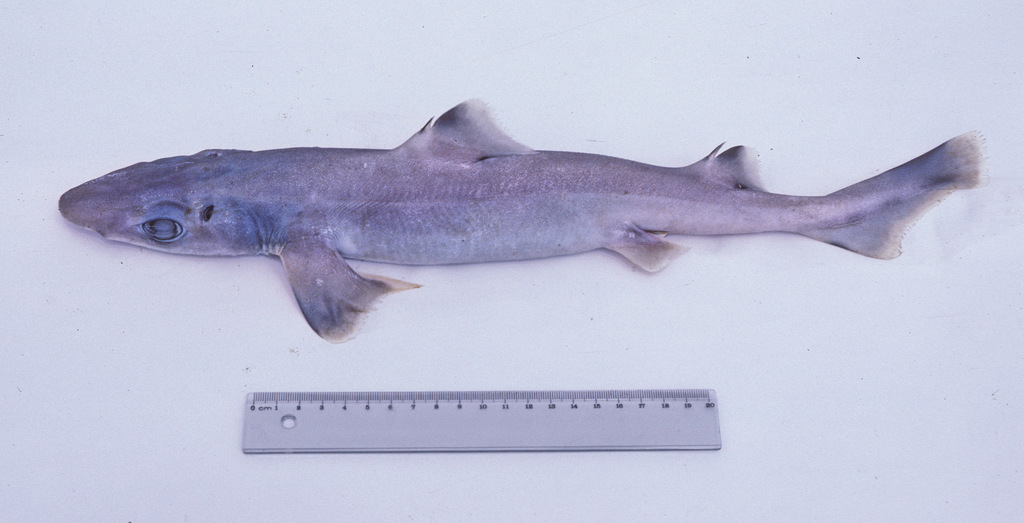
Harrisson's Dogfish
Centrophorus harrissoni
The dumb gulper shark (Centrophorus harrissoni) is a rare and endangered deepwater dogfish, known from only along the east coast of Australia and isolated spots north and west of New Zealand. It is also known as the dumb shark, Harrison's deep-sea dogfish, or Harrison's dogfish.
From the article Dumb gulper shark on Wikipedia (CC BY-SA), quoted section by section
Description
The dumb gulper shark may grow to be 43 in (110 cm) long and has a long, robust head, a long, flattened snout, a large mouth, and large, green eyes, which help it see at 820 to 1260 ft (250 to 385 m) under water. The body is slender and of moderate size, and is grey to greyish-brown in colour, with a paler underside. Of the two dorsal fins, the first is larger than the second, and each has a short spine, a white rear margin, and a dark blotch towards the front, which is more distinct in juveniles. The large caudal fin is asymmetrical, with a longer upper lobe compared to the lower lobe. The broad teeth of this species differs between the upper and lower jaws, with the lower teeth being much larger. The teeth also differ between the male and female, with the male having much more erect, upright upper teeth, and upward-curving tips on the lower teeth. The dumb gulper shark is very similar in appearance to the closely related little gulper shark.
Wikipedia: “Characteristics”
Range & habitat
This shark is found off the coasts of eastern Australia and New Zealand. Its habitat is in the demersal zone on the upper to middle continental slope.
Wikipedia: “Habitat”
What it does
These sharks eat mostly teleost fishes (particularly myctophids), cephalopods and crustaceans. Females produce a maximum of one to two pups every one to two years. Newborn pups range in size from 35 cm to 40 cm. Evidence suggests that the left-side uterus is less functional than the right-side. They can live up to 46 years on average.
Wikipedia: “Behaviour”
Where it lives
Recorded sightings
—
geo-referenced records in GBIF, from museums, herbaria and field observers.
Drag the globe to turn it. Dots are where records exist, not a range map; darker means more records.
In the stacks
Searching the stacks…
Every page naming Centrophorus harrissoni in the Biodiversity Heritage Library →
This page is assembled live from iNaturalist, GBIF, Wikipedia, the Source Library and the Internet Archive. It is not yet part of the hand-edited codex. iNaturalist taxon 96919.